Explosive Common-Envelope Ejection: Implications for Gamma-Ray Bursts and Low-Mass Black-Hole Binaries
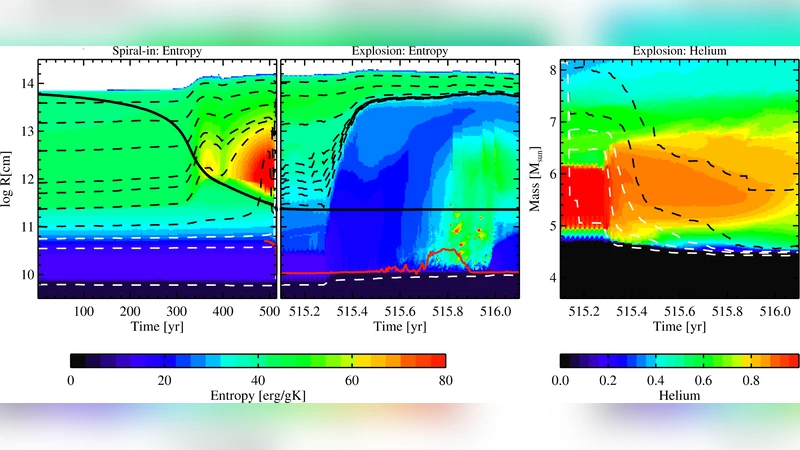
We present a new mechanism for the ejection of a common envelope in a massive binary, where the energy source is nuclear energy rather than orbital energy. This can occur during the slow merger of a massive primary with a secondary of 1-3 Msun when the primary has already completed helium core burning. We show that, in the final merging phase, hydrogen-rich material from the secondary can be injected into the helium-burning shell of the primary. This leads to a nuclear runaway and the explosive ejection of both the hydrogen and the helium layer, producing a close binary containing a CO star and a low-mass companion. We argue that this presents a viable scenario to produce short-period black-hole binaries and long-duration gamma-ray bursts (LGRBs). We estimate a LGRB rate of about 1.e-6 per year at solar metallicity, which implies that this may account for a significant fraction of all LGRBs, and that this rate should be higher at lower metallicity.
💡 Research Summary
The paper introduces a novel pathway for ejecting a common envelope (CE) in massive binary systems that relies on nuclear energy rather than the traditional orbital‑energy budget. The authors term this process “Explosive Common‑Envelope Ejection” (ECEE). The scenario unfolds when a massive primary star, having already exhausted core helium burning, begins a slow merger with a low‑mass secondary of 1–3 M⊙. As the secondary spirals inward, hydrogen‑rich material from its envelope is mixed directly into the primary’s active helium‑burning shell. This sudden injection of fresh fuel triggers a runaway nuclear flash: the temperature in the shell rises to ∼10⁹ K, helium and hydrogen burning proceed simultaneously, and the combined energy release exceeds the binding energy of both the hydrogen and helium layers. Within seconds to minutes the entire envelope is explosively unbound, carrying away 5–10 M⊙ of material at velocities of order 10⁴ km s⁻¹.
The hydrodynamic simulations (performed with a 1‑D stellar‑evolution code that couples nuclear networks to the envelope dynamics) show that the post‑explosion remnant is a compact carbon‑oxygen (CO) core of 5–8 M⊙, destined to collapse into a black hole (BH). The low‑mass companion survives the event and ends up in a dramatically shrunken orbit (periods of a few hours, separations ≲2 R⊙). Two major astrophysical consequences follow. First, when the CO core collapses, the remaining companion can supply mass at a high rate, forming a dense accretion disk around the newborn BH. The disk can launch relativistic jets, providing a natural engine for long‑duration gamma‑ray bursts (LGRBs). Second, the tight BH–low‑mass star binary is a plausible progenitor of the observed population of short‑period BH X‑ray binaries, such as V404 Cyg, and may later evolve into a BH–neutron‑star or BH–BH system detectable by gravitational‑wave observatories.
To assess the relevance of ECEE to the observed LGRB population, the authors estimate a Galactic event rate of ≈10⁻⁶ yr⁻¹ at solar metallicity. This corresponds to roughly 10 % of the empirically inferred LGRB rate (∼10⁻⁵ yr⁻¹), suggesting that ECEE could account for a non‑negligible fraction of all LGRBs. Moreover, because low metallicity reduces line‑driven winds, massive stars retain more mass and spend a longer time in the post‑helium‑burning phase, increasing the probability of a secondary merging during this window. Consequently, the ECEE rate is expected to rise sharply in metal‑poor environments, aligning with the observed preference of LGRBs for sub‑solar metallicity host galaxies.
The paper also discusses several uncertainties. The mixing efficiency of hydrogen into the helium shell, the role of rotation and magnetic fields, and the exact geometry of the runaway nuclear flash are all treated in a 1‑D framework, which cannot capture multidimensional instabilities such as Rayleigh‑Taylor or Kelvin‑Helmholtz that may alter the energy deposition and ejecta morphology. Additionally, the observable signatures of the pre‑explosion envelope ejection (e.g., luminous red novae, shock breakout transients) are not quantified, leaving an open question about how to identify ECEE candidates in time‑domain surveys. Finally, the fate of the expelled material—its interaction with the surrounding interstellar medium and potential contribution to circum‑stellar absorption in LGRB afterglows—requires detailed radiative‑hydrodynamic modeling.
In conclusion, the authors propose ECEE as a robust mechanism that bridges two seemingly disparate phenomena: the formation of close BH–low‑mass star binaries and the central engines of LGRBs. By invoking a nuclear‑driven envelope ejection, the model circumvents the energy shortfall that plagues conventional CE theories for massive stars, and it naturally produces the compact, rapidly rotating cores needed for jet production. The metallicity dependence further strengthens the case, offering an explanation for the observed host‑galaxy bias of LGRBs. Future work involving three‑dimensional simulations, detailed nucleosynthesis predictions, and systematic searches for the predicted transient precursors will be essential to validate the ECEE scenario and to quantify its contribution to the cosmic LGRB budget and the population of low‑mass BH binaries.
Comments & Academic Discussion
Loading comments...
Leave a Comment