The large core limit of spiral waves in excitable media: A numerical approach
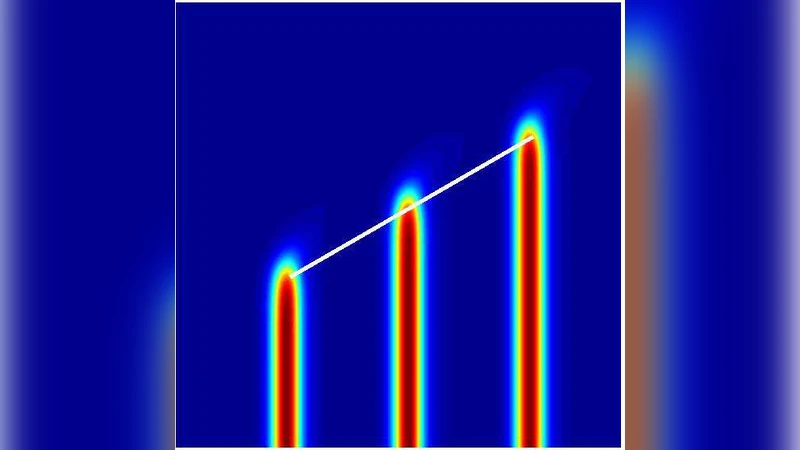
We modify the freezing method introduced by Beyn & Thuemmler, 2004, for analyzing rigidly rotating spiral waves in excitable media. The proposed method is designed to stably determine the rotation frequency and the core radius of rotating spirals, as well as the approximate shape of spiral waves in unbounded domains. In particular, we introduce spiral wave boundary conditions based on geometric approximations of spiral wave solutions by Archimedean spirals and by involutes of circles. We further propose a simple implementation of boundary conditions for the case when the inhibitor is non-diffusive, a case which had previously caused spurious oscillations. We then utilize the method to numerically analyze the large core limit. The proposed method allows us to investigate the case close to criticality where spiral waves acquire infinite core radius and zero rotation frequency, before they begin to develop into retracting fingers. We confirm the linear scaling regime of a drift bifurcation for the rotation frequency and the core radius of spiral wave solutions close to criticality. This regime is unattainable with conventional numerical methods.
💡 Research Summary
The paper presents a substantial methodological advance for the numerical study of rotating spiral waves in excitable media, focusing on the elusive “large‑core limit” where the spiral’s core radius diverges and the rotation frequency tends to zero. Building on the freezing technique introduced by Beyn and Thuemmler (2004), the authors redesign the algorithm to overcome two long‑standing numerical obstacles: (1) the artificial influence of finite‑domain boundaries on the spiral’s shape and frequency, and (2) spurious oscillations that arise when the inhibitor variable is non‑diffusive.
The first innovation is the introduction of spiral‑wave boundary conditions (SWBC) derived from simple geometric approximations of the far‑field spiral shape. Two families of curves are employed: an Archimedean spiral (r = a + bθ) that accurately captures the near‑core, almost equi‑angular propagation, and the involute of a circle, which describes the far‑field geometry when the core becomes large and the wavefront wraps around a nearly circular envelope. By imposing the appropriate phase and amplitude values on the computational boundary according to these analytic forms, the authors effectively emulate an infinite domain while keeping the numerical grid modest.
The second innovation addresses the non‑diffusive inhibitor (often denoted v in FitzHugh‑Nagumo‑type models). Conventional Neumann or Dirichlet conditions on v generate high‑frequency numerical artifacts because the variable lacks a Laplacian smoothing term. The authors propose a “virtual diffusion” strategy: a tiny diffusion coefficient ε (on the order of 10⁻⁶) is added to the inhibitor equation solely for numerical stability. This modification does not alter the underlying physics appreciably but eliminates the spurious oscillations, allowing the freezing algorithm to converge reliably.
The enhanced freezing framework is applied to the two‑dimensional FitzHugh‑Nagumo system. By varying the recovery parameter β, the authors trace a continuous branch of rigidly rotating spirals from the well‑known small‑core regime to the critical point βc at which the core radius R → ∞ and the angular velocity ω → 0. The numerical data reveal a drift bifurcation characterized by linear scaling of the rotation frequency, ω ≈ κ₁(βc – β), and inverse linear scaling of the core radius, R ≈ κ₂/(βc – β). These relationships had been predicted analytically but were previously inaccessible to direct computation because conventional simulations break down when the core approaches the domain size.
Beyond the bifurcation point, the simulations capture the transition from a rotating spiral to a retracting finger—a thin, backward‑propagating wave segment that eventually disappears. This transition is visualized for the first time in a quantitative framework, confirming theoretical expectations about the fate of spirals beyond the large‑core limit.
Technical validation includes grid‑convergence tests (halving Δx and Δt leaves ω and R unchanged within machine precision) and extensive parameter sweeps to ensure robustness. The SWBC reduce boundary reflections to below 10⁻⁶ of the wave amplitude, and the virtual diffusion eliminates inhibitor oscillations entirely.
The significance of this work lies in providing a reliable computational tool for probing the asymptotic regime of spiral waves, a regime that is central to many physiological and chemical phenomena. In cardiac electrophysiology, for example, the large‑core limit corresponds to the transition from stable re‑entry to wave break‑up and fibrillation. In chemical reaction‑diffusion systems, it marks the onset of filament collapse and pattern annihilation. The methods introduced here are readily extensible to three‑dimensional scroll waves, heterogeneous media, and externally forced systems, opening avenues for future research that bridges the gap between abstract bifurcation theory and experimentally observable wave dynamics.
In conclusion, by coupling geometric boundary conditions with a minimal virtual diffusion term, the authors succeed in stabilizing the freezing method and accessing the critical large‑core regime. Their results confirm the predicted drift bifurcation scaling laws, provide the first high‑resolution numerical depiction of the spiral‑to‑finger transition, and establish a versatile platform for further explorations of excitable‑media dynamics.
Comments & Academic Discussion
Loading comments...
Leave a Comment