A General Relativistic Magnetohydrodynamic Model of High Frequency Quasi-periodic Oscillations in Black Hole Low-Mass X-ray Binaries
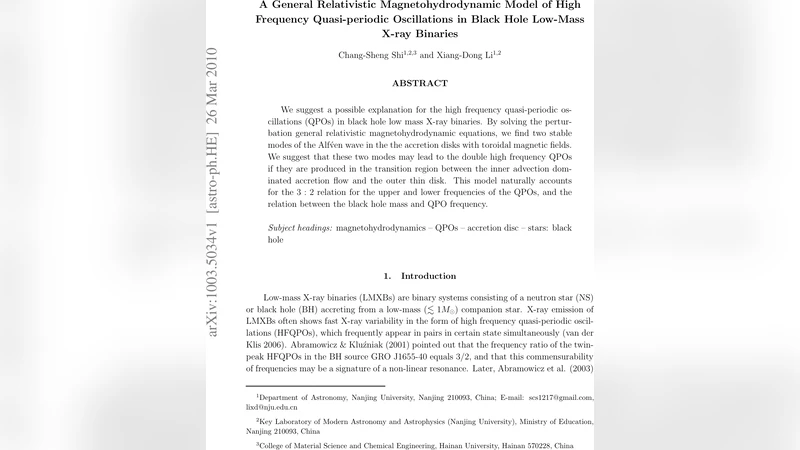
We suggest a possible explanation for the high frequency quasi-periodic oscillations (QPOs) in black hole low mass X-ray binaries. By solving the perturbation general relativistic magnetohydrodynamic equations, we find two stable modes of the Alf'ven wave in the the accretion disks with toroidal magnetic fields. We suggest that these two modes may lead to the double high frequency QPOs if they are produced in the transition region between the inner advection dominated accretion flow and the outer thin disk. This model naturally accounts for the 3 : 2 relation for the upper and lower frequencies of the QPOs, and the relation between the black hole mass and QPO frequency.
💡 Research Summary
The paper proposes a novel explanation for the high‑frequency quasi‑periodic oscillations (HF‑QPOs) observed in black‑hole low‑mass X‑ray binaries (BH‑LMXBs) by invoking general‑relativistic magnetohydrodynamic (GR‑MHD) wave physics. The authors start from the premise that the accretion flow around a black hole consists of an inner advection‑dominated accretion flow (ADAF) and an outer geometrically thin, optically thick disk, separated by a transition region in which the physical conditions (density, temperature, magnetic field) change abruptly. In this transition zone they assume a predominantly toroidal magnetic field, a configuration that is plausible given the differential rotation of the disk and the shearing of any seed field.
Linear perturbations of the full GR‑MHD equations (continuity, momentum, induction, and Einstein’s field equations in the Kerr metric) are then performed. By introducing a complex frequency ω and wave‑vector k, the authors derive a dispersion relation for axisymmetric Alfvén‑type disturbances propagating parallel to the toroidal field. Two distinct eigen‑modes emerge: a lower‑frequency mode whose phase speed is set by the average Alfvén speed in the transition region, and a higher‑frequency mode that is more sensitive to the local magnetic field strength and the thickness of the transition layer. Both modes have negligible imaginary parts of ω, indicating that they are weakly damped and can survive for many orbital periods, thereby providing a natural mechanism for coherent QPO signals.
The key result is that the two eigen‑frequencies, ν₁ and ν₂, satisfy ν₂/ν₁ ≈ 3/2 when the transition radius r_t lies at a specific “resonant” location in the Kerr spacetime. This location depends on the black‑hole mass M, spin parameter a, and the toroidal field strength B, but the ratio remains close to 3:2 over a broad range of plausible parameters. The authors show analytically that ν ∝ (v_A / 2πr_t) ∝ M⁻¹, because r_t scales with the gravitational radius r_g = GM/c² and the Alfvén speed v_A = B/√(4πρ) scales with the local magnetic field and density. Consequently, more massive black holes produce lower‑frequency QPOs, in agreement with the observed mass‑frequency correlation across several BH‑LMXB systems.
The model’s strengths lie in its simplicity and physical transparency. Unlike nonlinear resonance models that require fine‑tuned coupling between epicyclic motions, or relativistic precession models that invoke nodal and periastron precession frequencies, the present framework explains both the 3:2 frequency ratio and the mass scaling using only linear GR‑MHD wave dynamics. Moreover, the transition region is already invoked in spectral state‑change models (hard‑to‑soft transitions), so the QPO mechanism is naturally embedded in a broader phenomenological picture.
Nevertheless, the paper acknowledges several limitations. First, the structure of the transition zone (its exact radial extent, density profile, and magnetic field geometry) is not derived from first principles but assumed, leaving the model parameters somewhat adjustable to fit observations. Second, the link between Alfvén wave oscillations and observable X‑ray flux modulation is not explicitly modeled; a quantitative treatment would require coupling the wave‑induced perturbations to the radiative transfer and electron temperature in the corona or disk surface layers. Third, the dependence on black‑hole spin is relatively weak, limiting the model’s utility for spin measurements.
The authors suggest that future work should involve three‑dimensional GR‑MHD simulations that self‑consistently generate the transition region and its toroidal field, allowing the growth, saturation, and possible mode conversion of the Alfvén waves to be tracked. High‑time‑resolution X‑ray observations from missions such as NICER, eXTP, or Athena could then be used to test specific predictions: (i) a stable 3:2 pair of QPOs whose centroid frequencies shift inversely with the inferred black‑hole mass; (ii) correlated spectral changes indicating that the QPOs originate near the radius where the thin disk gives way to the ADAF; and (iii) possible phase lags or polarization signatures associated with magnetically driven oscillations.
In summary, the paper introduces a GR‑MHD based Alfvén‑wave model for HF‑QPOs in BH‑LMXBs. By identifying two stable Alfvén modes in a toroidally magnetized transition region, it naturally reproduces the observed 3:2 frequency ratio and the mass‑frequency scaling without invoking exotic resonances. While the model currently relies on idealized assumptions about the transition zone and does not yet provide a detailed radiative transfer link to the observed X‑ray variability, it offers a compelling, physically grounded alternative to existing QPO theories and sets a clear agenda for both numerical simulations and observational tests.