A population of gamma-ray emitting globular clusters seen with the Fermi Large Area Telescope
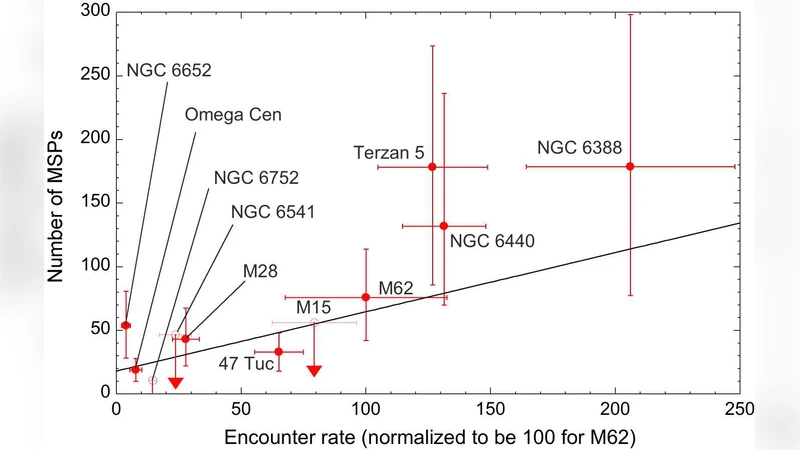
Globular clusters with their large populations of millisecond pulsars (MSPs) are believed to be potential emitters of high-energy gamma-ray emission. Our goal is to constrain the millisecond pulsar populations in globular clusters from analysis of gamma-ray observations. We use 546 days of continuous sky-survey observations obtained with the Large Area Telescope aboard the Fermi Gamma-ray Space Telescope to study the gamma-ray emission towards 13 globular clusters. Steady point-like high-energy gamma-ray emission has been significantly detected towards 8 globular clusters. Five of them (47 Tucanae, Omega Cen, NGC 6388, Terzan 5, and M 28) show hard spectral power indices $(0.7 < \Gamma <1.4)$ and clear evidence for an exponential cut-off in the range 1.0-2.6 GeV, which is the characteristic signature of magnetospheric emission from MSPs. Three of them (M 62, NGC 6440 and NGC 6652) also show hard spectral indices $(1.0 < \Gamma < 1.7)$, however the presence of an exponential cut-off can not be unambiguously established. Three of them (Omega Cen, NGC 6388, NGC 6652) have no known radio or X-ray MSPs yet still exhibit MSP spectral properties. From the observed gamma-ray luminosities, we estimate the total number of MSPs that is expected to be present in these globular clusters. We show that our estimates of the MSP population correlate with the stellar encounter rate and we estimate 2600-4700 MSPs in Galactic globular clusters, commensurate with previous estimates. The observation of high-energy gamma-ray emission from a globular cluster thus provides a reliable independent method to assess their millisecond pulsar populations that can be used to make constraints on the original neutron star X-ray binary population, essential for understanding the importance of binary systems in slowing the inevitable core collapse of globular clusters.
💡 Research Summary
The authors present a systematic study of gamma‑ray emission from Galactic globular clusters (GCs) using 546 days of continuous sky‑survey data collected by the Large Area Telescope (LAT) aboard the Fermi Gamma‑ray Space Telescope. Their primary aim is to exploit the characteristic high‑energy signatures of millisecond pulsars (MSPs) to infer the underlying MSP populations in GCs, thereby providing an independent probe of the binary evolution processes that shape cluster dynamics.
A sample of thirteen GCs was selected, spanning a range of stellar encounter rates, distances, and previously known MSP content. The LAT data were processed with the Pass 7 event reconstruction, selecting photons in the 100 MeV–100 GeV band. For each cluster a 10° region of interest was defined, and a standard binned likelihood analysis was performed including the Galactic diffuse, isotropic diffuse, and all catalogued point sources within the ROI. The source model for each GC was initially a simple power law; if the fit indicated a hard spectrum (photon index Γ < 2) the authors added an exponential cutoff term to test for the MSP‑like curvature.
Significant (TS > 25) point‑like emission was detected toward eight of the thirteen clusters. Five clusters—47 Tucanae, Omega Centauri, NGC 6388, Terzan 5, and M 28—exhibit hard power‑law indices (0.7 < Γ < 1.4) together with well‑constrained exponential cutoffs in the 1.0–2.6 GeV range. This spectral shape matches the canonical magnetospheric emission of MSPs observed in the field, strongly suggesting that the detected gamma rays arise from the cumulative magnetospheric output of a large MSP ensemble.
Three additional clusters—M 62, NGC 6440, and NGC 6652—also show hard spectra (1.0 < Γ < 1.7) but the statistical significance of a cutoff is insufficient to claim a definitive MSP signature. Nonetheless, the hard indices are consistent with an MSP origin, possibly reflecting a smaller MSP population or higher background contamination that masks the curvature. Notably, Omega Centauri, NGC 6388, and NGC 6652 have no previously identified radio or X‑ray MSPs, yet their gamma‑ray spectra are indistinguishable from those of clusters with known MSPs. This demonstrates the superior sensitivity of gamma‑ray observations to hidden MSP populations that may be radio‑quiet or heavily obscured.
To translate gamma‑ray luminosities into MSP numbers, the authors adopt an average gamma‑ray efficiency ηγ ≈ 0.08 (the fraction of a pulsar’s spin‑down power emitted above 100 MeV) and a typical MSP spin‑down power Lsd ≈ 10³⁴ erg s⁻¹. The total MSP count for a given cluster is then estimated as N_MSP ≈ Lγ / (ηγ × Lsd). Applying this prescription yields MSP numbers ranging from a few dozen in the less massive clusters to several hundred in the most luminous ones. When plotted against the stellar encounter rate Γenc (a proxy for the frequency of close stellar interactions that can form binaries), the inferred N_MSP shows a near‑linear correlation, confirming theoretical expectations that dynamical encounters drive MSP production in dense stellar systems.
Summing over all Galactic GCs, the authors infer a total MSP population of roughly 2.6 × 10³ to 4.7 × 10³, in excellent agreement with previous estimates derived from radio surveys, X‑ray studies, and dynamical modeling. This convergence validates gamma‑ray observations as a reliable, independent census method.
Beyond the population count, the paper highlights several broader implications. First, the detection of MSP‑like gamma‑ray spectra in clusters lacking known radio/X‑ray MSPs suggests that many MSPs may be radio‑quiet, beamed away from Earth, or hidden by scattering in the dense cluster environment. Second, the tight link between encounter rate and MSP abundance provides a quantitative tool to assess how binary formation and evolution counteract core collapse in GCs, a central problem in cluster dynamics. Finally, the authors propose that gamma‑ray identified clusters should be prioritized for deep radio and X‑ray follow‑up, as the gamma‑ray signal effectively flags the presence of an unseen MSP reservoir.
In summary, this work leverages the Fermi‑LAT’s all‑sky monitoring capability to reveal a population of gamma‑ray emitting globular clusters, confirms that their high‑energy spectra bear the hallmark of MSP magnetospheric emission, and demonstrates that gamma‑ray luminosities can be translated into robust estimates of MSP numbers. The resulting MSP census aligns with dynamical expectations and provides a powerful new avenue for probing the binary‑driven evolution of globular clusters.
Comments & Academic Discussion
Loading comments...
Leave a Comment