Near-infrared observations of Rotating Radio Transients
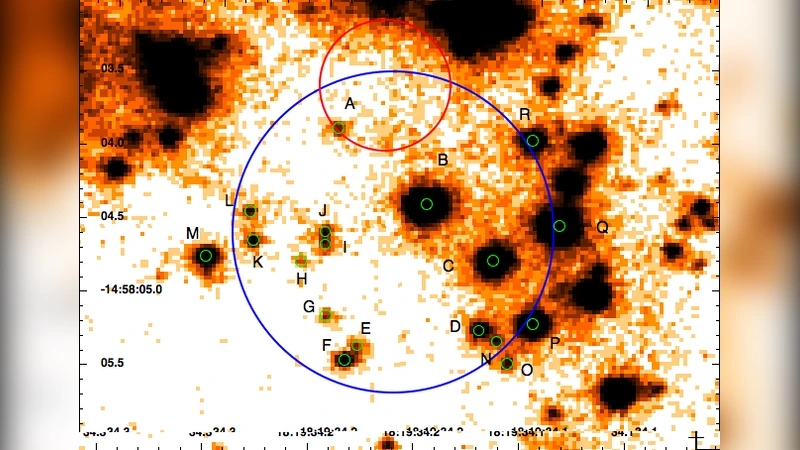
We report on the first near-infrared observations obtained for Rotating RAdio Transients (RRATs). Using adaptive optics devices mounted on the ESO Very Large Telescope (VLT), we observed two objects of this class: RRAT J1819-1458, and RRAT J1317-5759. These observations have been performed in 2006 and 2008, in the J, H and Ks bands. We found no candidate infrared counterpart to RRAT J1317-5759, down to a limiting magnitude of Ks ~ 21. On the other hand, we found a possible candidate counterpart for RRAT J1819-1458, having a magnitude of Ks=20.96+/-0.10 . In particular, this is the only source within a 1 sigma error circle around the source’s accurate X-ray position, although given the crowded field we cannot exclude that this is due to a chance coincidence. The infrared flux of the putative counterpart to the highly magnetic RRAT J1819-1458, is higher than expected from a normal radio pulsar, but consistent with that seen from magnetars. We also searched for the near-infrared counterpart to the X-ray diffuse emission recently discovered around RRAT J1819-1458, but we did not detect this component in the near-infrared band. We discuss the luminosity of the putative counterpart to RRAT J1819-1458, in comparison with the near-infrared emission of all isolated neutron stars detected to date in this band (5 pulsars and 7 magnetars).
💡 Research Summary
The paper presents the first near‑infrared (NIR) observations of Rotating Radio Transients (RRATs), a class of neutron stars that emit sporadic, short radio bursts. Using the adaptive‑optics (AO) facilities on the ESO Very Large Telescope (VLT), the authors targeted two well‑studied RRATs—J1819‑1458 and J1317‑5759—through the standard J (1.25 µm), H (1.65 µm) and Ks (2.15 µm) filters. Observations were carried out in 2006 (J1317‑5759) and 2008 (J1819‑1458), achieving sub‑arcsecond resolution and astrometric precision sufficient to overlay the accurate X‑ray positions obtained from Chandra/XMM‑Newton data.
For RRAT J1317‑5759, no NIR source was detected within the 1σ X‑ray error circle down to a limiting magnitude of Ks≈21. This non‑detection sets a stringent upper limit on any possible NIR emission and suggests that either the object is intrinsically faint in the infrared or that its emission is heavily absorbed.
In contrast, a single point‑like source was found inside the 1σ error circle of RRAT J1819‑1458 with a measured magnitude of Ks = 20.96 ± 0.10. The field is crowded, so a chance alignment with an unrelated background star cannot be ruled out; however, the positional coincidence and the fact that it is the only object within the error region make it a plausible counterpart. The inferred NIR flux is significantly higher—by roughly one to two orders of magnitude—than the extrapolation of the typical radio‑pulsar NIR spectral energy distribution, yet it aligns well with the NIR luminosities observed for magnetars (high‑magnetic‑field neutron stars).
The authors also searched for NIR emission associated with the diffuse X‑ray nebula recently discovered around J1819‑1458 (radius ≈13″). No extended infrared counterpart was found, implying that the X‑ray halo is likely dominated by non‑thermal processes (e.g., particle outflows) that do not produce detectable NIR radiation at the current sensitivity.
A comparative analysis places the putative J1819‑1458 NIR luminosity among the small sample of isolated neutron stars detected in the infrared: five ordinary radio pulsars and seven magnetars. Its luminosity falls squarely within the magnetar regime, reinforcing the hypothesis that at least some RRATs—particularly the highly magnetized J1819‑1458 (B ≈ 5 × 10¹³ G)—share emission mechanisms with magnetars rather than with ordinary rotation‑powered pulsars.
The paper’s significance lies in opening a new wavelength window for RRAT studies. By establishing that a high‑magnetic‑field RRAT can be as bright in the NIR as known magnetars, it supports models where magnetospheric currents, twisted magnetic fields, or fallback disks contribute to the infrared output. The non‑detection of J1317‑5759 also highlights the diversity within the RRAT population, suggesting a range of magnetic field strengths, ages, or environmental conditions.
Future work should aim at deeper NIR imaging with next‑generation facilities (e.g., JWST, ELT) to confirm the counterpart, monitor possible variability, and obtain low‑resolution spectra that could reveal thermal versus non‑thermal components. Simultaneous multi‑band monitoring (radio, X‑ray, NIR) would be essential to test whether the infrared emission is correlated with radio bursts or X‑ray outbursts, thereby constraining the physical link between RRATs, magnetars, and conventional pulsars. In summary, this study provides the first empirical NIR data for RRATs, suggests a magnetar‑like infrared behavior for J1819‑1458, and sets the stage for comprehensive multi‑wavelength investigations of this enigmatic neutron‑star subclass.