Discovery of a new photometric sub-class of faint and fast classical novae
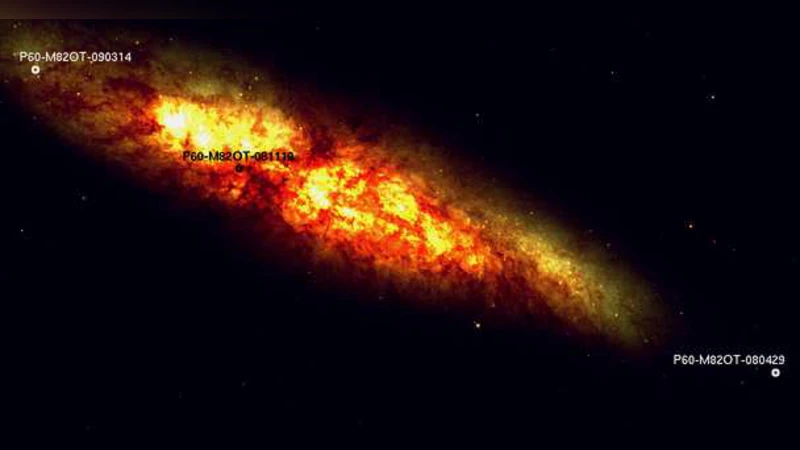
We present photometric and spectroscopic follow-up of a sample of extragalactic novae discovered by the Palomar 60-inch telescope during a search for “Fast Transients In Nearest Galaxies” (P60-FasTING). Designed as a fast cadence (1-day) and deep (g < 21 mag) survey, P60-FasTING was particularly sensitive to short-lived and faint optical transients. The P60-FasTING nova sample includes 10 novae in M31, 6 in M81, 3 in M82, 1 in NGC2403 and 1 in NGC891. This significantly expands the known sample of extragalactic novae beyond the Local Group, including the first discoveries in a starburst environment. Surprisingly, our photometry shows that this sample is quite inconsistent with the canonical Maximum Magnitude Rate of Decline (MMRD) relation for classical novae. Furthermore, the spectra of the P60-FasTING sample are indistinguishable from classical novae. We suggest that we have uncovered a sub-class of faint and fast classical novae in a new phase space in luminosity-timescale of optical transients. Thus, novae span two orders of magnitude in both luminosity and time. Perhaps, the MMRD, which is characterized only by the white dwarf mass, was an over-simplification. Nova physics appears to be characterized by quite a rich four-dimensional parameter space in white dwarf mass, temperature, composition and accretion rate.
💡 Research Summary
The paper reports the results of the Palomar 60‑inch “Fast Transients In Nearest Galaxies” (P60‑FasTING) survey, which was specifically designed to capture short‑lived, faint optical transients in nearby galaxies. By employing a one‑day cadence and reaching a depth of g < 21 mag, the survey was sensitive to events that traditional supernova searches often miss. Over the course of the program, the authors identified 21 classical novae: ten in M31, six in M81, three in the starburst galaxy M82, and one each in NGC 2403 and NGC 891. This represents a substantial increase in the extragalactic nova sample beyond the Local Group and includes the first nova detections in a starburst environment.
Photometric analysis shows that the majority of these novae reach a peak absolute magnitude of M_V ≈ ‑6 to ‑7 mag and decline by two magnitudes within 2–3 days. Such “fast‑faint” behavior is markedly inconsistent with the canonical Maximum Magnitude–Rate of Decline (MMRD) relation, which predicts brighter peaks for faster declines. The deviation is on the order of 1–2 mag, well beyond the scatter expected from observational uncertainties, indicating a genuine physical difference rather than a selection bias.
Spectroscopic follow‑up, performed with larger telescopes, reveals that the emission‑line spectra (Fe II and He/N classes) are indistinguishable from those of classical novae in the Milky Way and M31. Line widths, ionization ratios, and nebular diagnostics all fall within the range of previously known novae, suggesting that the underlying explosion mechanism is the same.
The authors interpret the photometric discrepancy as evidence for a previously unrecognized sub‑class of classical novae occupying a new region of the luminosity–timescale parameter space. They argue that nova outbursts cannot be described solely by white‑dwarf mass, as the traditional MMRD assumes, but instead depend on at least four key parameters: white‑dwarf mass, surface temperature, chemical composition, and mass‑accretion rate. In particular, lower‑mass white dwarfs (≈ 0.8 M_⊙) with relatively cool surfaces (∼10⁴ K) and high accretion rates (∼10⁻⁸ M_⊙ yr⁻¹) are expected to produce shallow thermonuclear runaways that eject less material at higher velocities, yielding faint, rapidly declining light curves.
The detection of such novae in M82 demonstrates that this sub‑class also occurs in environments with intense star formation and potentially higher binary interaction rates. Consequently, the nova population appears to span two orders of magnitude in both peak luminosity and decline timescale, challenging the universality of the MMRD as a distance indicator. The paper calls for a reassessment of nova‑based distance scales and for more extensive multi‑wavelength monitoring to map the full four‑dimensional parameter space governing nova eruptions. Future work will involve higher cadence, deeper surveys, and detailed theoretical modeling to quantify how each of the four parameters shapes the observed light curves and spectra.
Comments & Academic Discussion
Loading comments...
Leave a Comment