Positions and sizes of X-ray solar flare sources
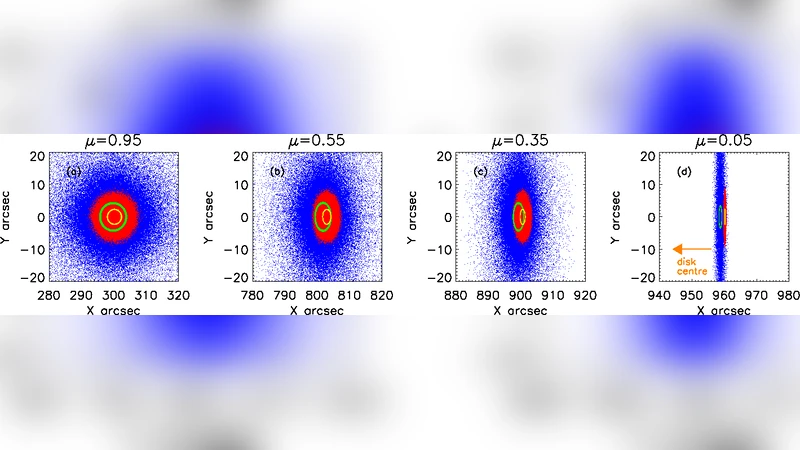
We investigate the positions and source sizes of X-ray solar flare sources taking into account Compton backscattering (albedo). Using a Monte Carlo simulation of X-ray photon transport including photo-electric absorption and Compton scattering, we calculate the apparent source sizes and positions of X-ray sources at the solar disk for various source sizes, spectral indices and directivities of the primary source. We show that the albedo effect will alter the true source positions and substantially increase the measured source sizes. The source positions are shifted up to $\sim 0.5"$ radially towards the disk centre and 5 arcsecond source sizes can be two times larger even for an isotropic source (minimum albedo effect) at 1 Mm above the photosphere. X-ray sources therefore should have minimum observed sizes, thus FWHM source size (2.35 times second-moment) will be as large as $\sim 7"$ in the 20-50 keV range for a disk-centered point source at a height of 1 Mm ($\sim 1.4"$) above the photosphere. The source size and position change is the largest for flatter primary X-ray spectra, stronger downward anisotropy, for sources closer to the solar disk centre, and between the energies of 30 and 50 keV. Albedo should be taken into account when X-ray footpoint positions, footpoint motions or source sizes from e.g. RHESSI or Yohkoh data are interpreted, and suggest that footpoint sources should be larger in X-rays than in optical or EUV ranges.
💡 Research Summary
The paper investigates how Compton back‑scattering (the solar albedo effect) modifies the apparent positions and sizes of hard X‑ray sources associated with solar flares. Using a Monte Carlo photon‑transport code that includes both photo‑electric absorption and Compton scattering, the authors simulate X‑ray emission from a source located 1 Mm above the photosphere. They vary three key parameters: the intrinsic source size (0.5–5 arcsec FWHM), the spectral index of the primary photon distribution (γ = 2–5), and the directivity of the primary emission (from isotropic to strongly downward‑beamed, μ ≈ 0.8). For each configuration they compute the distribution of photons that reach the observer after undergoing possible back‑scattering from the dense photospheric layers.
The results show that albedo photons form a broad halo around the primary source, substantially enlarging the observed source. Even a point‑like primary source (intrinsic FWHM ≈ 1.4″) appears with a full‑width‑half‑maximum of ≈ 7″ in the 20–50 keV band when located at disk centre. The apparent source size can be up to twice the true size for modestly extended sources, and the effect is strongest for flat spectra (low γ), strong downward anisotropy, and for sources positioned near the solar disc centre. The energy dependence is non‑monotonic: the albedo contribution peaks between 30 and 50 keV, where the balance between photo‑electric absorption (dominant at lower energies) and decreasing Compton cross‑section (dominant at higher energies) maximises the reflected flux.
In addition to size inflation, the centroid of the observed X‑ray emission is shifted radially toward the solar centre by up to ≈ 0.5″. This shift arises because the reflected photons preferentially return from the side of the source that faces the disc centre, breaking the symmetry of the observed intensity distribution. The magnitude of the shift grows with increasing downward directivity and decreasing spectral index, mirroring the behaviour of the size increase.
These findings have direct implications for the interpretation of RHESSI, Yohkoh, and future STIX observations. Many previous analyses have assumed isotropic emission and ignored albedo, leading to underestimates of true footpoint separations, motion speeds, and source compactness. The paper demonstrates that X‑ray footpoints should systematically appear larger than their optical or EUV counterparts, simply because the albedo halo adds a diffuse component that broadens the measured profile. Consequently, any quantitative study of footpoint dynamics, energy deposition, or magnetic reconnection geometry must incorporate an albedo correction.
The authors propose a practical approach: generate response kernels (point‑spread functions) for a grid of source heights, spectral indices, and directivities using their Monte Carlo code, then deconvolve observed images to retrieve the intrinsic source parameters. They also suggest extending the model to three‑dimensional, multi‑source configurations and to higher photon energies, where the albedo contribution declines but may still be non‑negligible for very bright flares. In summary, the albedo effect is not a minor correction; it can double apparent source sizes and shift centroids by several tenths of an arcsecond, especially in the 30–50 keV range. Properly accounting for it is essential for accurate solar‑flare X‑ray diagnostics.
Comments & Academic Discussion
Loading comments...
Leave a Comment