Fast magnetic reconnection in three dimensional MHD simulations
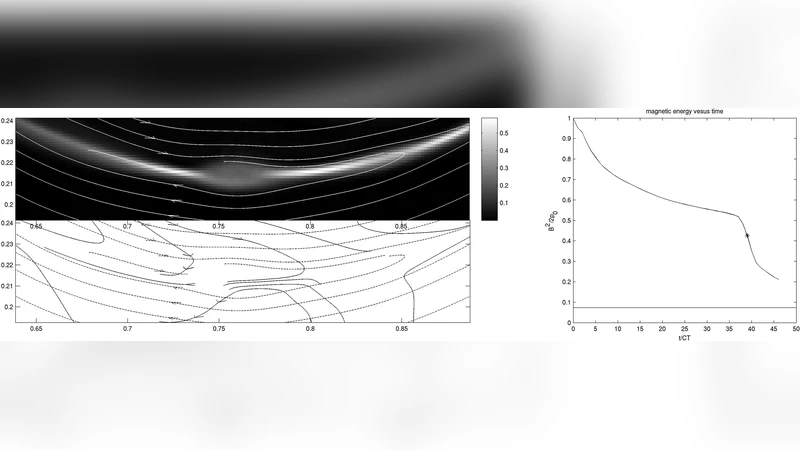
We present a constructive numerical example of fast magnetic reconnection in a three dimensional periodic box. Reconnection is initiated by a strong, localized perturbation to the field lines. The solution is intrinsically three dimensional, and its gross properties do not depend on the details of the simulations. $\sim 50%$ of the magnetic energy is released in an event which lasts about one Alfven time, but only after a delay during which the field lines evolve into a critical configuration. We present a physical picture of the process. The reconnection regions are dynamical and mutually interacting. In the comoving frame of these regions, reconnection occurs through an X-like point, analogous to Petschek reconnection. The dynamics appear to be driven by global flows, not local processes.
💡 Research Summary
The paper addresses a long‑standing problem in plasma astrophysics: how magnetic reconnection can proceed at rates fast enough to explain observed energetic events such as solar flares, coronal mass ejections, and magnetospheric substorms. Classical two‑dimensional Sweet‑Parker theory predicts reconnection speeds that are orders of magnitude too slow, while Petschek’s model offers a fast solution but requires a localized diffusion region whose existence in realistic three‑dimensional (3‑D) plasmas is uncertain. To explore this issue, the authors perform fully 3‑D magnetohydrodynamic (MHD) simulations in a periodic cubic domain. The governing equations are the ideal MHD set with uniform viscosity and resistivity; the numerical scheme employs a high‑order finite‑difference method on grids ranging from 256³ to 512³ cells, ensuring convergence of the results.
The initial magnetic configuration consists of two oppositely directed uniform fields separated by a plane, but without an explicit current sheet. A strong, localized perturbation is then imposed in a small spherical region near the domain centre. This perturbation twists the field lines, driving them toward a critical topology in which a thin, highly curved current concentration forms. The evolution quickly becomes intrinsically three‑dimensional: instead of a single planar current sheet, a network of interacting plasma “blobs” emerges, each carrying its own localized reconnection site. In the comoving frame of any of these blobs, the magnetic geometry resembles an X‑type point, analogous to the Petschek configuration, with standing slow‑mode shocks that facilitate rapid flux transfer.
A key result is that about half of the initial magnetic energy is converted into thermal and kinetic energy within roughly one Alfvén crossing time (τ_A = L / V_A). The reconnection proceeds after an initial delay of ~0.5 τ_A, during which the field lines self‑organize into the critical configuration. Once the X‑type geometry is established, the reconnection rate reaches V_rec ≈ 0.1–0.2 V_A, essentially independent of the exact amplitude of the initial perturbation or the thickness of the emergent current layers. The authors attribute this robustness to global plasma flows that continuously reshape the reconnection region, rather than to local microphysical diffusion processes. Large‑scale, nearly incompressible vortical motions develop around the reconnection sites, feeding magnetic flux into the X‑points and sustaining the fast conversion of magnetic energy.
The study’s implications are twofold. First, it demonstrates that fast reconnection can arise naturally in fully three‑dimensional MHD without invoking anomalous resistivity or kinetic effects, provided that the system is allowed to develop global flow patterns that drive the magnetic topology toward a Petschek‑like state. Second, the dynamical, interacting nature of the reconnection regions suggests that in realistic astrophysical settings, multiple reconnection sites may operate simultaneously, leading to bursty, large‑scale energy release events. The authors acknowledge limitations, such as the use of uniform resistivity and the absence of kinetic particle physics, and propose future work incorporating more realistic dissipation models and particle acceleration diagnostics. Overall, the paper provides a compelling constructive example that bridges the gap between idealized reconnection theories and the complex, three‑dimensional reality of astrophysical plasmas.