1/f noise from nonlinear stochastic differential equations
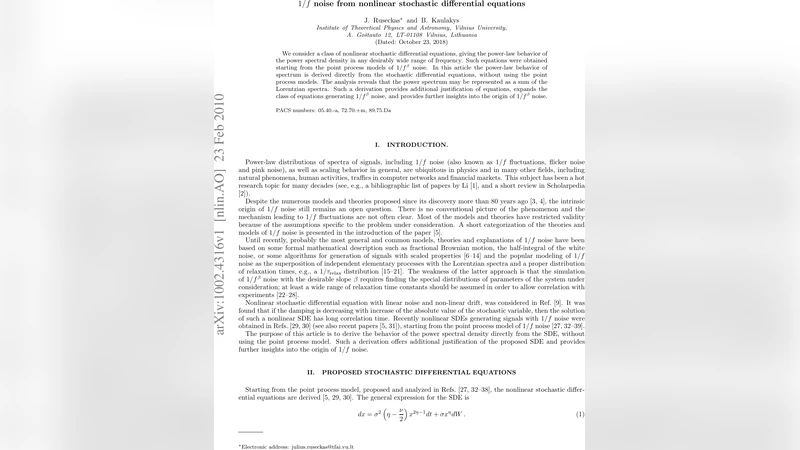
We consider a class of nonlinear stochastic differential equations, giving the power-law behavior of the power spectral density in any desirably wide range of frequency. Such equations were obtained starting from the point process models of 1/f^b noise. In this article the power-law behavior of spectrum is derived directly from the stochastic differential equations, without using the point process models. The analysis reveals that the power spectrum may be represented as a sum of the Lorentzian spectra. Such a derivation provides additional justification of equations, expands the class of equations generating 1/f^b noise, and provides further insights into the origin of 1/f^b noise.
💡 Research Summary
The paper addresses the ubiquitous phenomenon of 1/f β noise by constructing a class of nonlinear stochastic differential equations (SDEs) that generate power‑law spectra over arbitrarily wide frequency ranges. Historically, 1/f noise has been modeled using point‑process frameworks in which the inter‑event intervals follow heavy‑tailed distributions; such models, however, are intrinsically discrete and do not directly describe continuous physical systems. The authors start from the point‑process derivations, extract the underlying SDE structure, and then generalize it to a fully continuous, nonlinear form.
The central SDE is written in Itô form as
dx = σ x^η dW(t) + γ x^{2η‑1} dt,
where x(t) is the system variable, σ and γ are positive constants, η is a nonlinearity exponent, and dW(t) denotes a Wiener increment. The drift term scales as x^{2η‑1} while the diffusion term scales as x^η, producing state‑dependent noise intensity. By translating this SDE into its associated Fokker‑Planck equation, the authors obtain a stationary probability density p(x) ∝ x^{‑(1+2γ/σ²)} that exhibits a power‑law tail. This stationary distribution signals that the system spends a long time near a scale‑free regime, a prerequisite for long‑range correlations.
To connect the dynamics with spectral properties, the authors compute the autocorrelation function C(τ) = ⟨x(t)x(t+τ)⟩ using an eigenfunction expansion of the Fokker‑Planck operator. The expansion yields C(τ) = ∑_n a_n e^{‑λ_n τ}, where λ_n are eigenvalues and τ_n = 1/λ_n are characteristic relaxation times. Performing a Fourier transform gives the power spectral density (PSD)
S(f) = ∑_n a_n (2τ_n) /
Comments & Academic Discussion
Loading comments...
Leave a Comment