Quantization of branched coverings
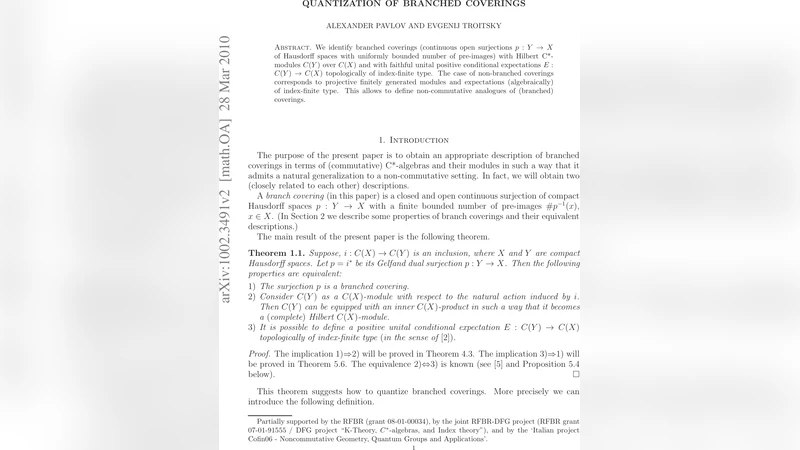
We identify branched coverings (continuous open surjections p:Y->X of Hausdorff spaces with uniformly bounded number of pre-images) with Hilbert C*-modules C(Y) over C(X) and with faithful unital positive conditional expectations E:C(Y)->C(X) topologically of index-finite type. The case of non-branched coverings corresponds to projective finitely generated modules and expectations (algebraically) of index-finite type. This allows to define non-commutative analogues of (branched) coverings.
💡 Research Summary
The paper establishes a precise correspondence between classical branched covering maps of Hausdorff spaces and structures familiar from operator‑algebraic non‑commutative geometry. A branched covering is a continuous open surjection p : Y → X such that the cardinality of each fiber p⁻¹(x) is uniformly bounded; the number may vary from point to point, producing “branch points”. The authors show that such a map can be encoded entirely by the C‑algebraic data (C(Y), C(X), E), where C(Y) and C(X) are the commutative C*-algebras of continuous complex‑valued functions on Y and X, respectively, and E : C(Y) → C(X) is the averaging conditional expectation induced by p.
The construction proceeds as follows. The pull‑back ϕ : C(X) → C(Y), ϕ(f)=f∘p, makes C(Y) a left C(X)-module. The map E is defined pointwise by
E(f)(x)= (1/|p⁻¹(x)|) ∑_{y∈p⁻¹(x)} f(y),
which is well‑defined because the fiber cardinalities are finite and uniformly bounded. E is linear, positive, unital, and faithful. Using E as an inner product ⟨f,g⟩:=E(f* g), C(Y) becomes a Hilbert C(X)-module; completeness follows from the completeness of C(Y) as a Banach space.
A central technical point is that E is of index‑finite type in the sense of Watatani. This means there exists a finite family {u_i, v_i}⊂C(Y) such that for every ξ∈C(Y) we have
ξ = ∑_i u_i E(v_i* ξ)
and the sum ∑_i u_i v_i* equals the unit of C(X). The existence of such a quasi‑basis is equivalent to the uniform bound on fiber cardinalities, i.e., to the branched covering condition. Consequently, the topological data of p is captured exactly by the algebraic data (C(Y), C(X), E) with E of index‑finite type.
When p is an ordinary (unbranched) covering of degree n, every fiber has the same cardinality n. In this case C(Y) is a finitely generated projective C(X)-module; the quasi‑basis can be chosen to be orthonormal, and the index of E is the integer n. Thus the classical theory of covering spaces corresponds to the algebraic notion of projective finitely generated modules and algebraic index‑finite expectations.
The authors then turn to the non‑commutative setting. Given an inclusion of unital C*-algebras A⊂B, a faithful unital positive conditional expectation E : B → A of index‑finite type endows B with the structure of a Hilbert A‑module. The pair (B, E) is declared a non‑commutative branched covering of A. This definition generalizes Hopf‑Galois extensions, quantum torus coverings, and other quantum group co‑actions where a finite‑dimensional quantum symmetry provides a finite quasi‑basis. The index of E now plays the role of a “branching weight” and can be a non‑scalar central element of A, reflecting the possible non‑uniformity of quantum fibers.
The paper further investigates how the index interacts with K‑theory. The class of the Hilbert A‑module B in K₀(A) is shown to be invariant under homotopies of the expectation, and the index determines the multiplicity of this class. In the commutative case this recovers the classical relationship between the degree of a covering and the induced map on K‑theory. In the quantum case it provides a tool for computing K‑theoretic invariants of non‑commutative branched coverings, opening a path toward a “branched covering theory” in non‑commutative topology.
Finally, the authors discuss several examples: (i) the standard n‑fold covering of the circle, (ii) a branched covering of the 2‑sphere obtained by collapsing a finite set of points, (iii) the inclusion C(T²)⊂C(T²)⋊ℤ_n arising from a finite cyclic action, and (iv) a quantum SU(2)‑coaction yielding a non‑commutative 2‑sphere with branching at the north and south poles. These illustrate how the abstract framework captures both classical and quantum phenomena.
In summary, the paper provides a robust bridge between the classical theory of branched coverings and the operator‑algebraic language of Hilbert C*-modules and conditional expectations. By identifying the topological branching data with the index‑finite type property of a conditional expectation, it furnishes a natural definition of non‑commutative branched coverings and lays groundwork for further exploration of their K‑theoretic and geometric properties.
Comments & Academic Discussion
Loading comments...
Leave a Comment