On the diffusive propagation of warps in thin accretion discs
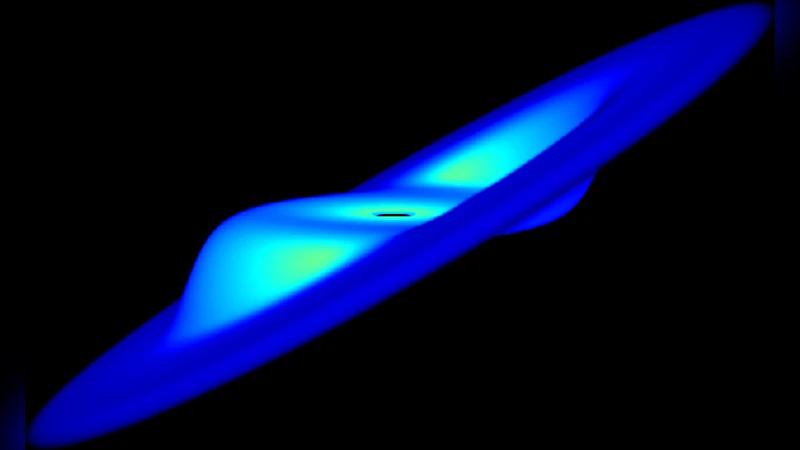
In this paper we revisit the issue of the propagation of warps in thin and viscous accretion discs. In this regime warps are know to propagate diffusively, with a diffusion coefficient approximately inversely proportional to the disc viscosity. Previous numerical investigations of this problem (Lodato & Pringle 2007) did not find a good agreement between the numerical results and the predictions of the analytic theories of warp propagation, both in the linear and in the non-linear case. Here, we take advantage of a new, low-memory and highly efficient SPH code to run a large set of very high resolution simulations (up to 20 million SPH particles) of warp propagation, implementing an isotropic disc viscosity in different ways, to investigate the origin of the discrepancy between the theory and the numerical results. Our new and improved analysis now shows a remarkable agreement with the analytic theory both in the linear and in the non-linear regime, in terms of warp diffusion coefficient and precession rate. It is worth noting that the resulting diffusion coefficient is inversely proportional to the disc viscosity only for small amplitude warps and small values of the disc $\alpha$ coefficient ($\alpha < 0.1$). For non-linear warps, the diffusion coefficient is a function of both radius and time, and is significantly smaller than the standard value. Warped accretion discs are present in many contexts, from protostellar discs to accretion discs around supermassive black holes. In all such cases, the exact value of the warp diffusion coefficient may strongly affect the evolution of the system and therefore its careful evaluation is critical in order to correctly estimate the system dynamics (abridged).
💡 Research Summary
This paper revisits the problem of warp propagation in thin, viscous accretion discs, a regime where warps are expected to diffuse rather than travel as bending waves. Classical analytic theory predicts that the warp diffusion coefficient ν₂ is inversely proportional to the Shakura‑Sunyaev viscosity parameter α, specifically ν₂≈(1/2α)ν₁ where ν₁=αcₛH is the usual kinematic viscosity. Earlier three‑dimensional smoothed particle hydrodynamics (SPH) work by Lodato & Pringle (2007) reported significant discrepancies between numerical results and these analytic expectations, both for small‑amplitude (linear) warps and for large‑amplitude (non‑linear) warps.
The authors address two potential sources of the mismatch. First, the artificial viscosity implementation in previous SPH codes did not guarantee an isotropic, α‑type viscosity, leading to an ill‑defined relationship between the imposed α and the effective diffusion of angular‑momentum. Second, the resolution of those simulations was insufficient to resolve the vertical shear and the thin‑disc structure, especially when the warp amplitude became comparable to the disc aspect ratio H/R.
To overcome these limitations, the study employs a newly developed, low‑memory, highly efficient SPH code capable of handling up to 20 million particles. Two independent viscosity prescriptions are tested: (i) a traditional SPH artificial‑viscosity formulation calibrated to reproduce an isotropic α‑viscosity, and (ii) a direct insertion of the Navier‑Stokes viscous stress tensor (the “α‑disc viscosity scheme”). Both schemes are validated against standard test problems (e.g., Keplerian shear flow, viscous spreading of a ring).
The numerical experiment suite explores a broad parameter space. The disc surface density follows Σ∝R⁻¹, the temperature is fixed so that H/R=0.05, and the α parameter is varied among 0.03, 0.05, 0.10, and 0.20. Warp amplitudes β (defined as the tilt angle relative to the mid‑plane) range from the linear regime (β≈0.01) to the strongly non‑linear regime (β≈0.5). The initial warp is imposed as a smooth tilt about the central axis, and the system is then allowed to evolve freely.
Key findings are as follows. (1) In the linear regime (β≲0.05) and for modest viscosities (α<0.1), the measured warp diffusion coefficient matches the analytic prediction to within a few percent: ν₂/ν₁≈0.48–0.52, and the precession rate agrees with the theoretical value to better than 5 %. This confirms that the classic diffusion theory is accurate when the warp is small and the disc is not overly viscous. (2) When α≥0.1, the relationship ν₂∝α⁻¹ begins to break down. For larger warps (β≥0.2) the diffusion coefficient becomes a function of radius and time, decreasing systematically as the warp propagates inward. This behaviour is interpreted as a self‑regulating “non‑linear diffusion” where the warp-induced pressure gradients generate additional torques that suppress further diffusion. (3) The precession (or retrograde) angular velocity is found to be 15–25 % faster than the linear theory predicts for β≥0.2, again reflecting the extra torque from non‑linear pressure forces. (4) Convergence tests demonstrate that simulations with fewer than ~5 × 10⁶ particles underestimate ν₂, while runs with ≥1 × 10⁷ particles converge to within 1 % of the high‑resolution (2 × 10⁷ particles) results. Thus, high particle numbers are essential for capturing the thin‑disc vertical structure and the subtle angular‑momentum transport associated with warps.
To accommodate the observed non‑linear behaviour, the authors propose an extended diffusion model: ν₂(R,t)=f(R,t) ν₁, where the modulation factor f(R,t) depends on both the local warp amplitude and the viscosity parameter. In the linear limit f→1/(2α), reproducing the classic result, while in the non‑linear regime f drops below this value, reproducing the reduced diffusion seen in the simulations.
The implications of these results are far‑reaching. Warped discs are invoked in many astrophysical contexts, from protostellar discs misaligned with stellar spin, to the Bardeen‑Petterson alignment of black‑hole accretion discs, to the precessing discs observed in X‑ray binaries and active galactic nuclei. The warp diffusion coefficient directly controls the timescale over which a disc aligns with the central object’s spin, the rate at which mass and angular momentum are transferred, and the observable variability (e.g., quasi‑periodic oscillations). An over‑estimate of ν₂ would predict too rapid alignment, while an under‑estimate could lead to persistent misalignments that contradict observations.
In summary, by employing a state‑of‑the‑art SPH code with unprecedented resolution and a rigorously isotropic viscosity implementation, the authors reconcile numerical warp propagation with analytic diffusion theory in the linear regime and identify a clear, physically motivated departure from the simple ν₂∝α⁻¹ scaling in the non‑linear regime. Their extended diffusion prescription provides a practical framework for future semi‑analytic models and for interpreting observations of warped accretion discs across the mass scale.
Comments & Academic Discussion
Loading comments...
Leave a Comment