Polynomial constants of motion for Calogero-type systems in three dimensions
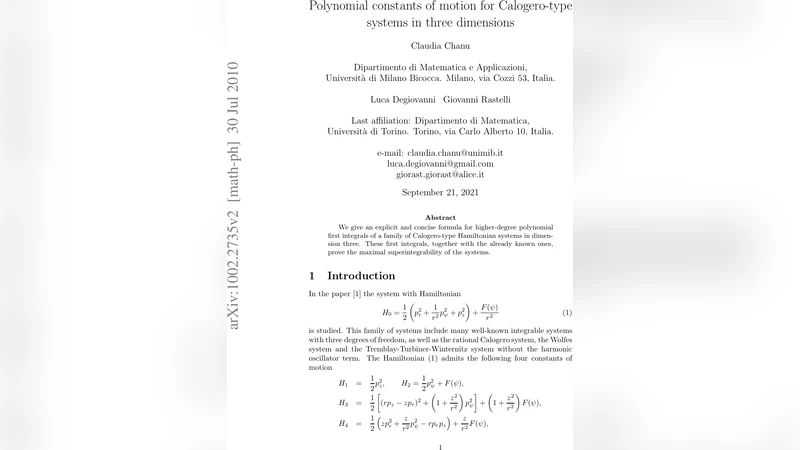
We give an explicit and concise formula for higher-degree polynomial first integrals of a family of Calogero-type Hamiltonian systems in dimension three. These first integrals, together with the already known ones, prove the maximal superintegrability of the systems.
💡 Research Summary
The paper addresses the long‑standing problem of establishing maximal superintegrability for a broad class of three‑dimensional Calogero‑type Hamiltonian systems. These systems are characterized by a kinetic term that separates naturally in spherical coordinates and a potential consisting of an isotropic harmonic confinement together with inverse‑square pairwise interactions of Calogero type. While the energy (H) and the squared total angular momentum (L^{2}) are obvious conserved quantities, they are insufficient to reach the required (2N-1 = 5) independent integrals for a system with three degrees of freedom. Consequently, the existence of additional, higher‑order integrals remained conjectural.
The authors introduce a systematic construction of polynomial first integrals of arbitrary degree. The key idea is to map the dynamics onto a complex algebraic curve by defining the complex variable (z = e^{i\phi}) (encoding the azimuthal angle) and the real variable (\xi = \cos\theta) (encoding the polar angle). In this representation the Hamiltonian flow becomes a set of polynomial vector fields acting on ((z,\xi)). By exploiting the algebraic properties of Lagrange and loop algebras, the authors build a family of polynomials \
Comments & Academic Discussion
Loading comments...
Leave a Comment