Stability and chaos in coupled two-dimensional maps on Gene Regulatory Network of bacterium E.Coli
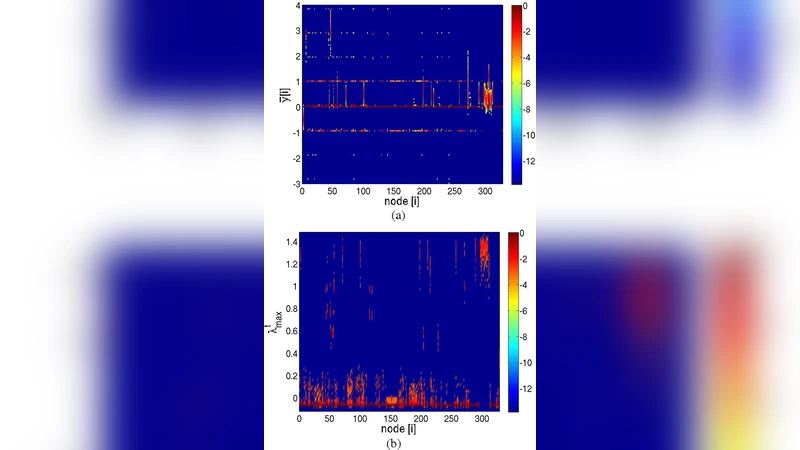
The collective dynamics of coupled two-dimensional chaotic maps on complex networks is known to exhibit a rich variety of emergent properties which crucially depend on the underlying network topology. We investigate the collective motion of Chirikov standard maps interacting with time delay through directed links of Gene Regulatory Network of bacterium Escherichia Coli. Departures from strongly chaotic behavior of the isolated maps are studied in relation to different coupling forms and strengths. At smaller coupling intensities the network induces stable and coherent emergent dynamics. The unstable behavior appearing with increase of coupling strength remains confined within a connected sub-network. For the appropriate coupling, network exhibits statistically robust self-organized dynamics in a weakly chaotic regime.
💡 Research Summary
The paper investigates how the topology of a real biological network influences the collective dynamics of coupled chaotic maps. Each node of the Escherichia coli gene‑regulatory network (GRN) – 424 genes and 519 directed interactions taken from RegulonDB – is assigned a two‑dimensional Chirikov standard map (θₙ₊₁ = θₙ + pₙ₊₁, pₙ₊₁ = pₙ + K sin θₙ with K = 1). In isolation the map is strongly chaotic (maximal Lyapunov exponent ≈ 0.96).
Coupling is introduced through the directed links with a unit time‑delay (τ = 1). Three coupling schemes are examined: (i) linear averaging of the delayed states of the in‑neighbors, (ii) a saturating non‑linear (tanh) function of the averaged delayed states, and (iii) a mixture of the two. The overall update rule reads
xᵢ(t + 1) = (1 − ε) f(xᵢ(t)) + ε Φ(⟨xⱼ(t − τ)⟩ⱼ∈Nᵢ),
where ε∈
Comments & Academic Discussion
Loading comments...
Leave a Comment