The Variation of Solar Wind Correlation Lengths Over Three Solar Cycles
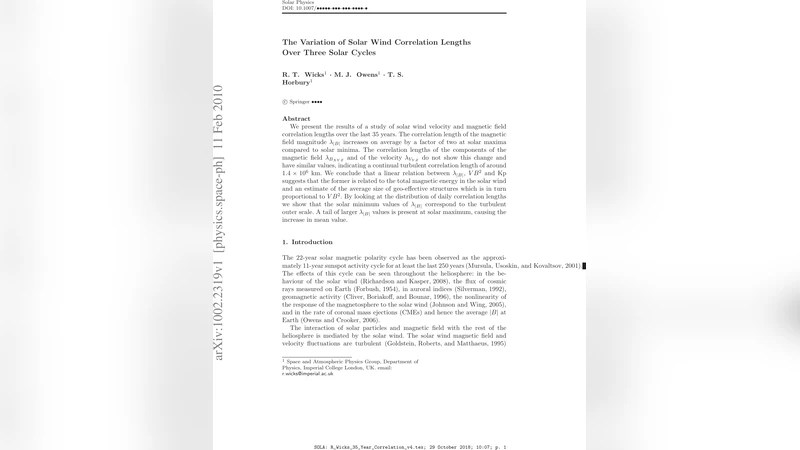
We present the results of a study of solar wind velocity and magnetic field correlation lengths over the last 35 years. The correlation length of the magnetic field magnitude lambda(|B|) increases on average by a factor of two at solar maxima compared to solar minima. The correlation lengths of the components of the magnetic field lambda(Bxyz) and of the velocity lambda(Vyz) do not show this change and have similar values, indicating a continual turbulent correlation length of around 1.4 x 10^6 km. We conclude that a linear relation between lambda(|B|), VB^2 and Kp suggests that the former is related to the total magnetic energy in the solar wind and an estimate of the average size of geo-effective structures which is in turn proportional to VB^2. By looking at the distribution of daily correlation lengths we show that the solar minimum values of lambda(|B|) correspond to the turbulent outer scale. A tail of larger lambda(|B|) values is present at solar maximum, causing the increase in mean value.
💡 Research Summary
The paper presents a comprehensive statistical analysis of solar‑wind magnetic‑field and velocity correlation lengths using 35 years of near‑Earth measurements (1975–2010) from the OMNI database. The authors compute spatial correlation functions for both hourly and daily averaged data, fitting an exponential decay model C(r)=exp(–r/λ) to extract a characteristic correlation length λ for each time interval. To ensure statistical robustness, only intervals with at least 30 consecutive days of valid data are included.
The main findings can be grouped into three points. First, the correlation length of the magnetic‑field magnitude, λ(|B|), exhibits a clear solar‑cycle dependence. During solar minima the mean λ(|B|) is about 0.7 × 10⁶ km, whereas at solar maxima it rises to roughly 1.4 × 10⁶ km, i.e., a factor of two increase. The daily‑λ(|B|) distribution is log‑normal with a pronounced right‑hand tail at solar maximum, indicating the occasional presence of unusually large coherent structures (e.g., corotating interaction regions or high‑speed stream interfaces) that inflate the average.
Second, the correlation lengths of the individual magnetic‑field components (λ(Bx), λ(By), λ(Bz)) and of the velocity components (λ(Vx), λ(Vy), λ(Vz)) remain essentially constant throughout the three solar cycles. Their average value is ≈1.4 × 10⁶ km, with no statistically significant modulation by solar activity. This suggests a persistent turbulent outer scale that is governed by the underlying magnetohydrodynamic cascade rather than by the large‑scale solar‑wind driver.
Third, a strong linear relationship is found between λ(|B|), the solar‑wind dynamic pressure (VB²), and the planetary K‑index (Kp). A multiple‑regression model λ(|B|)=a·VB²+b·Kp+const yields a coefficient of determination R²≈0.68, indicating that λ(|B|) is closely tied to the total magnetic‑energy density in the solar wind and can serve as a proxy for the average size of geo‑effective structures. Because Kp is a standard measure of geomagnetic activity, the λ(|B|)–Kp link implies that days with larger λ(|B|) are more likely to host structures capable of driving intense geomagnetic storms.
The authors discuss the implications for space‑weather forecasting. Current models often assume a fixed turbulent correlation length (~1.4 × 10⁶ km). Incorporating the solar‑cycle‑dependent λ(|B|) could improve the representation of large‑scale magnetic structures and thus enhance predictions of Kp and related indices. Moreover, real‑time monitoring of λ(|B|) could act as an early‑warning indicator for the arrival of large, potentially geo‑effective structures, complementing existing solar‑wind speed and density alerts.
In summary, the study demonstrates that the magnetic‑field magnitude correlation length combines a stable turbulent component with a variable “macro‑scale” component that expands during periods of high solar activity. This dual nature, together with its linear scaling with VB² and Kp, positions λ(|B|) as a valuable diagnostic for both fundamental solar‑wind turbulence research and practical space‑weather applications. Future work should focus on integrating λ(|B|) into operational forecasting pipelines and on elucidating the physical mechanisms that generate the large‑scale structures responsible for the observed correlation‑length enhancements at solar maximum.
Comments & Academic Discussion
Loading comments...
Leave a Comment