Thermonuclear .Ia Supernovae from Helium Shell Detonations: Explosion Models and Observables
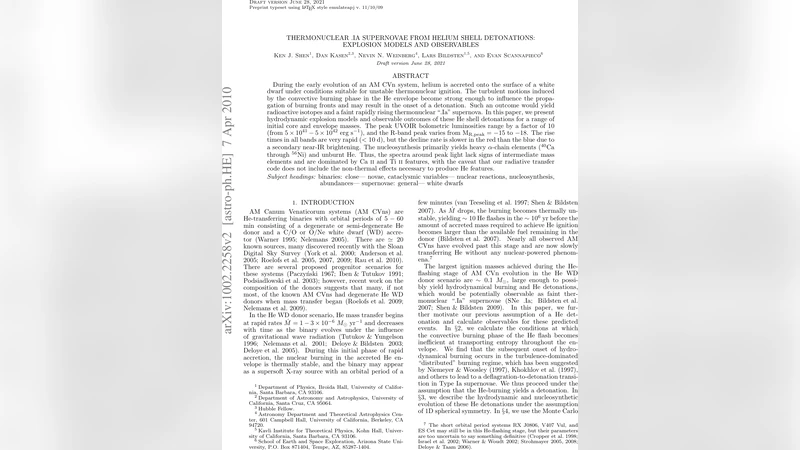
During the early evolution of an AM CVn system, helium is accreted onto the surface of a white dwarf under conditions suitable for unstable thermonuclear ignition. The turbulent motions induced by the convective burning phase in the He envelope become strong enough to influence the propagation of burning fronts and may result in the onset of a detonation. Such an outcome would yield radioactive isotopes and a faint rapidly rising thermonuclear “.Ia” supernova. In this paper, we present hydrodynamic explosion models and observable outcomes of these He shell detonations for a range of initial core and envelope masses. The peak UVOIR bolometric luminosities range by a factor of 10 (from 5e41 - 5e42 erg/s), and the R-band peak varies from M_R,peak = -15 to -18. The rise times in all bands are very rapid (<10 d), but the decline rate is slower in the red than the blue due to a secondary near-IR brightening. The nucleosynthesis primarily yields heavy alpha-chain elements (40Ca through 56Ni) and unburnt He. Thus, the spectra around peak light lack signs of intermediate mass elements and are dominated by CaII and TiII features, with the caveat that our radiative transfer code does not include the non-thermal effects necessary to produce He features.
💡 Research Summary
This paper investigates a specific class of faint, rapidly evolving thermonuclear transients—so‑called “.Ia” supernovae—that are theorized to arise from detonations of thin helium shells on the surfaces of white dwarfs (WDs) in AM CVn binary systems. The authors begin by describing the astrophysical context: in the early stages of an AM CVn system, a low‑mass helium‑rich donor transfers material onto a carbon‑oxygen (or oxygen‑neon) WD at rates that allow a helium layer to accumulate. When the base of this layer reaches temperatures of a few ×10⁹ K, convection becomes vigorous, and turbulent motions can distort the flame front. If the turbulence is strong enough, the subsonic deflagration can transition to a supersonic detonation, igniting the entire helium shell almost instantaneously.
To explore the observable consequences, the authors construct a grid of six hydrodynamic explosion models. Core masses of 0.6, 0.8, and 1.0 M⊙ are combined with helium shell masses of 0.02, 0.05, and 0.10 M⊙. Each model is evolved with a one‑dimensional Lagrangian hydrodynamics code that includes a detailed nuclear reaction network (≈150 isotopes, >1000 reactions). The simulations track the propagation of the detonation front, the development of the shock, and the resulting nucleosynthesis. The key nucleosynthetic outcome is the production of heavy α‑chain nuclei—⁴⁰Ca, ⁴⁴Ti, ⁴⁸Cr, ⁵²Fe, and ⁵⁶Ni—together with a substantial fraction of unburnt helium. Intermediate‑mass elements (Si, S, Ar) are essentially absent because the burning never reaches the densities required for their synthesis; the helium shell is too thin and the burning proceeds at relatively low densities.
Radiative‑transfer calculations are performed with a Monte‑Carlo code (based on SEDONA) to generate synthetic light curves and spectra. The bolometric peak luminosities span a factor of ten, from 5 × 10⁴¹ to 5 × 10⁴² erg s⁻¹, corresponding to absolute R‑band magnitudes of roughly –15 to –18. All models rise to peak in less than ten days in every photometric band, making them among the fastest‑rising thermonuclear transients known. The decline is wavelength‑dependent: red bands (R, I) fade more slowly than blue bands (U, B) because a secondary near‑infrared brightening appears a few days after maximum. This secondary bump is driven by the radioactive decay of ⁵⁶Ni and ⁴⁸Cr, whose heating is re‑processed by the expanding ejecta.
Spectroscopically, the models predict a dominance of calcium and titanium features. Near maximum light the spectra are characterized by strong Ca II H&K, the Ca II infrared triplet, and a forest of Ti II lines that heavily blanket the blue/near‑UV region (λ < 4000 Å). The lack of Si II λ6355 and other intermediate‑mass element lines distinguishes these events from normal Type Ia supernovae. The authors note that their radiative‑transfer treatment does not include non‑thermal excitation/ionization, so helium lines (e.g., He I 5876 Å) are not reproduced, even though in reality non‑thermal electrons from radioactive decay could produce observable He I features.
Parameter variations reveal clear trends: larger core masses increase the total kinetic energy and thus the peak luminosity, while more massive helium shells lengthen the rise time modestly and enhance the production of ⁵⁶Ni, leading to a more pronounced NIR bump. The models therefore map a continuous family of .Ia transients that can explain the observed diversity among faint, fast transients such as SN 2002bj, SN 2010X, and SN 2015H. The authors argue that the predicted light‑curve shapes, peak magnitudes, and spectral signatures provide a robust framework for identifying .Ia events in upcoming wide‑field surveys (e.g., LSST, ZTF).
In conclusion, the paper delivers a comprehensive theoretical picture linking helium‑shell detonations on accreting white dwarfs to a distinct observational class of faint, rapidly rising supernovae. By coupling detailed hydrodynamics, nucleosynthesis, and radiative‑transfer, the authors quantify how core and shell masses control the energetics, elemental yields, and photometric behavior. Their work not only clarifies the physical origin of .Ia supernovae but also offers concrete diagnostics—fast rise, Ca II/Ti II‑dominated spectra, and a red‑ward slowing of the decline—that can be used to isolate these events in large transient datasets, thereby advancing our understanding of binary white‑dwarf evolution and the diversity of thermonuclear explosions.
Comments & Academic Discussion
Loading comments...
Leave a Comment