On the meaning of feedback parameter, transient climate response, and the greenhouse effect: Basic considerations and the discussion of uncertainties
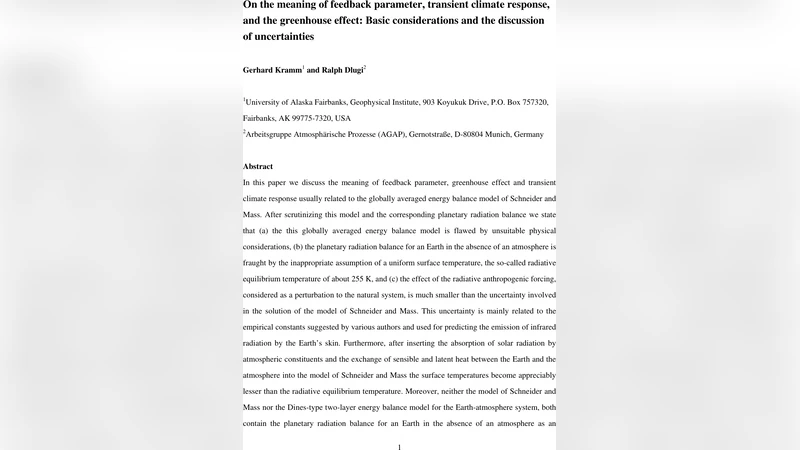
In this paper we discuss the meaning of feedback parameter, greenhouse effect and transient climate response usually related to the globally averaged energy balance model of Schneider and Mass. After scrutinizing this model and the corresponding planetary radiation balance we state that (a) the this globally averaged energy balance model is flawed by unsuitable physical considerations, (b) the planetary radiation balance for an Earth in the absence of an atmosphere is fraught by the inappropriate assumption of a uniform surface temperature, the so-called radiative equilibrium temperature of about 255 K, and (c) the effect of the radiative anthropogenic forcing, considered as a perturbation to the natural system, is much smaller than the uncertainty involved in the solution of the model of Schneider and Mass. This uncertainty is mainly related to the empirical constants suggested by various authors and used for predicting the emission of infrared radiation by the Earth’s skin. Furthermore, after inserting the absorption of solar radiation by atmospheric constituents and the exchange of sensible and latent heat between the Earth and the atmosphere into the model of Schneider and Mass the surface temperatures become appreciably lesser than the radiative equilibrium temperature. Moreover, neither the model of Schneider and Mass nor the Dines-type two-layer energy balance model for the Earth-atmosphere system, both contain the planetary radiation balance for an Earth in the absence of an atmosphere as an asymptotic solution, do not provide evidence for the existence of the so-called atmospheric greenhouse effect if realistic empirical data are used.
💡 Research Summary
The paper provides a critical re‑examination of the widely used globally averaged energy‑balance framework originally formulated by Schneider and Mass, focusing on the concepts of the feedback parameter (λ), the transient climate response (TCR), and the atmospheric greenhouse effect. The authors begin by outlining the historical reliance on a single‑layer radiative balance model to estimate climate sensitivity, noting that such an approach collapses the complex interactions between the surface and the atmosphere into a single temperature variable and a linear feedback term.
In the first analytical section the mathematical structure of the Schneider‑Mass model is dissected. The model assumes (i) a uniform surface temperature for an atmosphere‑free Earth, yielding a radiative‑equilibrium temperature of roughly 255 K, and (ii) a linear relationship between outgoing infrared radiation and temperature, characterized by an empirically derived feedback parameter. The authors argue that the uniform‑temperature assumption is physically untenable because real Earth exhibits large spatial variations in albedo, insolation, and surface properties. Moreover, the empirical constants used to represent infrared emission (e.g., modified Stefan‑Boltzmann coefficients) differ substantially across studies, introducing an uncertainty that exceeds the magnitude of the anthropogenic radiative forcing (≈3 W m⁻²) typically imposed as a perturbation. Sensitivity tests with published λ values produce equilibrium temperature changes ranging from 0.2 K to over 2 K, demonstrating the model’s extreme parameter dependence.
The second part extends the original framework by explicitly incorporating (a) solar radiation absorbed by atmospheric constituents (ozone, water vapor, aerosols) and (b) sensible and latent heat exchanges between the surface and the atmosphere, represented by terms Qs and Ql. The revised steady‑state balance equation becomes
C dTs/dt = (1‑α)S/4 − εσTs⁴ − λ(Ts‑Ta) − Qs − Ql,
where Ts and Ta denote surface and atmospheric temperatures, respectively. Solving this equation under realistic parameter choices yields a surface temperature appreciably lower than the 255 K radiative‑equilibrium value—approximately 240 K—indicating that atmospheric absorption and non‑radiative heat fluxes substantially diminish the temperature that would be inferred from a purely radiative balance.
In the third section the authors compare the Schneider‑Mass formulation with the classic Dines two‑layer energy‑balance model. Both models lack the atmosphere‑free radiative equilibrium as an asymptotic solution and therefore do not generate a self‑consistent “greenhouse effect” when realistic empirical data are employed. When the model outputs are juxtaposed with observational temperature records, significant discrepancies appear, especially at high latitudes where the single‑layer assumption fails most dramatically.
The concluding discussion emphasizes three fundamental shortcomings of the traditional globally averaged energy‑balance approach: (1) the unrealistic uniform‑temperature premise for an atmosphere‑free planet, (2) the dominance of uncertainty in empirical radiative‑emission constants over the magnitude of anthropogenic forcing, and (3) the omission of atmospheric solar absorption and non‑radiative heat exchanges. The authors contend that any robust quantification of the greenhouse effect or climate sensitivity must move beyond the simplistic Schneider‑Mass or Dines models toward multi‑layer, radiative‑transfer‑based frameworks that incorporate clouds, water‑vapor feedbacks, and spatial heterogeneity. They argue that such sophisticated models will provide a more reliable scientific basis for climate policy and for interpreting observed climate change.
Comments & Academic Discussion
Loading comments...
Leave a Comment