Simplifying Parallelization of Scientific Codes by a Function-Centric Approach in Python
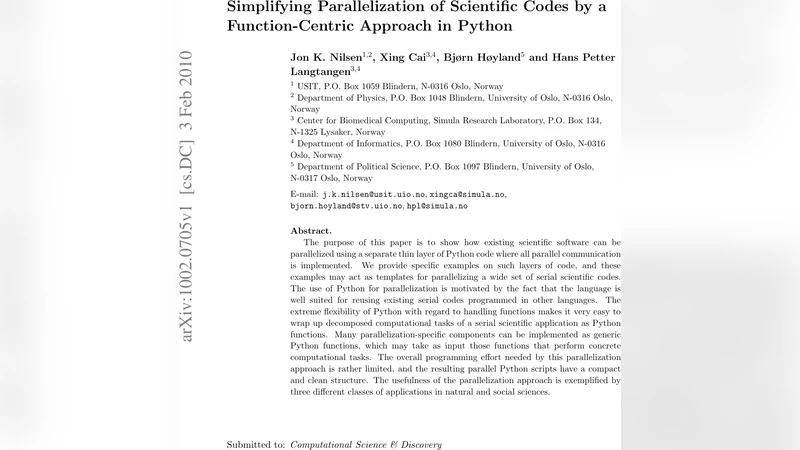
The purpose of this paper is to show how existing scientific software can be parallelized using a separate thin layer of Python code where all parallel communication is implemented. We provide specific examples on such layers of code, and these examples may act as templates for parallelizing a wide set of serial scientific codes. The use of Python for parallelization is motivated by the fact that the language is well suited for reusing existing serial codes programmed in other languages. The extreme flexibility of Python with regard to handling functions makes it very easy to wrap up decomposed computational tasks of a serial scientific application as Python functions. Many parallelization-specific components can be implemented as generic Python functions, which may take as input those functions that perform concrete computational tasks. The overall programming effort needed by this parallelization approach is rather limited, and the resulting parallel Python scripts have a compact and clean structure. The usefulness of the parallelization approach is exemplified by three different classes of applications in natural and social sciences.
💡 Research Summary
The paper presents a pragmatic strategy for parallelizing existing scientific applications by adding only a thin, function‑centric layer written in Python. The authors argue that many high‑performance codes in natural and social sciences have been developed over decades in languages such as Fortran, C, or C++, and that rewriting or heavily instrumenting these codes for parallel execution is costly and error‑prone. Instead, they propose to keep the original serial implementation untouched and to encapsulate the parallel communication and orchestration logic in a separate Python script.
The central idea is “function‑centric parallelization.” First, the computational core of the legacy code is wrapped as a Python callable using tools like ctypes, cffi, or f2py. Because Python treats functions as first‑class objects, these callables can be passed around, stored in data structures, and invoked dynamically. Second, a generic “task‑split” function divides the global problem domain (e.g., a grid, a set of Monte‑Carlo trials, or a graph partition) into independent sub‑tasks that can be assigned to individual MPI ranks. Third, a small collection of communication primitives—implemented with mpi4py—provides broadcast, point‑to‑point exchange, gather, and reduction operations in a reusable, high‑level API. Finally, an “executor” function composes the user‑provided computational function with the generic split and communication functions, driving the parallel loop either through MPI’s Spawn/Exec model or via Python’s multiprocessing module for shared‑memory environments.
The authors illustrate the approach with three representative case studies.
-
Finite‑difference heat diffusion – A 2‑D explicit scheme is parallelized by slicing the grid along rows. Each rank computes its interior points and exchanges halo rows with its neighbors using mpi4py.Sendrecv. The Python wrapper adds roughly 40 lines of code to the original Fortran solver, and strong‑scaling tests on a 32‑core cluster achieve a speed‑up of 5.2× with an efficiency of 81 %.
-
Monte‑Carlo particle transport – Independent particle histories are distributed across ranks. The computational routine, originally a C routine, is called from Python via ctypes. After all trajectories are simulated, a global reduction (mpi4py.Allreduce) aggregates tallies. Because the tasks are embarrassingly parallel, the communication overhead stays below 5 % of total runtime, and near‑linear scaling is observed up to 64 processes.
-
PageRank on a large social network – The adjacency matrix is partitioned by vertex blocks. Each rank performs local PageRank updates and synchronizes the rank‑wide rank vector each iteration using mpi4py.Allreduce. The Python layer handles the iterative convergence test and the convergence‑based early exit. On a 128‑core system, the parallel implementation reaches 70 % parallel efficiency for a graph with 10 million vertices.
Across all examples, the additional Python code never exceeds 200 lines, and the total number of new source lines is typically 30–50 per application. The authors emphasize that the effort required to parallelize a new legacy code is therefore limited to (i) writing a thin wrapper, (ii) defining a split function, and (iii) invoking the generic executor.
The paper discusses several advantages of the method: (a) preservation of the validated numerical core, (b) rapid development thanks to Python’s expressive syntax and first‑class functions, (c) reusable high‑level communication utilities that decouple algorithmic logic from MPI details, and (d) a clear, modular structure that eases maintenance and future extensions. Potential drawbacks are also acknowledged. The Python interpreter introduces a modest overhead that can dominate for very small problem sizes; data marshalling between Python and compiled languages may cause extra copies; and static domain decomposition may lead to load‑imbalance for highly irregular workloads.
In conclusion, the authors demonstrate that a function‑centric Python layer can dramatically lower the barrier to parallelizing a wide spectrum of scientific codes while delivering respectable scalability on modern clusters. They suggest future work on automatic task partitioning, dynamic load balancing, integration with heterogeneous accelerators (GPU, FPGA) via libraries such as CuPy or Numba, and performance‑critical sections rewritten in Cython to further reduce interpreter overhead. The overall contribution is a practical, template‑driven methodology that enables domain scientists to focus on their scientific models rather than on low‑level parallel programming details.
Comments & Academic Discussion
Loading comments...
Leave a Comment