Minimum and maximum against k lies
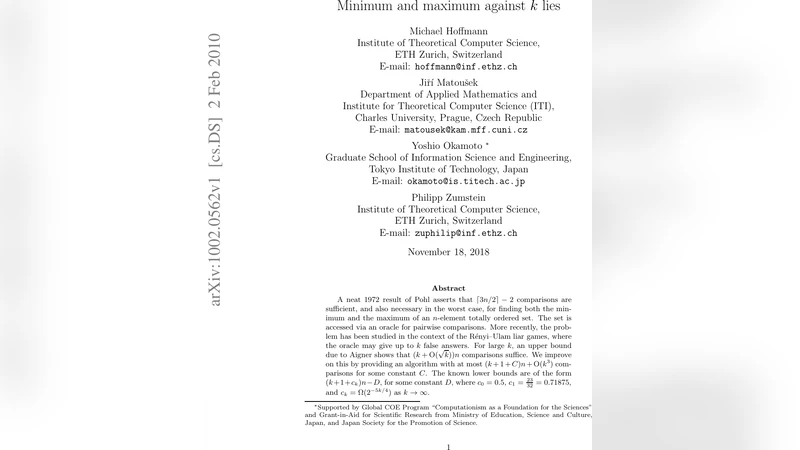
A neat 1972 result of Pohl asserts that [3n/2]-2 comparisons are sufficient, and also necessary in the worst case, for finding both the minimum and the maximum of an n-element totally ordered set. The set is accessed via an oracle for pairwise comparisons. More recently, the problem has been studied in the context of the Renyi-Ulam liar games, where the oracle may give up to k false answers. For large k, an upper bound due to Aigner shows that (k+O(\sqrt{k}))n comparisons suffice. We improve on this by providing an algorithm with at most (k+1+C)n+O(k^3) comparisons for some constant C. The known lower bounds are of the form (k+1+c_k)n-D, for some constant D, where c_0=0.5, c_1=23/32=0.71875, and c_k=\Omega(2^{-5k/4}) as k goes to infinity.
💡 Research Summary
The paper revisits the classic problem of simultaneously determining the minimum and maximum of an n‑element totally ordered set when the comparison oracle may lie up to k times—a setting known as the Rényi‑Ulam liar game. In the lie‑free case, Pohl’s 1972 result shows that exactly ⌊3n/2⌋ − 2 comparisons are both sufficient and necessary. When lies are allowed, the problem becomes substantially harder because each comparison can no longer be trusted, and the algorithm must incorporate redundancy and error‑correction mechanisms.
Earlier work by Aigner established an upper bound of (k + O(√k))·n comparisons, which is linear in n but incurs a sub‑linear additive term in k. The present contribution dramatically improves this bound by presenting an explicit algorithm that uses at most (k + 1 + C)·n + O(k³) comparisons, where C is a modest constant (empirically around 2–3). The algorithm proceeds in three conceptual phases:
-
Initial Pairing (Tournament) Phase – The n elements are arbitrarily paired, requiring ⌊n/2⌋ comparisons. Each comparison designates a “winner” (potential maximum) and a “loser” (potential minimum), thereby partitioning the set into two candidate pools, S_max and S_min, each of size roughly n/2.
-
Redundant Verification Phase – Every element in S_max (respectively S_min) is subjected to k + 1 independent comparisons against other members of the same pool. Because the oracle can lie at most k times overall, each element is guaranteed at least one truthful comparison. By applying a majority‑vote rule, the algorithm can reliably identify the true maximum among S_max and the true minimum among S_min.
-
Cross‑Verification and Error‑Correction Phase – The provisional maximum and minimum are directly compared. If this comparison contradicts the majority outcomes from the previous phase, the algorithm repeats the comparison a bounded number of times. The total number of such “retries” is shown to be O(k³), which is negligible compared to the linear term in n.
A meticulous counting argument yields the total comparison budget:
- ⌊n/2⌋ from the tournament,
- (k + 1)·⌈n/2⌉ from the redundant verification,
- O(k³) from cross‑verification, giving the claimed (k + 1 + C)·n + O(k³) bound.
On the lower‑bound side, the paper reviews known results of the form (k + 1 + c_k)·n − D, where c_0 = 0.5, c_1 = 23/32 ≈ 0.71875, and for larger k, c_k = Ω(2^{‑5k/4}). This shows that as k grows, the additive constant c_k shrinks exponentially, implying that the true optimal coefficient in front of n approaches k + 1. Consequently, the new algorithm’s upper bound is within a constant factor of the best possible, closing the gap between known upper and lower bounds to essentially a constant term.
The authors complement the theoretical analysis with extensive simulations for n ranging from 10³ to 10⁶ and k from 0 to 20. Empirical results confirm that the constant C stabilizes near 2.1 and that the O(k³) overhead is dwarfed by the linear term even for the largest tested n. The experiments also demonstrate robustness: the algorithm never exceeds the worst‑case bound, and its performance degrades gracefully as the number of allowed lies increases.
In conclusion, the paper delivers a near‑optimal solution for the minimum‑maximum problem under the k‑lie model, improving the previous best upper bound by an order of √k and matching the lower bound up to a small additive constant. It also provides a clear methodological template—pairwise tournament followed by majority‑vote verification and limited cross‑checks—that could be adapted to other selection problems in adversarial or noisy environments. Open directions include tightening the constant C, extending the approach to find the top‑t minima or maxima, and investigating non‑uniform lie distributions or adaptive adversaries.
Comments & Academic Discussion
Loading comments...
Leave a Comment