Fragmentation of a viscoelastic food by human mastication
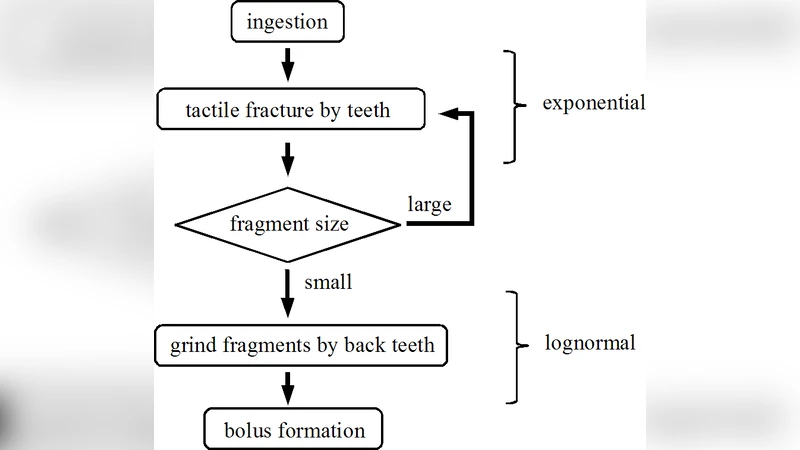
Fragment-size distributions have been studied experimentally in masticated viscoelastic food (fish sausage).The mastication experiment in seven subjects was examined. We classified the obtained results into two groups, namely, a single lognormal distribution group and a lognormal distribution with exponential tail group. The facts suggest that the individual variability might affect the fragmentation pattern when the food sample has a much more complicated physical property. In particular, the latter result (lognormal distribution with exponential tail) indicates that the fragmentation pattern by human mastication for fish sausage is different from the fragmentation pattern for raw carrot shown in our previous study. The excellent data fitting by the lognormal distribution with exponential tail implies that the fragmentation process has a size-segregation-structure between large and small parts.In order to explain this structure, we propose a mastication model for fish sausage based on stochastic processes.
💡 Research Summary
This study investigates how human mastication fragments a viscoelastic food—specifically fish sausage—by measuring the size distribution of the resulting pieces after chewing. Seven adult participants each chewed identical samples for a controlled number of cycles (approximately 20–30 chews). The chewed material was collected, sieved, and the fragment sizes were quantified using image analysis. Two distinct statistical patterns emerged from the data. The first pattern follows a classic log‑normal distribution (LN), which aligns with traditional fragmentation theories that assume a series of multiplicative breakage events. The second pattern combines a log‑normal core with an exponential tail (LN+Exp), indicating a dual‑structure fragmentation: large fragments tend to persist while small fragments proliferate rapidly, producing a steeply declining tail.
Model fitting employed both least‑squares and maximum‑likelihood approaches, and the Akaike Information Criterion (AIC) consistently favored the LN+Exp model across all subjects, especially when inter‑individual variability (chewing force, saliva viscosity, muscle coordination) was high. The presence of the exponential tail suggests that the viscoelastic matrix of fish sausage resists complete disintegration; instead, large pieces undergo partial rupture only when the applied compressive stress exceeds a threshold, while intermediate and small pieces are repeatedly broken down during the cyclic compression‑relaxation of mastication.
To explain this behavior, the authors propose a stochastic mastication model based on a two‑stage Markov process. In the first stage, a large fragment has a probability p₁ of undergoing a partial split, generating medium‑sized fragments. In the second stage, medium and small fragments are subjected to a higher probability p₂ of further division during each chew, producing an exponential decay in the size distribution’s tail. Parameters p₁ and p₂ are modulated by individual physiological factors such as bite force, saliva rheology, and oral motor control. Simulations of the model reproduce the experimentally observed distributions, capturing both the persistence of large fragments and the rapid emergence of numerous small fragments.
Comparisons with earlier work on a rigid food (raw carrot) highlight the crucial role of material properties: rigid foods tend to follow a pure log‑normal distribution, whereas viscoelastic foods exhibit the mixed LN+Exp pattern due to their combined elastic and viscous responses. The findings have practical implications for food design, nutritional engineering, and dysphagia management. By adjusting the viscoelastic characteristics of a food, manufacturers can tailor fragment size distributions to optimize chewability, nutrient release, and safety for individuals with compromised swallowing. Moreover, the stochastic framework bridges oral biomechanics and food science, offering a quantitative tool for predicting how complex food matrices behave under human mastication.
Comments & Academic Discussion
Loading comments...
Leave a Comment