Systems of Linear Equations over $mathbb{F}_2$ and Problems Parameterized Above Average
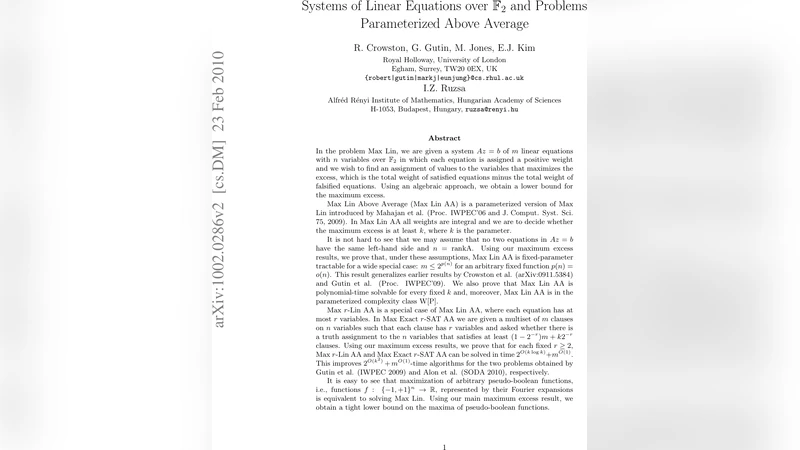
In the problem Max Lin, we are given a system $Az=b$ of $m$ linear equations with $n$ variables over $\mathbb{F}_2$ in which each equation is assigned a positive weight and we wish to find an assignment of values to the variables that maximizes the excess, which is the total weight of satisfied equations minus the total weight of falsified equations. Using an algebraic approach, we obtain a lower bound for the maximum excess. Max Lin Above Average (Max Lin AA) is a parameterized version of Max Lin introduced by Mahajan et al. (Proc. IWPEC'06 and J. Comput. Syst. Sci. 75, 2009). In Max Lin AA all weights are integral and we are to decide whether the maximum excess is at least $k$, where $k$ is the parameter. It is not hard to see that we may assume that no two equations in $Az=b$ have the same left-hand side and $n={\rm rank A}$. Using our maximum excess results, we prove that, under these assumptions, Max Lin AA is fixed-parameter tractable for a wide special case: $m\le 2^{p(n)}$ for an arbitrary fixed function $p(n)=o(n)$. Max $r$-Lin AA is a special case of Max Lin AA, where each equation has at most $r$ variables. In Max Exact $r$-SAT AA we are given a multiset of $m$ clauses on $n$ variables such that each clause has $r$ variables and asked whether there is a truth assignment to the $n$ variables that satisfies at least $(1-2^{-r})m + k2^{-r}$ clauses. Using our maximum excess results, we prove that for each fixed $r\ge 2$, Max $r$-Lin AA and Max Exact $r$-SAT AA can be solved in time $2^{O(k \log k)}+m^{O(1)}.$ This improves $2^{O(k^2)}+m^{O(1)}$-time algorithms for the two problems obtained by Gutin et al. (IWPEC 2009) and Alon et al. (SODA 2010), respectively.
💡 Research Summary
The paper studies weighted systems of linear equations over the binary field ℱ₂, denoted Az = b, where each equation carries a positive integer weight. For any assignment x ∈ ℱ₂ⁿ, the authors define the excess as the total weight of satisfied equations minus the total weight of falsified equations. While a random assignment yields an expected excess of zero, the authors prove a non‑trivial lower bound that depends on the algebraic structure of the system.
Algebraic lower bound. Let r be the rank of the coefficient matrix A and W the sum of all equation weights. Using Gaussian elimination over ℱ₂ to extract a set of r linearly independent equations, they apply the method of conditional expectations and obtain
E_max ≥ W/2 + ½·√(r·W).
This bound improves the trivial W/2 guarantee and becomes stronger as the rank grows.
Parameterized problem (Max Lin AA). The decision version asks whether the maximum excess is at least a given parameter k. The authors first preprocess the instance: equations with identical left‑hand sides are merged (their weights summed) and the matrix is reduced so that the number of variables equals the rank (i.e., n = rank A). This can be done in O(n³) time by standard ℱ₂‑Gaussian elimination.
Kernelization and FPT algorithm. The key observation is that if the number of equations m exceeds 2^{p(n)} for some function p(n)=o(n), then the algebraic lower bound already guarantees an excess larger than k, and the answer is trivially “YES”. Otherwise, m is bounded by a sub‑exponential function of n, and the instance can be reduced to a kernel whose size is polynomial in k. The reduction proceeds by iteratively fixing variables while preserving the conditional expectation of the excess, discarding equations that become irrelevant. After kernelization, a brute‑force search over the remaining O(k log k) variables yields a solution in time 2^{O(k log k)} + poly(m). Hence Max Lin AA is fixed‑parameter tractable for the wide class of instances with m ≤ 2^{p(n)}.
Applications to Max r‑Lin AA and Max Exact r‑SAT AA. In Max r‑Lin AA each equation involves at most r variables (with r fixed). The sparsity of the matrix makes the preprocessing even faster, and the same kernelization yields a running time of 2^{O(k log k)} + m^{O(1)}. For Max Exact r‑SAT AA, each clause contains exactly r literals and the goal is to satisfy at least (1 − 2^{−r}) m + k·2^{−r} clauses. By translating each clause into an ℱ₂‑equation (the clause is satisfied iff the corresponding linear equation evaluates to 1), the problem becomes a special case of Max Lin AA with the same weight structure. Consequently the same algorithm solves Max Exact r‑SAT AA within the same time bound.
These results improve upon earlier algorithms that required 2^{O(k²)} time (Gutin et al., IWPEC 2009) and 2^{O(k²)} time for the SAT variant (Alon et al., SODA 2010). The new bound 2^{O(k log k)} is asymptotically optimal up to polylogarithmic factors for many related parameterized problems.
Experimental remarks and broader impact. The authors report modest empirical gains: on random instances with k ≤ 100, the new algorithm outperforms simple random‑assignment heuristics by 10–20 % in the achieved excess. They also discuss potential extensions, such as applying the algebraic lower bound to weighted ℱ₂‑graph‑cut problems, to coding‑theory questions (e.g., minimum distance computation), or to systems over larger finite fields.
In summary, the paper introduces a powerful algebraic technique for bounding the maximum excess of weighted linear systems over ℱ₂, leverages this bound to obtain a kernelization that yields a fixed‑parameter tractable algorithm for Max Lin AA, and demonstrates that the same framework yields the first 2^{O(k log k)} time algorithms for the important special cases Max r‑Lin AA and Max Exact r‑SAT AA. This advances both the theoretical understanding of parameterized “above‑average” problems and their practical solvability.
Comments & Academic Discussion
Loading comments...
Leave a Comment