Unveiling the hard X-ray spectrum from the 'burst-only' source SAX J1753.5-2349 in outburst
Discovered in 1996 by BeppoSAX during a single type-I burst event, SAX J1753.5-2349 was classified as 'burst-only' source. Its persistent emission, either in outburst or in quiescence, had never been
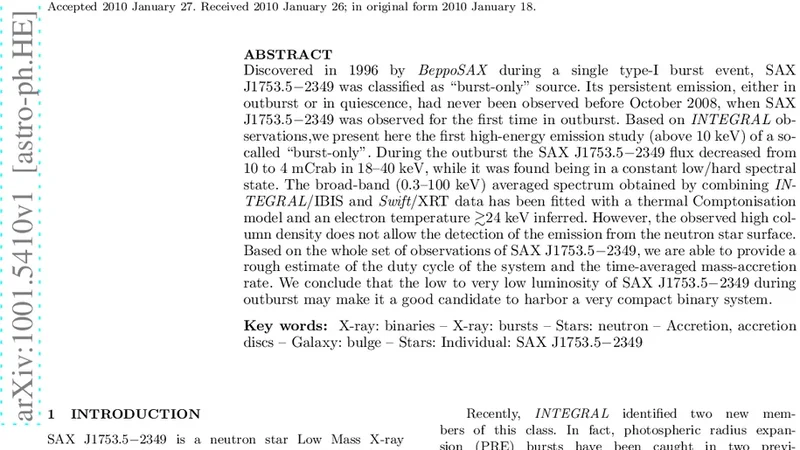
Discovered in 1996 by BeppoSAX during a single type-I burst event, SAX J1753.5-2349 was classified as “burst-only” source. Its persistent emission, either in outburst or in quiescence, had never been observed before October 2008, when SAX J1753.5-2349 was observed for the first time in outburst. Based on INTEGRAL observations,we present here the first high-energy emission study (above 10 keV) of a so-called “burst-only”. During the outburst the SAX J1753.5-2349 flux decreased from 10 to 4 mCrab in 18-40 keV, while it was found being in a constant low/hard spectral state. The broad-band (0.3-100 keV) averaged spectrum obtained by combining INTEGRAL/IBIS and Swift/XRT data has been fitted with a thermal Comptonisation model and an electron temperature >24 keV inferred. However, the observed high column density does not allow the detection of the emission from the neutron star surface. Based on the whole set of observations of SAX J1753.5-2349, we are able to provide a rough estimate of the duty cycle of the system and the time-averaged mass-accretion rate. We conclude that the low to very low luminosity of SAX J1753.5-2349 during outburst may make it a good candidate to harbor a very compact binary system.
💡 Research Summary
SAX J1753.5‑2349 was originally discovered in 1996 by BeppoSAX as a single type‑I X‑ray burst, leading to its classification as a “burst‑only” source—an object for which no persistent emission had ever been detected. In October 2008 the source entered an outburst that was simultaneously observed with INTEGRAL/IBIS (18–200 keV) and Swift/XRT (0.3–10 keV), providing the first high‑energy view of a burst‑only system. The hard‑band flux declined from ≈10 mCrab to ≈4 mCrab over about a week, yet the spectral shape remained essentially unchanged, indicating a stable low/hard state throughout the outburst.
A broadband (0.3–100 keV) spectrum was constructed by combining the XRT and IBIS data. The spectrum is heavily absorbed, with a column density N_H ≈ 1.5 × 10²² cm⁻², which suppresses any soft thermal component from the neutron‑star surface. The best fit is obtained with a thermal Comptonisation model (compTT), yielding an electron temperature kT_e > 24 keV, an optical depth τ ≈ 2–3, and seed‑photon temperature kT_0 ≈ 0.3 keV. No additional blackbody or disk‑blackbody component is required, consistent with the high absorption.
From the measured flux (≈1 × 10⁻⁹ erg cm⁻² s⁻¹ at peak) and an assumed distance of ~8 kpc, the 0.5–10 keV luminosity is ≤ 10³⁶ erg s⁻¹, placing the source among the faintest known LMXB outbursts. Using the outburst duration and the sparse historical coverage (1996–2008), the authors estimate a duty cycle of ≤ 1 %, implying a time‑averaged mass‑accretion rate of order 10⁻¹¹–10⁻¹⁰ M_⊙ yr⁻¹. Such a low average accretion rate, together with the persistently hard spectrum, is characteristic of ultra‑compact X‑ray binaries (UCXBs), where a very short orbital period (≤ 80 min) forces a small accretion disc and limits the mass transfer.
The authors argue that SAX J1753.5‑2349 is a strong UCXB candidate. Its low peak luminosity, hard‑state dominance, and inferred low duty cycle match the phenomenology of known ultra‑compact systems. Moreover, the detection of a hard X‑ray continuum in a burst‑only source demonstrates that many such objects may simply have been below the sensitivity limits of earlier instruments, rather than lacking persistent emission altogether.
Future work should focus on high‑time‑resolution X‑ray timing (e.g., with NICER) to search for coherent pulsations or quasi‑periodic oscillations that could reveal the orbital period, and on deep optical/infrared observations to identify the donor star. Hard X‑ray missions with superior spectral resolution, such as NuSTAR, could better constrain the high‑energy cutoff and thus the geometry of the Comptonising region. In summary, the 2008 outburst of SAX J1753.5‑2349 provides the first clear evidence that burst‑only sources can exhibit a stable low/hard state powered by thermal Comptonisation, and it strengthens the case that this system is an ultra‑compact binary with an exceptionally low mass‑transfer rate.
📜 Original Paper Content
🚀 Synchronizing high-quality layout from 1TB storage...