The host galaxies of core-collapse supernovae and gamma ray bursts
We present a comparative study of the galactic and small scale environments of gamma-ray bursts (GRB) and core collapse supernovae (CCSN). We use a sample of 34 GRB hosts at z<1.2, and a comparison sa
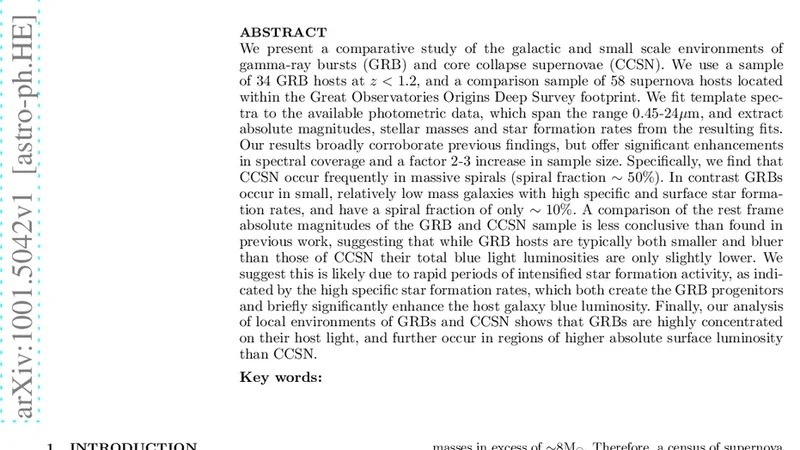
We present a comparative study of the galactic and small scale environments of gamma-ray bursts (GRB) and core collapse supernovae (CCSN). We use a sample of 34 GRB hosts at z<1.2, and a comparison sample of 58 supernova hosts located within the Great Observatories Origins Deep Survey footprint. We fit template spectra to the available photometric data, which span the range 0.45-24 micron, and extract absolute magnitudes, stellar masses and star formation rates from the resulting fits. Our results broadly corroborate previous findings, but offer significant enhancements in spectral coverage and a factor 2-3 increase in sample size. Specifically, we find that CCSN occur frequently in massive spirals (spiral fraction ~50%). In contrast GRBs occur in small, relatively low mass galaxies with high specific and surface star formation rates, and have a spiral fraction of only ~10%. A comparison of the rest frame absolute magnitudes of the GRB and CCSN sample is less conclusive than found in previous work, suggesting that while GRB hosts are typically both smaller and bluer than those of CCSN their total blue light luminosities are only slightly lower. We suggest this is likely due to rapid periods of intensified star formation activity, as indicated by the high specific star formation rates, which both create the GRB progenitors and briefly significantly enhance the host galaxy blue luminosity. Finally, our analysis of local environments of GRBs and CCSN shows that GRBs are highly concentrated on their host light, and further occur in regions of higher absolute surface luminosity than CCSN.
💡 Research Summary
The paper presents a systematic comparison of the host galaxies of long‑duration gamma‑ray bursts (GRBs) and core‑collapse supernovae (CCSNe) using a substantially enlarged data set and broader spectral coverage than previous studies. The authors assembled 34 GRB hosts at redshifts z < 1.2 and 58 CCSN hosts drawn from the Great Observatories Origins Deep Survey (GOODS) field. For each galaxy they collected multi‑wavelength photometry spanning the rest‑frame 0.45–24 µm range, then performed spectral‑energy‑distribution (SED) fitting with Bruzual & Charlot stellar population models. From the best‑fit templates they derived absolute B‑band magnitudes, stellar masses, star‑formation rates (SFRs), and specific SFRs (sSFR = SFR/M*).
The analysis confirms several trends reported earlier but with higher statistical significance. CCSNe are found preferentially in massive, often spiral galaxies: roughly half of the CCSN hosts are classified as spirals, and their median stellar mass is of order 10^10 M⊙. By contrast, GRB hosts are typically low‑mass systems (median ≈10^9 M⊙), with a spiral fraction of only ~10 %. GRB hosts also exhibit markedly elevated sSFRs, frequently exceeding 1 Gyr⁻¹, indicating that they are caught during brief, intense star‑formation episodes. This high sSFR explains why GRB hosts, despite being smaller and bluer, have only modestly lower rest‑frame B‑band luminosities than CCSN hosts: the burst of recent star formation temporarily boosts the blue light.
A key part of the study examines the sub‑galactic locations of the transients. By overlaying the transient positions on high‑resolution HST images, the authors quantify the fraction of host light at the explosion sites. GRBs are strongly concentrated on the brightest pixels and on regions of high surface brightness, whereas CCSNe show a more uniform distribution across their hosts. This spatial bias supports the idea that GRB progenitors (likely low‑metallicity, rapidly rotating massive stars) form preferentially in the most vigorous star‑forming clumps, while CCSNe arise from a broader range of massive stars that are less sensitive to local star‑formation intensity.
Methodologically, the paper improves upon earlier work by roughly doubling the sample size and by incorporating mid‑infrared data, which reduces uncertainties in dust attenuation and stellar‑mass estimates. The authors acknowledge that the redshift ceiling (z ≈ 1.2) limits the ability to probe the highest‑redshift GRB population, and they suggest that future observations with JWST, Euclid, and the Roman Space Telescope will be essential to extend these conclusions to earlier cosmic epochs.
In summary, the study provides robust evidence that GRBs and CCSNe trace different galactic environments: GRBs favor low‑mass, low‑metallicity, high‑sSFR galaxies and occur in the brightest, most actively star‑forming regions within those hosts, while CCSNe are more common in massive, often spiral galaxies and are less tightly linked to the most luminous star‑forming knots. These findings sharpen our understanding of the progenitor channels for both phenomena and underscore the importance of host‑galaxy context in interpreting transient surveys.
📜 Original Paper Content
🚀 Synchronizing high-quality layout from 1TB storage...