The diffuse radio filament in the merging system ZwCl 2341.1+0000
In some clusters of galaxies, a diffuse non-thermal emission is present, not obviously associated with any individual galaxy. These sources have been identified as relics, mini-halos, and halos accord
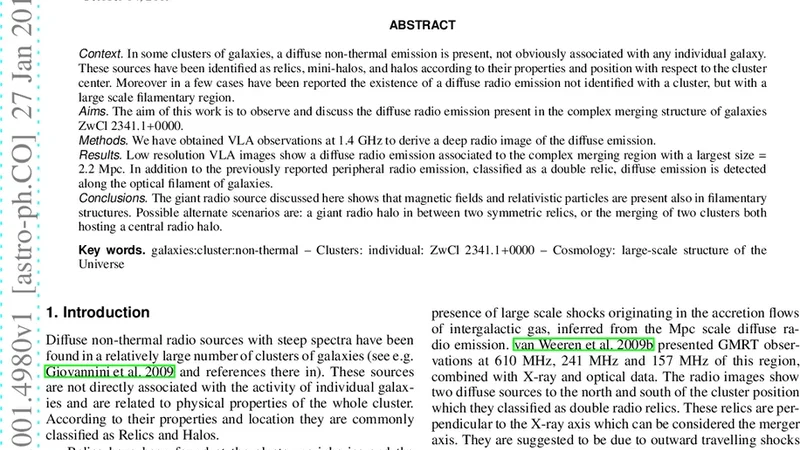
In some clusters of galaxies, a diffuse non-thermal emission is present, not obviously associated with any individual galaxy. These sources have been identified as relics, mini-halos, and halos according to their properties and position with respect to the cluster center. Moreover in a few cases have been reported the existence of a diffuse radio emission not identified with a cluster, but with a large scale filamentary region. The aim of this work is to observe and discuss the diffuse radio emission present in the complex merging structure of galaxies ZwCl 2341.1+0000. We have obtained VLA observations at 1.4 GHz to derive a deep radio image of the diffuse emission. Low resolution VLA images show a diffuse radio emission associated to the complex merging region with a largest size = 2.2 Mpc. In addition to the previously reported peripheral radio emission, classified as a double relic, diffuse emission is detected along the optical filament of galaxies. The giant radio source discussed here shows that magnetic fields and relativistic particles are present also in filamentary structures. Possible alternate scenarios are: a giant radio halo in between two symmetric relics, or the merging of two clusters both hosting a central radio halo.
💡 Research Summary
The paper presents a detailed radio study of the merging galaxy system ZwCl 2341.1+0000, focusing on a newly identified, extremely extended diffuse radio feature that stretches over 2.2 Mpc. Using deep Very Large Array (VLA) observations at 1.4 GHz, the authors combine B‑ and C‑configuration data to produce a low‑resolution (≈45 arcsec) image with a sensitivity of ~10 µJy beam⁻¹. The resulting map reveals three main components: (i) two peripheral relics that had been reported in earlier work, located on the eastern and western edges of the system; (ii) a broad, low‑surface‑brightness emission that fills the region between the relics and follows the optical filament of galaxies; and (iii) a faint, essentially unpolarized halo‑like component with a spectral index of α≈‑1.2.
The central diffuse emission aligns remarkably well with the galaxy filament identified in optical surveys, suggesting that magnetic fields and relativistic electrons are not confined to the dense intra‑cluster medium (ICM) but also permeate the lower‑density large‑scale structure. Under minimum‑energy assumptions the magnetic field strength in the filament is estimated to be 0.1–0.5 µG, an order of magnitude lower than typical cluster cores but still significant for a filamentary environment. The spectral steepness and the lack of strong polarization point toward turbulent re‑acceleration of electrons rather than pure diffusive shock acceleration (DSA) at a single shock front.
To interpret the observations, the authors propose two plausible scenarios. The first treats the central emission as a genuine giant radio halo that has been generated by merger‑driven turbulence filling the volume between the two relics. In this picture the relics mark outward‑propagating shock fronts, while the halo traces the turbulent cascade that re‑accelerates seed electrons throughout the merging system. The second scenario envisions that ZwCl 2341.1+0000 actually consists of two merging sub‑clusters, each originally hosting its own central radio halo. During the ongoing merger the two halos overlap, producing the observed continuous emission that bridges the relics. Both interpretations can accommodate the observed size, spectral index, and low polarization, but they differ in the implied energy budget and the role of large‑scale magnetic fields.
The study has broader implications for our understanding of non‑thermal phenomena in the cosmic web. It demonstrates that diffuse synchrotron emission can exist on scales comparable to the length of galaxy filaments, confirming that magnetic fields and relativistic particles are widespread beyond the virialized cores of clusters. This challenges the traditional classification of diffuse cluster radio sources (relics, mini‑halos, halos) and suggests that a more nuanced taxonomy, incorporating filamentary radio structures, is required.
Future work should aim at (1) low‑frequency observations with LOFAR, MWA, or the upcoming SKA‑Low to better constrain the spectral curvature and search for ultra‑steep spectrum components; (2) higher‑frequency, higher‑resolution imaging (e.g., with ASKAP, MeerKAT, or the VLA in A‑configuration) to resolve possible sub‑structures and measure any residual polarization; (3) deep X‑ray mapping with Chandra or XMM‑Newton to locate shock fronts and quantify the thermal pressure distribution; and (4) cosmological magneto‑hydrodynamic simulations that explicitly model particle acceleration and magnetic field amplification in filamentary environments. Such multi‑wavelength, multi‑scale approaches will be essential to determine whether the observed emission is best described as a single, unprecedented giant halo or as the superposition of multiple halos, and to elucidate the mechanisms that seed and sustain cosmic‑ray electrons across the large‑scale structure of the Universe.
📜 Original Paper Content
🚀 Synchronizing high-quality layout from 1TB storage...