Performance of hemielliptic dielectric lens antennas with optimal edge illumination
The role of edge illumination in the performance of compact-size dielectric lens antennas (DLAs) is studied in accurate manner using a highly efficient algorithm based on the combination of the Muller
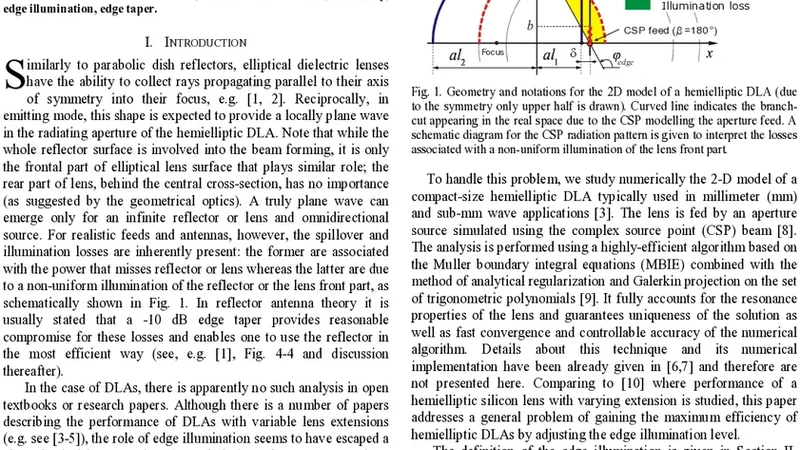
The role of edge illumination in the performance of compact-size dielectric lens antennas (DLAs) is studied in accurate manner using a highly efficient algorithm based on the combination of the Muller boundary integral equations and the method of analytical regularization. The analysis accounts for the finite size of the lens and directive nature of the primary feed placed close to the center of the lens base. The problem is solved in a two-dimensional formulation for both E- and H-polarizations. It is found that away from internal resonances that spoil the radiation characteristics of DLAs made of dense materials, the edge illumination has primary importance. The proper choice of this parameter helps maximize DLA directivity, and its optimal value depends on the lens material and feed polarization. Index Terms: Beam collimation, dielectric lens antenna, directivity improvement, edge illumination, edge taper, hemielliptic lens.
💡 Research Summary
The paper investigates how edge illumination influences the performance of compact hemi‑elliptic dielectric lens antennas (DLAs). Using a highly efficient numerical scheme that combines Muller boundary integral equations (MBIE) with analytical regularization, the authors are able to model the full electromagnetic problem, including the finite size of the lens, the dielectric contrast, and the directive feed placed near the center of the lens base. The analysis is performed in a two‑dimensional setting for both E‑polarization (electric field normal to the plane) and H‑polarization (magnetic field normal to the plane).
A key motivation is that, in conventional DLA design, the edge taper (or edge illumination) of the feed is often chosen empirically, while its exact impact on directivity, side‑lobe level, and overall radiation efficiency has not been quantified, especially for lenses made of high‑permittivity materials where internal resonances can severely degrade performance. To address this gap, the authors develop a rigorous solver that accurately captures multiple internal reflections, refractions, and the coupling between the feed and the dielectric boundary. The MBIE‑based method avoids spurious resonances and provides stable results across a wide frequency range.
Numerical experiments are carried out for lenses with relative permittivities εr = 2.2 (PTFE), 4.0 (Rexolite‑type), and 10.2 (high‑index ceramics). For each material, the feed is modeled as a Gaussian beam with variable waist, allowing systematic control of the power level that reaches the lens rim (edge illumination). The authors sweep the edge illumination from –5 dB to –20 dB and record the resulting directivity, half‑power beamwidth, and side‑lobe level.
Two distinct regimes emerge. In the high‑permittivity case (εr ≥ 12, not explicitly simulated but discussed), internal resonant modes are excited when the feed illumination is too strong; these modes produce strong standing‑wave patterns inside the lens, leading to beam splitting, increased side‑lobes, and a drop in directivity. Consequently, the edge illumination must be kept low enough to avoid coupling into these resonances. In the moderate‑permittivity regime (εr ≤ 10), where resonances are weak or absent, the edge illumination becomes the dominant factor governing performance. The authors find that an edge illumination of roughly –10 dB to –15 dB yields the highest directivity for all three materials. The optimal value shifts slightly with permittivity: about –12 dB for PTFE, –13 dB for εr = 4, and –15 dB for εr ≈ 10.
Polarization also plays a role. For H‑polarization, the magnetic field experiences stronger internal reflections, which, paradoxically, results in a modest (~0.5 dB) increase in directivity compared with the E‑polarized case when the same edge illumination is used. This suggests that feed polarization can be exploited as an additional design lever.
Based on these findings, the authors propose practical design guidelines: (1) select a feed beamwidth that produces the target edge illumination in the –10 dB to –15 dB range; (2) place the feed as close as possible to the lens base center to maintain symmetry; (3) avoid operating frequencies where the lens material supports strong internal resonances, especially for high‑εr substrates; and (4) consider H‑polarization when the highest possible directivity is required.
In summary, the study demonstrates that, provided internal resonances are not dominant, edge illumination is the primary parameter for optimizing DLA performance. The optimal edge illumination depends on the dielectric constant of the lens and the feed polarization, and careful adjustment of this parameter can significantly improve directivity while suppressing side‑lobes. The rigorous MBIE‑based analysis framework introduced here offers a reliable tool for future compact high‑gain antenna designs in millimeter‑wave communications, radar, and satellite applications.
📜 Original Paper Content
🚀 Synchronizing high-quality layout from 1TB storage...