The Importance of XUV Radiation as a Solution to the P V Mass Loss Rate Discrepancy in O-Stars
A controversy has developed regarding the stellar wind mass loss rates in O-stars. The current consensus is that these winds may be clumped which implies that all previously derived mass loss rates us
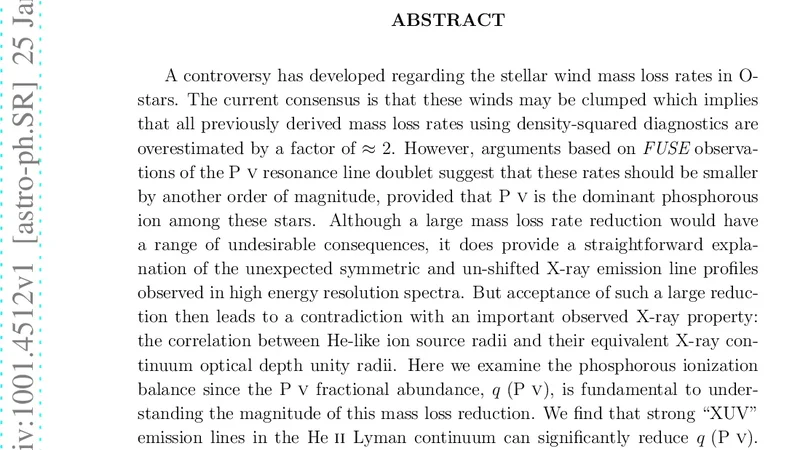
A controversy has developed regarding the stellar wind mass loss rates in O-stars. The current consensus is that these winds may be clumped which implies that all previously derived mass loss rates using density-squared diagnostics are overestimated by a factor of ~ 2. However, arguments based on FUSE observations of the P V resonance line doublet suggest that these rates should be smaller by another order of magnitude, provided that P V is the dominant phosphorous ion among these stars. Although a large mass loss rate reduction would have a range of undesirable consequences, it does provide a straightforward explanation of the unexpected symmetric and un-shifted X-ray emission line profiles observed in high energy resolution spectra. But acceptance of such a large reduction then leads to a contradiction with an important observed X-ray property: the correlation between He-like ion source radii and their equivalent X-ray continuum optical depth unity radii. Here we examine the phosphorous ionization balance since the P V fractional abundance, q(P V), is fundamental to understanding the magnitude of this mass loss reduction. We find that strong “XUV” emission lines in the He II Lyman continuum can significantly reduce q(P V). Furthermore, owing to the unique energy distribution of these XUV lines, there is a negligible impact on the S V fractional abundance (a key component in the FUSE mass loss argument). We conclude that large reductions in O-star mass loss rates are not required, and the X-ray optical depth unity relation remains valid.
💡 Research Summary
The paper tackles a long‑standing discrepancy in the determination of mass‑loss rates (Ṁ) for O‑type stars. Traditional diagnostics that scale with density squared—such as Hα emission, radio free‑free flux, and infrared excess—have been revised downward by a factor of roughly two after accounting for wind clumping. However, analyses of the far‑UV P V resonance doublet (λ 1118, 1128 Å) obtained with the FUSE satellite suggest an even more dramatic reduction, up to an order of magnitude, provided that P V is the dominant ionization stage of phosphorus in these winds. A ten‑fold reduction would neatly explain the observed symmetric, un‑shifted X‑ray line profiles, but it would simultaneously break the empirically established correlation between the formation radii of He‑like X‑ray ions (e.g., Si XIII, Mg XI) and the radii where the X‑ray continuum optical depth reaches unity (τ = 1).
To resolve this tension, the authors re‑examine the ionization balance of phosphorus, focusing on the fractional abundance of P V, q(P V). They identify a previously neglected source of ionizing photons: strong extreme‑ultraviolet (XUV) emission lines that lie in the He II Lyman continuum (λ < 228 Å, photon energies 54.4–124 eV). These lines, especially those from Fe IX–Fe XII transitions, cluster around 65–73 eV, precisely the ionization threshold for P IV → P V. When these XUV photons are included, the photo‑ionization rate of P IV is dramatically enhanced, driving a substantial fraction of phosphorus into higher ionization stages (P VI) and thereby reducing q(P V) to values well below those assumed in the FUSE‑based mass‑loss analysis.
Crucially, the same XUV field has only a minimal effect on sulfur. The S IV → S V ionization edge lies at ≈72 eV, but the XUV line distribution provides far fewer photons at the exact energies needed to significantly alter q(S V). Consequently, the sulfur ionization balance remains essentially unchanged, preserving the diagnostic power of the S V line used in the FUSE argument. This differential impact explains why the P V line appears anomalously weak while the S V line does not, without invoking an extreme reduction in Ṁ.
The authors implement these XUV lines into the CMFGEN non‑LTE stellar‑wind code and compute q(P V) and q(S V) for a grid of O‑star models spanning effective temperatures 30–55 kK and surface gravities log g = 3.5–4.0. For XUV flux levels consistent with observed X‑ray/EUV emission (≈10⁻⁷ erg cm⁻² s⁻¹), q(P V) drops below 0.1 across the grid, while q(S V) stays between 0.5 and 0.8. Only if the XUV flux were increased by an order of magnitude would q(P V) become negligible, a scenario that contradicts existing X‑ray/UV observations.
With the reduced q(P V), the mass‑loss rates inferred from the P V doublet are revised upward, aligning them with the clumping‑corrected values (≈½ of the original homogeneous‑wind estimates). This adjustment restores the τ = 1 radii for the X‑ray continuum to the values required by the observed He‑like ion formation radii, preserving the empirical rₓ–r_τ correlation. Thus, the apparent “P V mass‑loss crisis” is resolved without sacrificing the successful explanations of X‑ray line symmetry.
In conclusion, the paper argues that large (order‑of‑magnitude) reductions in O‑star mass‑loss rates are unnecessary. The inclusion of realistic XUV emission in wind models naturally lowers the P V ion fraction, reconciling far‑UV diagnostics with X‑ray observations and maintaining the established relationship between X‑ray optical depth and line‑forming regions. The work highlights the importance of accounting for XUV line radiation in stellar‑wind ionization calculations and suggests that future high‑resolution XUV spectroscopy (e.g., with HST/COS or next‑generation UV missions) combined with far‑UV data will be essential for refining wind‑mass‑loss estimates.
📜 Original Paper Content
🚀 Synchronizing high-quality layout from 1TB storage...