Small hemielliptic dielectric lens antenna analysis in 2-D: boundary integral equations versus geometrical and physical optics
We assess the accuracy and relevance of the numerical algorithms based on the principles of Geometrical Optics (GO) and Physical Optics (PO) in the analysis of reduced-size homogeneous dielectric lens
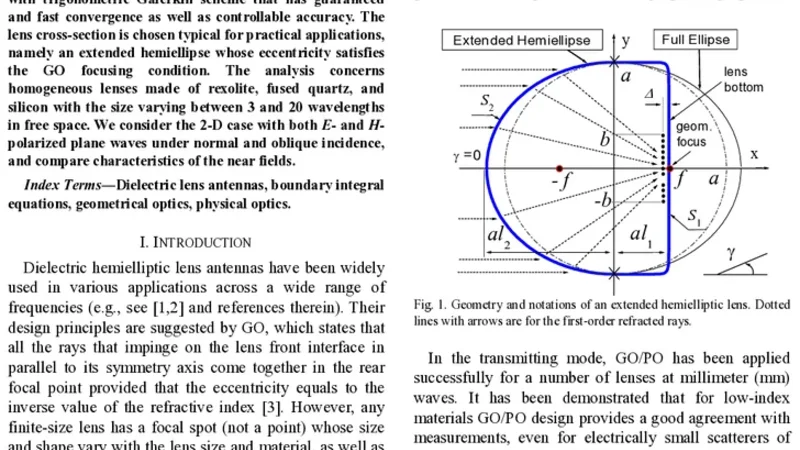
We assess the accuracy and relevance of the numerical algorithms based on the principles of Geometrical Optics (GO) and Physical Optics (PO) in the analysis of reduced-size homogeneous dielectric lenses prone to behave as open resonators. As a benchmark solution, we use the Muller boundary integral equations discretized with trigonometric Galerkin scheme that has guaranteed and fast convergence as well as controllable accuracy. The lens cross-section is chosen typical for practical applications, namely an extended hemiellipse whose eccentricity satisfies the GO focusing condition. The analysis concerns homogeneous lenses made of rexolite, fused quartz, and silicon with the size varying between 3 and 20 wavelengths in free space. We consider the 2-D case with both E- and H-polarized plane waves under normal and oblique incidence, and compare characteristics of the near fields.
💡 Research Summary
This paper presents a rigorous comparative study of two widely used approximate electromagnetic analysis techniques—Geometrical Optics (GO) and Physical Optics (PO)—against a benchmark solution based on the Muller Boundary Integral Equation (BIE) for two‑dimensional (2‑D) hemielliptic dielectric lens antennas. The authors focus on “reduced‑size” lenses whose dimensions range from three to twenty free‑space wavelengths (λ₀) and whose cross‑section is an extended hemiellipse whose eccentricity satisfies the GO focusing condition e = 1/n (n being the refractive index). Three homogeneous dielectric materials are examined: rexolite (ε≈2.53), fused quartz (ε≈3.78), and silicon (ε≈11.7). Both E‑polarized (electric field out of the 2‑D plane) and H‑polarized (magnetic field out of the plane) plane waves are considered under normal incidence as well as oblique incidences of 30° and 45°.
The benchmark solution employs the Muller BIE discretized with a trigonometric Galerkin scheme. This approach expands the unknown surface currents in a Fourier series, leading to a well‑conditioned linear system that converges rapidly and allows the user to prescribe a target numerical error. Because the BIE formulation inherently satisfies the exact boundary conditions on the dielectric interface, it captures all wave phenomena—including multiple internal reflections, phase accumulation, and resonant cavity modes—that are otherwise neglected by GO and PO.
In contrast, GO treats the lens as a purely ray‑tracing device: incident rays are refracted according to Snell’s law, and the focal point is predicted from the geometric parameters of the hemiellipse. PO improves upon GO by approximating the induced surface currents on the illuminated side of the lens and then integrating these currents to obtain the radiated field. However, PO still assumes that the interior field can be represented by a simple equivalent current distribution and does not account for standing‑wave patterns or high‑Q resonances that may develop inside a compact high‑index lens.
The numerical experiments reveal a clear size‑ and material‑dependent trend. For lenses larger than roughly 10 λ₀ made of low‑index material (rexolite), GO and PO predict the focal location and near‑field intensity with errors typically below 5 % relative to the BIE results. In this regime the ray picture dominates, and the interior field is well approximated by a single refracted beam. As the lens size shrinks below 5 λ₀ or the dielectric constant increases (quartz and especially silicon), the BIE solution exhibits pronounced resonant peaks in the near‑field magnitude. These peaks correspond to internal Fabry‑Pérot‑like modes formed by multiple reflections between the curved front surface and the flat base of the hemiellipse. The resonant fields can be three to four times stronger than the non‑resonant focusing field, and their spatial distribution is highly non‑uniform, showing multiple hot spots rather than a single focal point. GO completely misses these resonances, predicting a smeared focal region with significantly underestimated field strength. PO, while capturing some diffraction effects, still fails to reproduce the correct resonance frequencies and the associated field enhancement.
Polarization effects are also significant. For H‑polarization (magnetic field parallel to the invariant axis), the continuity condition on the tangential electric field is less restrictive, leading to larger induced surface currents and consequently stronger internal resonances. The BIE results show that H‑polarized lenses can support higher‑Q modes than their E‑polarized counterparts, a nuance that GO/PO does not capture.
Oblique incidence further accentuates the limitations of the approximate methods. GO predicts a simple shift of the focal point according to the incident angle, assuming linear ray propagation inside the lens. The BIE, however, reveals that the phase front undergoes complex distortion due to the combination of refraction, internal reflection, and interference, resulting in asymmetric field patterns and, in some cases, the excitation of different resonant modes than those observed under normal incidence. PO’s current‑based approximation partially accounts for the altered illumination but still cannot model the resulting interference accurately.
From a computational standpoint, the GO/PO framework is extremely fast and requires minimal memory, making it attractive for preliminary design sweeps, parametric studies, or real‑time beam‑steering simulations where high precision is not critical. The trigonometric Galerkin BIE, while more demanding (O(N²) operations for N basis functions), converges exponentially with the number of Fourier modes and provides controllable accuracy down to machine precision. The authors demonstrate that for the smallest lenses (≈3 λ₀) and the highest‑index material (silicon), a basis set of only 30–40 modes suffices to achieve relative errors below 0.1 % in the near‑field quantities of interest.
In conclusion, the paper establishes that the Muller BIE solution is the definitive benchmark for assessing dielectric lens performance, especially when the lens dimensions are comparable to the wavelength or when high‑index materials are employed. GO and PO remain valuable tools for large, low‑index lenses where ray optics dominate, but their applicability diminishes sharply in regimes where internal resonances, polarization‑dependent effects, and oblique incidence introduce wave phenomena beyond simple ray tracing. These findings have direct implications for the design of compact high‑gain antennas, millimeter‑wave imaging systems, and integrated photonic lenses, where accurate prediction of near‑field behavior is essential for achieving the desired performance.
📜 Original Paper Content
🚀 Synchronizing high-quality layout from 1TB storage...