The black hole in NGC 1313 X-2: constraints on the mass from optical observations
We present a theoretical study on the nature of the ultra-luminous X-ray source NGC 1313 X-2. We evolved a set of binaries with high mass donor stars orbiting a 20 M_Sun or a 50-100 M_Sun black hole.
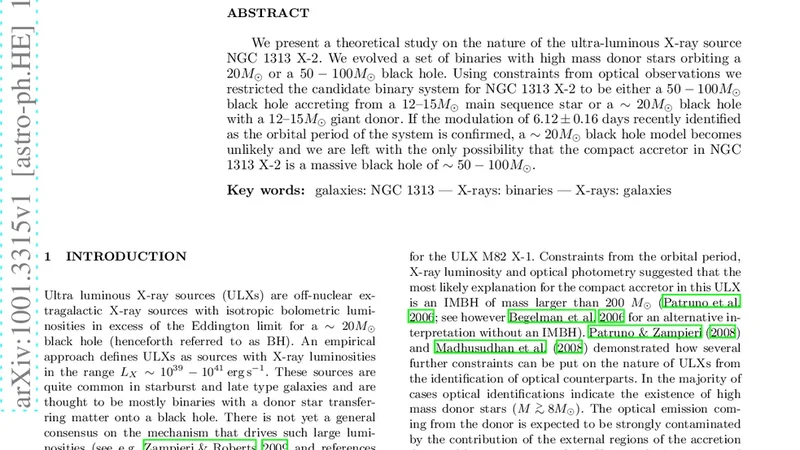
We present a theoretical study on the nature of the ultra-luminous X-ray source NGC 1313 X-2. We evolved a set of binaries with high mass donor stars orbiting a 20 M_Sun or a 50-100 M_Sun black hole. Using constraints from optical observations we restricted the candidate binary system for NGC 1313 X-2 to be either a 50-100 M_Sun black hole accreting from a 12-15 M_Sun main sequence star or a ~20 M_Sun black hole with a 12-15 M_Sun giant donor. If the modulation of ~6.12 days recently identified as the orbital period of the system is confirmed, a ~20 M_Sun black hole model becomes unlikely and we are left with the only possibility that the compact accretor in NGC 1313 X-2 is a massive black hole of ~50-100 M_Sun.
💡 Research Summary
The paper tackles the long‑standing question of what kind of compact object powers the ultra‑luminous X‑ray source (ULX) NGC 1313 X‑2. By coupling detailed binary‑evolution calculations with stringent constraints from optical observations, the authors narrow down the permissible configurations of the system. Two distinct black‑hole (BH) mass regimes are explored: a “standard” ∼20 M⊙ BH, typical of high‑mass X‑ray binaries, and a much heavier ∼50–100 M⊙ BH, which would place the source among the rare class of massive stellar‑origin black holes. For each BH mass, the donor star is assumed to be a high‑mass companion (12–15 M⊙) either on the main sequence (MS) or in a red‑giant (RG) phase.
The optical counterpart of NGC 1313 X‑2 has been identified with Hubble Space Telescope and VLT imaging. Its absolute V‑band magnitude (M_V ≈ –5.5) and blue colours (B–V ≈ 0.0, V–I ≈ –0.1) indicate a hot, relatively luminous star, consistent with a 12–15 M⊙ MS object rather than a cooler giant. Moreover, a periodic modulation of ≈6.12 days has been reported in the optical light curve; if this modulation reflects the orbital period, the binary must be close enough for the donor to fill—or nearly fill—its Roche lobe.
The evolutionary models compute mass‑transfer rates (Ṁ), Roche‑lobe geometry, and the structure of the accretion disc, while simultaneously predicting the X‑ray luminosity and the optical flux emerging from the disc, the donor, and any re‑processed emission. The key findings are:
-
20 M⊙ BH + MS donor – The Roche‑lobe radius at a 6‑day orbit is too small for a 12–15 M⊙ MS star to fill it without invoking extreme expansion. If the donor were a giant, the colour would be too red compared with observations. Consequently, this configuration cannot simultaneously reproduce the observed optical colours, absolute magnitude, and the putative orbital period.
-
20 M⊙ BH + RG donor – While a giant could fill the Roche lobe at a 6‑day period, the resulting optical spectrum would be markedly redder and brighter than measured, and the system would likely be in a short‑lived evolutionary stage, making the observed configuration statistically unlikely.
-
50–100 M⊙ BH + MS donor – A massive BH dramatically enlarges the orbital separation for a given period, allowing a 12–15 M⊙ MS star to comfortably fill its Roche lobe at ≈6 days. The mass‑transfer rate in these models often exceeds the Eddington limit for the BH, leading to super‑critical accretion flows. The authors discuss how excess material can be expelled in powerful winds or form a thick, geometrically‑inflated disc that reduces the radiative efficiency in X‑rays while still providing the observed optical luminosity. This scenario naturally yields the observed blue colours, absolute magnitude, and the modest X‑ray/optical flux ratio.
The paper also examines the impact of wind‑driven mass loss and non‑standard disc geometry on the emergent spectrum. In super‑critical regimes, a large fraction of the inflowing mass is expected to be lost in a radiatively‑driven outflow, which can reprocess high‑energy photons into the optical/UV band, further aligning the model predictions with the data.
Putting all constraints together, the authors conclude that the only viable solution is a massive black hole of ∼50–100 M⊙ accreting from a 12–15 M⊙ main‑sequence companion. The alternative 20 M⊙ BH model becomes highly improbable if the 6.12‑day modulation is confirmed as the orbital period. This result adds a compelling data point to the growing evidence that some ULXs host black holes significantly more massive than those found in typical Galactic X‑ray binaries, possibly formed via direct collapse of very massive stars in low‑metallicity environments. The study demonstrates the power of combining multi‑wavelength observations with sophisticated binary evolution modeling to disentangle the nature of extreme accreting systems.
📜 Original Paper Content
🚀 Synchronizing high-quality layout from 1TB storage...