Solution space heterogeneity of the random K-satisfiability problem: Theory and simulations
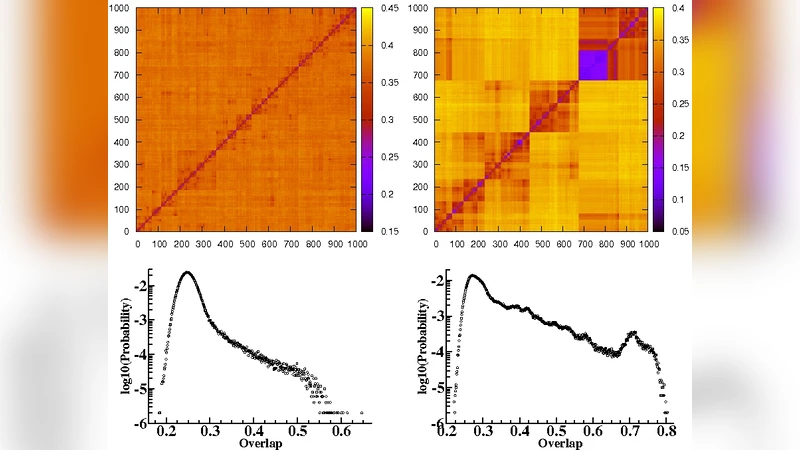
The random K-satisfiability (K-SAT) problem is an important problem for studying typical-case complexity of NP-complete combinatorial satisfaction; it is also a representative model of finite-connectivity spin-glasses. In this paper we review our recent efforts on the solution space fine structures of the random K-SAT problem. A heterogeneity transition is predicted to occur in the solution space as the constraint density alpha reaches a critical value alpha_cm. This transition marks the emergency of exponentially many solution communities in the solution space. After the heterogeneity transition the solution space is still ergodic until alpha reaches a larger threshold value alpha_d, at which the solution communities disconnect from each other to become different solution clusters (ergodicity-breaking). The existence of solution communities in the solution space is confirmed by numerical simulations of solution space random walking, and the effect of solution space heterogeneity on a stochastic local search algorithm SEQSAT, which performs a random walk of single-spin flips, is investigated. The relevance of this work to glassy dynamics studies is briefly mentioned.
💡 Research Summary
**
The paper investigates the fine‑grained structure of the solution space of random K‑satisfiability (K‑SAT) formulas, focusing on a previously unnoticed transition that precedes the well‑studied clustering transition. In a random K‑SAT instance, N Boolean variables are subject to M = αN randomly chosen K‑clauses. A configuration that satisfies all clauses is called a solution, and the set of all solutions S constitutes the solution space.
The authors introduce the overlap q(σ¹,σ²) = (1/N)∑₁ᴺ σᵢ¹σᵢ² as a measure of similarity between two solutions. For each possible overlap value q they count the number of solution pairs N(q) and define an entropy density s(q) = (1/N) ln N(q). The shape of s(q) determines whether the solution space is homogeneous (concave s(q)) or heterogeneous (non‑concave s(q)).
Using the replica‑symmetric (RS) cavity method, they construct a partition function Z(x) = ∑_{σ¹,σ²} exp
Comments & Academic Discussion
Loading comments...
Leave a Comment