Earthquake Forecast via Neutrino Tomography
We discuss the possibility of forecasting earthquakes by means of (anti)neutrino tomography. Antineutrinos emitted from reactors are used as a probe. As the antineutrinos traverse through a region pro
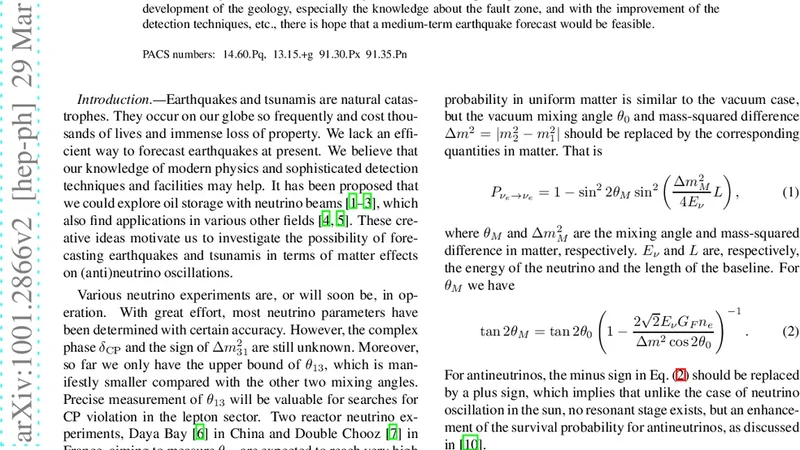
We discuss the possibility of forecasting earthquakes by means of (anti)neutrino tomography. Antineutrinos emitted from reactors are used as a probe. As the antineutrinos traverse through a region prone to earthquakes, observable variations in the matter effect on the antineutrino oscillation would provide a tomography of the vicinity of the region. In this preliminary work, we adopt a simplified model for the geometrical profile and matter density in a fault zone. We calculate the survival probability of electron antineutrinos for cases without and with an anomalous accumulation of electrons which can be considered as a clear signal of the coming earthquake, at the geological region with a fault zone, and find that the variation may reach as much as 3% for $\bar \nu_e$ emitted from a reactor. The case for a $\nu_e$ beam from a neutrino factory is also investigated, and it is noted that, because of the typically high energy associated with such neutrinos, the oscillation length is too large and the resultant variation is not practically observable. Our conclusion is that with the present reactor facilities and detection techniques, it is still a difficult task to make an earthquake forecast using such a scheme, though it seems to be possible from a theoretical point of view while ignoring some uncertainties. However, with the development of the geology, especially the knowledge about the fault zone, and with the improvement of the detection techniques, etc., there is hope that a medium-term earthquake forecast would be feasible.
💡 Research Summary
The paper investigates a novel concept: using reactor‑produced electron antineutrinos ( (\bar\nu_e) ) as a probe to forecast earthquakes by detecting changes in the matter‑induced oscillation effect as the neutrinos traverse a fault zone. The authors begin by noting that conventional earthquake forecasting relies on surface deformation, seismic precursors, and electromagnetic anomalies, all of which provide only short‑term or ambiguous warnings. In contrast, neutrinos interact weakly with matter yet experience the Mikheyev–Smirnov–Wolfenstein (MSW) effect, which makes their flavor oscillations sensitive to the local electron density. If a fault zone accumulates electrons (or, equivalently, increases its mass density) prior to rupture, the effective potential (V = \sqrt{2}G_F N_e) changes, altering the effective mixing parameters (\Delta m^2_{21}^{\rm eff}) and (\theta_{12}^{\rm eff}). This modification translates into a measurable shift in the survival probability (P_{ee}) of (\bar\nu_e).
To explore feasibility, the authors adopt a highly simplified geometric model: a rectangular fault slab 10 km long, 5 km wide, and 3 km thick, embedded in crustal material of density 2.7 g cm⁻³. They assume that, in the days leading up to a quake, the electron density within the slab rises by 5–10 % due to fluid migration, micro‑fracturing, or other geophysical processes. Reactor antineutrinos, with typical energies of 2–4 MeV, travel a baseline of roughly 100 km from the source to a detector placed on the opposite side of the fault. Using the standard two‑flavor survival formula with the matter term added, they compute the phase shift (\delta\phi \approx \Delta V L/(2E)). For the assumed density increase, (\delta\phi) reaches about 0.03 rad, which corresponds to a change in (P_{ee}) of up to 3 %.
The paper also evaluates a high‑energy electron‑neutrino beam (ν_e) from a hypothetical neutrino factory. Because the oscillation length at tens of GeV is of order 10⁴ km, the fault‑scale perturbation produces a negligible phase shift; thus, such beams are unsuitable for this application.
From an experimental standpoint, the authors identify three major obstacles. First, the statistical requirement: detecting a 3 % effect demands several thousand (\bar\nu_e) events in the relevant energy window, which translates into a detector mass of tens of kilotons and multi‑year exposure for a single reactor. Second, background suppression: atmospheric and geoneutrino fluxes, as well as detector systematics (energy calibration, position reconstruction), can easily mask the subtle signal. Third, geophysical uncertainty: the actual electron‑density profile of a fault zone is poorly known; existing seismic tomography provides only coarse constraints, and the assumed 5–10 % increase is speculative.
The authors conclude that, while the theoretical principle is sound—electron‑density anomalies can imprint a detectable modulation on reactor antineutrino oscillations—the current state of reactor facilities, large‑volume low‑energy neutrino detectors, and fault‑zone modeling makes practical earthquake forecasting infeasible. Nevertheless, they argue that future advances could change the balance. Improvements could include (i) constructing ultra‑large liquid‑scintillator detectors (≥ 30 kt) near high‑power reactors, (ii) developing real‑time, high‑resolution geophysical models of fault zones to predict the magnitude and spatial extent of electron‑density changes, and (iii) employing sophisticated statistical techniques to extract a small oscillation‑pattern deviation from background.
In summary, the paper presents a thought‑provoking interdisciplinary proposal that bridges particle physics and seismology. It quantifies the expected signal (up to a 3 % variation in (\bar\nu_e) survival probability) and outlines the technical and geological challenges that must be overcome before neutrino tomography could become a viable medium‑term earthquake‑forecasting tool.
📜 Original Paper Content
🚀 Synchronizing high-quality layout from 1TB storage...