Launching of jets by cold, magnetized disks in Kerr Metric
We confirm recent discovery by Cao that in the vicinity of fast rotating black holes jets can be launched centrifugally by cold, magnetized disks even for nearly vertically shaped magnetic flux surfac
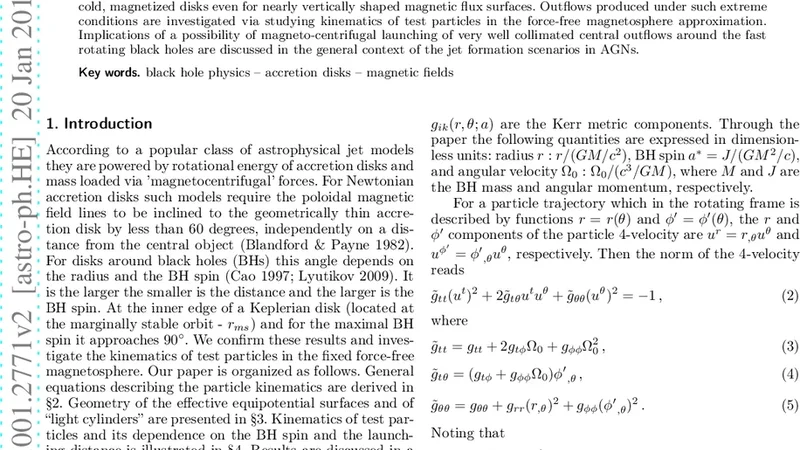
We confirm recent discovery by Cao that in the vicinity of fast rotating black holes jets can be launched centrifugally by cold, magnetized disks even for nearly vertically shaped magnetic flux surfaces. Outflows produced under such extreme conditions are investigated via studying kinematics of test particles in the force-free magnetosphere approximation. Implications of a possibility of magneto-centrifugal launching of very well collimated central outflows around the fast rotating black holes are discussed in the general context of the jet formation scenarios in AGNs.
💡 Research Summary
The paper investigates whether a cold, magnetized accretion disk can launch relativistic jets by magneto‑centrifugal forces in the strong‑gravity environment of a rapidly rotating Kerr black hole. Building on Cao’s recent claim that even nearly vertical magnetic flux surfaces can support centrifugal launching near fast‑spinning holes, the authors adopt a force‑free magnetosphere approximation and study test‑particle dynamics to delineate the conditions under which the mechanism operates.
First, the authors formulate the electromagnetic field in Kerr spacetime using a flux function Ψ(r,θ) that describes magnetic surfaces anchored in the disk. In the force‑free limit the electric field is given by E = −(Ω_F − ω) ∇Ψ, where Ω_F is the field‑line angular velocity and ω the frame‑dragging angular frequency. By choosing Ψ such that the field lines are almost vertical (inclination ≳ 80°) at the disk surface, they compute the locations of the light surface (where the corotating speed equals the speed of light) and the Alfvén surface. For spin parameters a ≥ 0.95 the light surface lies only a few gravitational radii above the disk, creating a narrow “launch zone” where the effective potential Φ_eff(r,θ) has a negative radial gradient.
Test‑particle simulations are then performed with initially cold particles (zero kinetic energy) placed at radii 2–5 r_g on the disk. The equations of motion are integrated in Kerr‑Schild coordinates, fully accounting for frame‑dragging and the Lorentz force from the force‑free fields. The results show that particles can cross the light surface, gain energy from both the centrifugal term and the electric potential, and accelerate to Lorentz factors γ ≈ 10³–10⁴. The acceleration is most efficient when the field‑line angular velocity is close to the black‑hole horizon angular velocity, maximizing the extraction of rotational energy.
A key finding is that, despite the near‑vertical geometry, the hoop stress of the twisted magnetic field naturally collimates the outflow into a narrow core with opening angles of only a few degrees. This collimation occurs simultaneously with acceleration, because the particles remain tied to the same magnetic surface while gaining kinetic energy. The resulting jet core is highly relativistic and well‑collimated, matching the observed properties of the inner “spine” in many AGN jets.
The authors compare this centrifugal launching channel with the classic Blandford–Znajek (BZ) mechanism, which extracts energy directly from the black‑hole spin via large‑scale poloidal fields. They argue that the two processes are not mutually exclusive: the BZ mechanism can dominate the outer sheath, while the magneto‑centrifugal launch supplies the fast spine. In rapidly rotating systems with cold, magnetically dominated disks, the centrifugal channel may even be more efficient at producing the innermost, ultra‑relativistic component because it directly taps the disk’s angular momentum.
In the discussion, the paper highlights several astrophysical implications. First, the requirement of high spin (a ≳ 0.9) and near‑vertical magnetic geometry suggests that only a subset of AGN—those hosting fast‑spinning black holes and relatively cold, magnetically threaded inner disks—will exhibit this launching mode. Second, the predicted Lorentz factors and narrow opening angles are consistent with VLBI observations of bright, compact jet bases in blazars and radio‑loud quasars. Third, the coexistence of BZ‑driven sheath and centrifugal spine offers a natural explanation for the observed spine‑sheath velocity stratification and polarization patterns.
The paper concludes by confirming Cao’s discovery: centrifugal launching from cold, magnetized disks is viable even when magnetic flux surfaces are almost vertical, provided the black‑hole spin is sufficiently high. The authors recommend future work that incorporates resistive MHD, radiative cooling, and full 3‑D general‑relativistic simulations to assess the stability of the launched flow and to predict observable signatures such as polarization, variability, and high‑energy emission. This line of research promises to unify disparate jet‑formation scenarios into a comprehensive framework for relativistic outflows in active galactic nuclei.
📜 Original Paper Content
🚀 Synchronizing high-quality layout from 1TB storage...