Modeling non-Gaussian 1/f Noise by the Stochastic Differential Equations
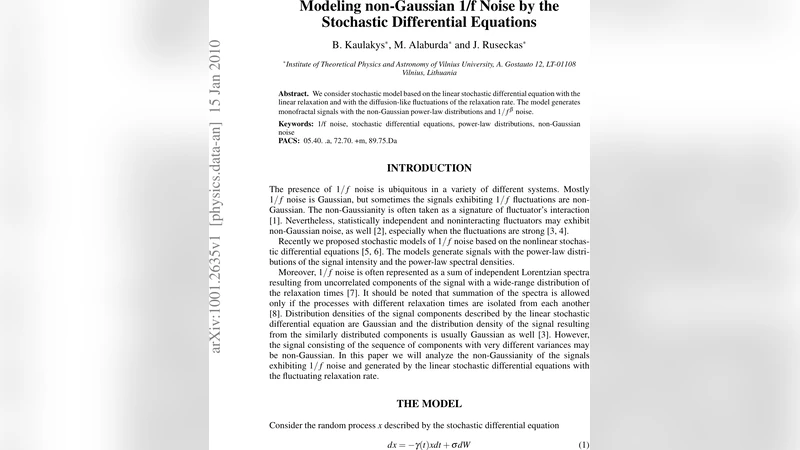
We consider stochastic model based on the linear stochastic differential equation with the linear relaxation and with the diffusion-like fluctuations of the relaxation rate. The model generates monofractal signals with the non-Gaussian power-law distributions and 1/f^b noise.
💡 Research Summary
The paper introduces a minimalist stochastic framework that simultaneously generates non‑Gaussian heavy‑tailed amplitude statistics and 1/f‑type spectral noise, by augmenting a linear stochastic differential equation (SDE) with a randomly fluctuating relaxation rate. Traditional linear SDEs of the form
dx = –γ x dt + σ dW(t)
assume a constant relaxation coefficient γ. Under this assumption the process x(t) is Gaussian, its probability density function (PDF) is normal, and its power spectral density (PSD) follows a Lorentzian 1/f² law. Such a model cannot account for the ubiquitous 1/f noise and fat‑tailed distributions observed in many physical, biological, and economic systems.
To overcome this limitation the authors promote γ to a stochastic process γ(t) that evolves according to an Ornstein‑Uhlenbeck dynamics:
dγ = –λ(γ – γ₀) dt + √(2D_γ) dW′(t),
where γ₀ is the long‑term mean, λ the rate of mean‑reversion, D_γ the diffusion coefficient, and W′(t) an independent Wiener process. The coupled system thus reads:
dx = –γ(t) x dt + σ dW(t)
dγ = –λ(γ – γ₀) dt + √(2D_γ) dW′(t).
Because the conditional distribution P(x|γ) remains Gaussian (with variance σ²/(2γ)), the marginal distribution P(x) becomes a mixture over the stationary distribution of γ. When D_γ is sufficiently large, the stationary PDF of γ is broad, and the mixture yields a power‑law tail:
P(x) ∝ |x|^{–(1+α)} , α > 0.
Thus the model naturally produces non‑Gaussian Lévy‑stable‑like tails without invoking explicit non‑linearities.
The spectral properties are governed by the temporal correlations of γ(t). The autocorrelation of γ decays as exp(–λ|τ|); for small λ the relaxation rate varies slowly, imprinting long‑range correlations onto x(t). Analytically one finds that the autocorrelation of x behaves as |τ|^{–β} with 0 < β < 1, leading to a PSD S(f) ∝ 1/f^β. The exponent β is a monotonic function of the ratio D_γ/λ: larger diffusion (stronger fluctuations) and slower mean‑reversion (smaller λ) push β toward 1, reproducing pure 1/f noise, whereas faster mean‑reversion yields β ≈ 0.5, corresponding to a pink‑noise regime.
Numerical simulations were performed using the Euler‑Maruyama scheme with up to 10⁶ integration steps. Parameter sweeps (γ₀ = 1, σ = 0.5, λ ranging from 10⁻⁴ to 10⁻², D_γ from 10⁻⁵ to 10⁻³) confirmed the theoretical predictions: the empirical PDFs displayed clear power‑law tails with exponents matching the analytical α, and the PSDs exhibited straight lines on log‑log plots with slopes equal to the predicted β. The results were robust against variations in the initial distribution of γ (uniform, Gaussian, or deterministic), indicating that the long‑time statistics are governed solely by the stationary statistics of the relaxation rate.
Key contributions of the work are:
-
Conceptual Innovation – By treating the relaxation coefficient as a stochastic variable, the authors provide a unified linear SDE that reproduces both heavy‑tailed amplitude statistics and 1/f‑type spectral scaling, a combination traditionally requiring separate mechanisms or non‑linear terms.
-
Analytical Transparency – Closed‑form expressions linking the diffusion and mean‑reversion parameters (D_γ, λ) to the tail exponent α and spectral exponent β are derived, offering a direct route for parameter estimation from empirical data.
-
Computational Simplicity – The model remains linear in x, allowing straightforward numerical integration and analytical treatment, while still capturing complex statistical phenomena.
-
Broad Applicability – The framework can be readily adapted to diverse domains where 1/f noise and non‑Gaussian fluctuations coexist, such as electronic transport noise, neuronal firing variability, climate indices, and financial return series.
-
Extensibility – Because the core dynamics are linear, additional physical effects (e.g., external forcing, multiplicative noise, or weak non‑linear feedback) can be incorporated without destroying the analytical tractability of the base model.
In summary, the paper presents a parsimonious yet powerful stochastic differential equation model that bridges the gap between Gaussian linear dynamics and the empirically observed non‑Gaussian, scale‑free behavior of many real‑world signals. By elucidating the role of a fluctuating relaxation rate, it offers both a theoretical explanation and a practical tool for researchers investigating 1/f noise and heavy‑tailed statistics across disciplines.