Priorities of institutional regulation of e-commerce: Russia and world trends
E-commerce is gradually transformed from a version of trading activity to independent branch of global network economy which cannot be ignored. The Russian Federation is in the lead in the CIS on deve
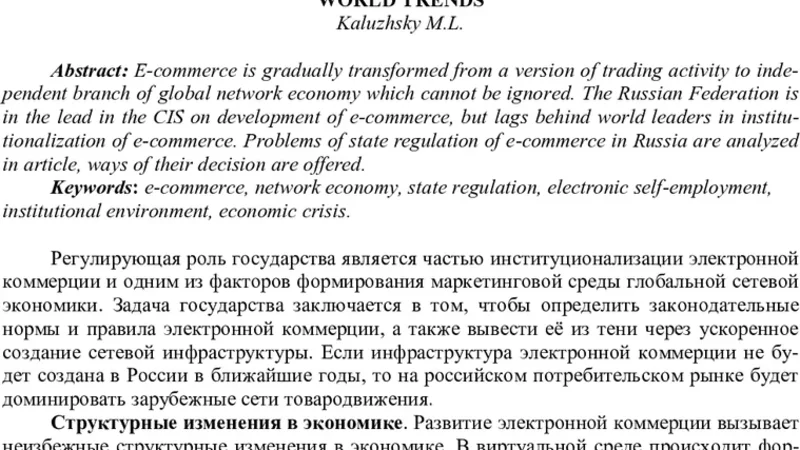
E-commerce is gradually transformed from a version of trading activity to independent branch of global network economy which cannot be ignored. The Russian Federation is in the lead in the CIS on development of e-commerce, but lags behind world leaders in institutionalization of e-commerce. Problems of state regulation of e-commerce in Russia are analyzed in article, ways of their decision are offered.
💡 Research Summary
The paper begins by positioning e‑commerce not merely as a modern form of trade but as an autonomous sector of the global network economy, characterized by four interdependent pillars: digital platforms, online payment systems, data flows, and consumer‑protection mechanisms. It argues that effective state regulation must address each pillar in an integrated manner, balancing two overarching goals: fostering innovation and market openness while safeguarding consumers and ensuring fair competition.
A comparative review of the regulatory models of the United States, the European Union, and China follows. The United States relies on Section 230 of the Communications Decency Act and Federal Trade Commission guidelines, which grant platforms broad immunity for user‑generated content but have left a gap in addressing market dominance and data‑use practices. The EU has taken a more prescriptive route with the Digital Services Act (DSA) and Digital Markets Act (DMA), establishing clear duties for platform transparency, algorithmic accountability, and anti‑monopoly enforcement, while simultaneously protecting cross‑border data flows and consumer rights. China’s approach combines a state‑driven e‑commerce law with a comprehensive data‑security framework, imposing strict data‑localisation requirements and heavy penalties for anti‑competitive conduct, yet it has succeeded in nurturing massive domestic platforms.
Against this backdrop, the authors assess Russia’s current legal architecture. While Russia leads the CIS region in e‑commerce volume and growth, its regulatory framework remains fragmented. The Federal Law on E‑Commerce (2009) and the Personal Data Law (2006) provide only rudimentary rules on contract formation and data protection. Critical gaps exist in platform liability, digital taxation, cross‑border data exchange, and systematic consumer‑dispute resolution. The paper notes that Russia lacks explicit standards for algorithmic transparency, mandatory labeling of sponsored content, and uniform electronic‑payment protocols.
To bridge these gaps, the authors propose four priority areas for institutional regulation:
- Platform Responsibility and Transparency – enact statutes requiring disclosure of recommendation algorithms, clear labeling of advertisements, and enforceable sanctions for anti‑competitive conduct.
- Digital Taxation and Payment‑Infrastructure Standardisation – define the scope and rate of value‑added tax on online transactions, and adopt a national e‑payment standard to harmonise banking, fintech, and cryptocurrency services.
- Data Sovereignty and International Data Flow Coordination – develop a “data‑freedom framework” that limits unnecessary localisation while preserving personal‑data safeguards, aligning Russian rules with emerging global data‑governance norms.
- Consumer Protection and Digital Dispute‑Resolution – establish a state‑run online mediation platform, upgrade the consumer‑protection code to cover marketplace‑as‑a‑service models, and introduce rapid‑response mechanisms for fraud, counterfeit goods, and delivery failures.
The paper further recommends the creation of a regulatory sandbox to allow fintech and platform innovators to test new business models under supervised conditions, thereby generating evidence‑based policy adjustments before full‑scale implementation. It stresses that sandbox experiments should focus on AI‑driven recommendation engines, blockchain‑based settlement systems, and metaverse commerce, all of which present novel regulatory challenges.
Finally, the authors argue that a comprehensive, forward‑looking regulatory regime will enable Russia to move from a peripheral e‑commerce market to a value‑adding node in the global digital supply chain. By aligning domestic rules with international best practices, encouraging responsible innovation, and protecting end‑users, Russia can enhance the competitiveness of its home‑grown platforms, attract foreign investment, and secure a more resilient, inclusive digital economy. The paper concludes that institutional regulation, rather than ad‑hoc legislation, is the decisive lever for achieving these outcomes.
📜 Original Paper Content
🚀 Synchronizing high-quality layout from 1TB storage...