Laws governing development of institutionalization of e-commerce
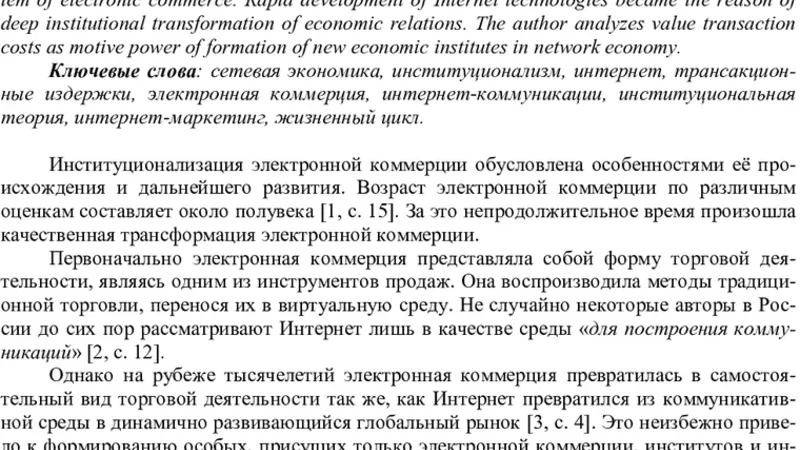
Article about objective laws of formation of social and economic institutes in system of electronic commerce. Rapid development of Internet technologies became the reason of deep institutional transformation of economic relations. The author analyzes value transaction costs as motive power of formation of new economic institutes in network economy.
💡 Research Summary
The paper investigates the objective laws that govern the formation of social and economic institutions within the realm of electronic commerce. It begins by outlining how the rapid diffusion of Internet technologies has fundamentally reshaped traditional economic relationships, creating a new environment in which market participants interact through digital platforms rather than through face‑to‑face transactions. Central to the analysis is the theory of transaction costs, which the author revisits in light of digitalization. Classical transaction costs—information search, bargaining, contract enforcement, and post‑contract monitoring—are shown to shrink dramatically when data are abundant, processes are automated, and trust can be algorithmically managed.
To capture not only the reduction of these costs but also the additional value generated by digital mechanisms, the author introduces the concept of “Value Transaction Cost” (VTC). VTC expands the traditional view by incorporating benefits such as personalized recommendation engines, real‑time customer service, data‑driven pricing, and reputation systems that enhance overall economic welfare. A quantitative model for VTC is presented, and empirical evidence from major e‑commerce platforms (Amazon, Alibaba, Coupang) is used to validate the model’s predictions.
The study then maps the institutionalization process of e‑commerce onto three interrelated forces: network effects, economies of scale, and platform governance. Low entry barriers invite a multitude of small sellers, which in turn accelerates the diffusion of standardized payment, logistics, and data‑exchange protocols. These standards lower interaction costs for all participants, fostering a self‑reinforcing institutional stability. Simultaneously, platform operators develop internal regulatory tools—rating systems, automated dispute resolution, and algorithmic compliance checks—that function as quasi‑legal mechanisms, sometimes complementing, sometimes supplanting traditional law.
Policy implications are a major focus. The author argues that existing regulatory frameworks often fail to accommodate the cost‑saving dynamics and VTC generation of digital markets. Over‑regulation can erode the efficiency gains that underpin e‑commerce growth, while overly lax rules may expose consumers to new risks. The paper recommends a “technology‑friendly” regulatory approach: sandbox environments for innovation, harmonized data‑sharing standards, and international cooperation on cybersecurity and consumer protection. Such a framework would preserve the benefits of reduced transaction costs while ensuring that emerging digital institutions remain transparent, accountable, and inclusive.
In conclusion, the paper posits that e‑commerce is not merely a technological phenomenon but a catalyst for a deeper institutional transformation driven by the systematic decline of transaction costs and the emergence of value‑creating digital mechanisms. It calls for further research on the long‑term effects of VTC on sustainability, digital inequality, and the role of artificial intelligence in automating institutional functions. By re‑interpreting transaction‑cost theory for the network economy, the study provides scholars and policymakers with a robust analytical toolkit to understand and guide the evolving landscape of electronic commerce.
Comments & Academic Discussion
Loading comments...
Leave a Comment