Optimal Exploration of Terrains with Obstacles
A mobile robot represented by a point moving in the plane has to explore an unknown terrain with obstacles. Both the terrain and the obstacles are modeled as arbitrary polygons. We consider two scenar
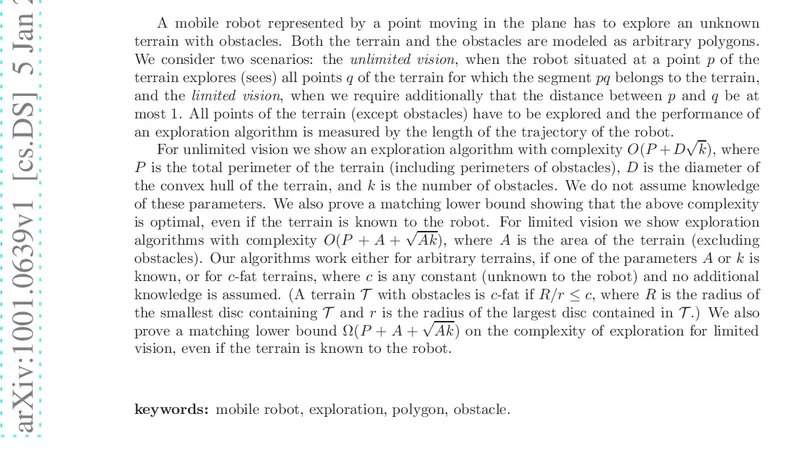
A mobile robot represented by a point moving in the plane has to explore an unknown terrain with obstacles. Both the terrain and the obstacles are modeled as arbitrary polygons. We consider two scenarios: the unlimited vision, when the robot situated at a point p of the terrain explores (sees) all points q of the terrain for which the segment pq belongs to the terrain, and the limited vision, when we require additionally that the distance between p and q be at most 1. All points of the terrain (except obstacles) have to be explored and the performance of an exploration algorithm is measured by the length of the trajectory of the robot. For unlimited vision we show an exploration algorithm with complexity O(P + D?k), where P is the total perimeter of the terrain (including perimeters of obstacles), D is the diameter of the convex hull of the terrain, and k is the number of obstacles. We do not assume knowledge of these parameters. We also prove a matching lower bound showing that the above complexity is optimal, even if the terrain is known to the robot. For limited vision we show exploration algorithms with complexity O(P + A + ?Ak), where A is the area of the terrain (excluding obstacles). Our algorithms work either for arbitrary terrains, if one of the parameters A or k is known, or for c-fat terrains, where c is any constant (unknown to the robot) and no additional knowledge is assumed. (A terrain T with obstacles is c-fat if R/r ? c, where R is the radius of the smallest disc containing T and r is the radius of the largest disc contained in T .) We also prove a matching lower bound ?(P + A + ?Ak) on the complexity of exploration for limited vision, even if the terrain is known to the robot.
💡 Research Summary
The paper studies the problem of exploring an unknown planar terrain that may contain polygonal obstacles, using a point‑robot that moves continuously in the plane. Exploration is defined as the robot having “seen” every point of the terrain that is not part of an obstacle. The performance metric is the total length of the robot’s trajectory. Two visibility models are considered. In the unlimited‑vision model the robot at a location p instantly sees any point q for which the straight segment pq lies entirely inside the terrain. In the limited‑vision model an additional distance constraint ‖p−q‖≤1 is imposed, i.e., the robot can only see points within a unit radius.
Unlimited Vision
The authors denote by P the total perimeter of the terrain (including the perimeters of all obstacles), by D the diameter of the convex hull of the terrain, and by k the number of obstacles. They design an exploration algorithm that does not require prior knowledge of P, D, or k, yet guarantees a trajectory length of O(P + D·√k). The algorithm proceeds as follows. While moving, the robot continuously builds a visibility graph whose vertices are the terrain vertices discovered so far and whose edges correspond to line‑of‑sight connections that lie completely inside the terrain. From this graph it incrementally constructs a minimum spanning tree (MST). The robot then follows a preorder walk of the MST, thereby visiting every vertex of the tree and consequently every region of the terrain. The length of the MST can be bounded by the sum of the total perimeter P and an additional term D·√k that accounts for the need to connect the k obstacles; each obstacle contributes on average √k edges of length at most D. Consequently the robot’s travel distance never exceeds a constant factor times (P + D·√k).
A matching lower bound is proved even when the terrain is known in advance. By arranging the obstacles in a “spiral” configuration that forces the robot to approach each obstacle from many directions, any deterministic exploration must incur at least Ω(P + D·√k) travel. Hence the algorithm is asymptotically optimal for unlimited vision.
Limited Vision
When the robot’s sight is limited to a unit radius, the problem becomes substantially harder because the robot cannot see far enough to directly connect distant parts of the terrain. The authors introduce a grid‑based decomposition. The terrain is overlaid with a square grid of side length ε<1. Each cell is classified as free (entirely inside the terrain) or blocked (intersecting an obstacle). The robot performs a depth‑first traversal of the free cells, moving from one cell to an adjacent one while staying within the unit visibility range. The number of cells is proportional to the area A of the terrain (excluding obstacles) divided by ε², and the total distance needed to visit all cells is O(A/ε). By choosing ε appropriately (e.g., ε≈1/√k or ε≈√(A/k) depending on which parameter is known), the authors obtain a total travel bound of O(P + A + √(A·k)). The term P accounts for the necessity of walking around the outer boundary, A is the basic cost of covering the interior area, and √(A·k) captures the extra detours required to approach the k obstacles.
The algorithm works without any prior knowledge of A or k if the terrain satisfies a “c‑fat” condition: the ratio between the radius R of the smallest enclosing disc and the radius r of the largest inscribed disc is bounded by a constant c. For c‑fat terrains the grid size can be chosen adaptively based only on local visibility, and the same O(P + A + √(A·k)) bound holds even when neither A nor k is known.
A lower bound of Ω(P + A + √(A·k)) is also established for limited vision. The construction places k small obstacles uniformly inside a large area A, forcing any exploration strategy to travel a distance proportional to the square root of the product A·k in order to reach each obstacle’s vicinity. This matches the upper bound, proving optimality.
Contributions and Implications
The paper delivers a complete theoretical characterization of the exploration cost for both unlimited and limited vision models. The key contributions are:
- An optimal O(P + D·√k) algorithm for unlimited vision that requires no a‑priori knowledge of terrain parameters.
- An optimal O(P + A + √(A·k)) algorithm for limited vision, applicable to arbitrary terrains when either A or k is known, and to all c‑fat terrains without any parameter knowledge.
- Matching lower‑bound constructions that demonstrate the impossibility of improving these asymptotic bounds, even when the terrain is fully known to the robot.
These results have practical relevance for autonomous mobile robots, unmanned ground vehicles, and inspection drones that must guarantee complete coverage of environments with unknown obstacles. The techniques—incremental visibility graph construction, MST‑based traversal, and adaptive grid covering—are robust to sensor noise and can be extended to three‑dimensional settings, dynamic obstacles, or multi‑robot cooperative exploration. The paper thus bridges a gap between geometric theory and real‑world robotic exploration, providing a solid foundation for future algorithmic developments in coverage and mapping tasks.
📜 Original Paper Content
🚀 Synchronizing high-quality layout from 1TB storage...