On the Lagrangian structure of integrable quad-equations
The new idea of flip invariance of action functionals in multidimensional lattices was recently highlighted as a key feature of discrete integrable systems. Flip invariance was proved for several particular cases of integrable quad-equations by Bazha…
Authors: Alex, er I. Bobenko, Yuri B. Suris (TU Berlin)
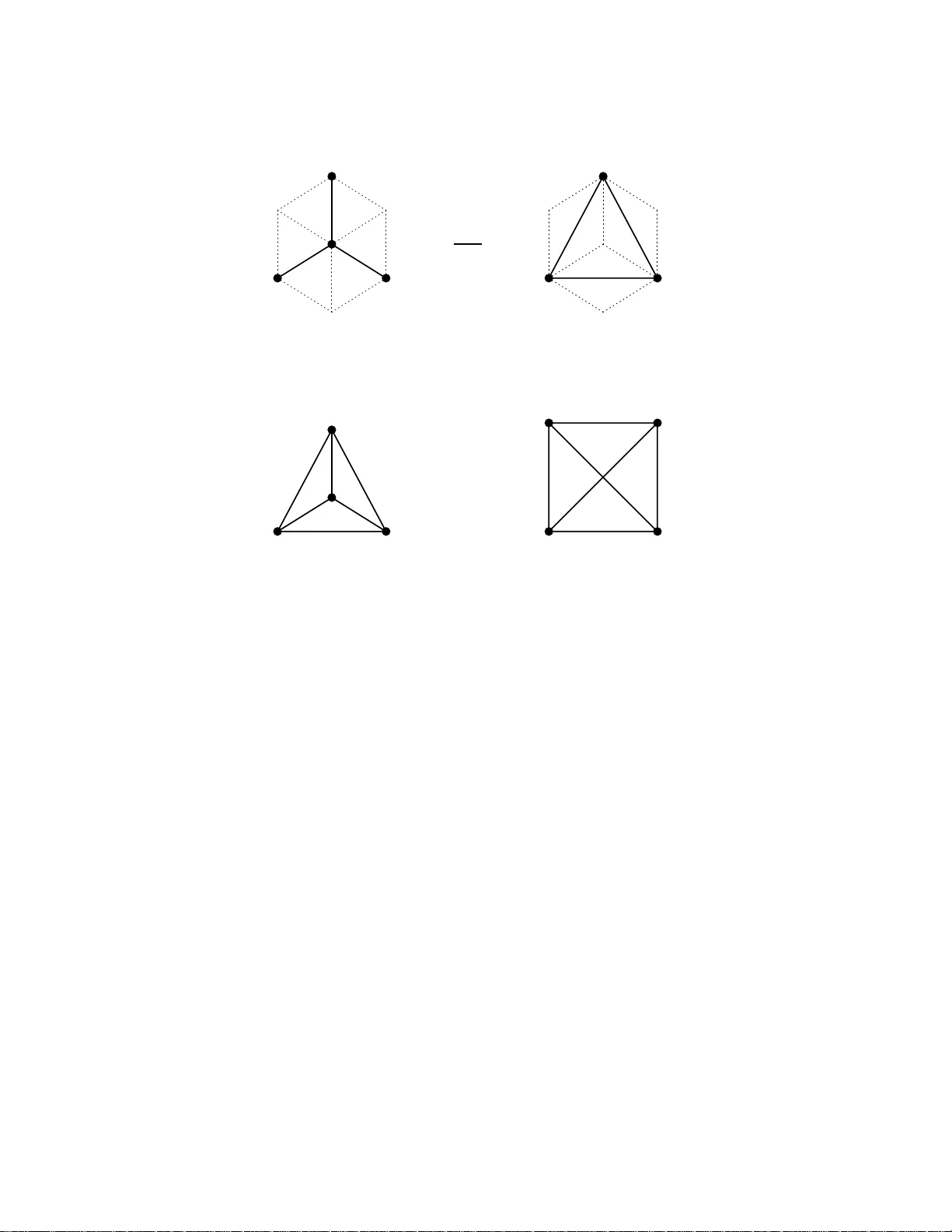
On the Lagrangi an structure of in tegrable quad-equati ons Alexander I. Bob enk o ∗ and Y uri B. Suris † Octob er 31, 2018 Abstract The new idea of flip inv a riance of action functionals in multidimensional lattices was recently highlighted as a key feature o f discrete in tegrable sy stems. Flip inv arianc e was prov ed for several particular c a ses of integrable q ua d-equations by Ba z hanov, Mangazeev and Serge ev and b y L o bb and Nijhoff. W e provide a simple and case- independent pro of for all in tegrable quad-equations. Moreover, w e find a new relatio n for Lag rangia ns within one elementary quadrilateral which seems to be a fundamental building blo ck of the v ario us v ersio ns of flip inv ariance. 1 In tro duction This pap er deals with some asp ects of the v ariational (Lagrangian) stru cture of integrable systems on qu ad-graphs (planar graph s with quadr ilateral faces), w hic h serve as discretiza- tions of integ rable PDEs with a t w o-dimensional space-time [8, 1]. W e identify integrabilit y of suc h systems with their m ultidimensional consistency [8, 15]. This prop ert y w as used in [1] to classify integ rable systems on quad-graphs. That pap er also introd uced a Lagrangian form ulation for them. The v ariational structure of discrete in tegrable systems is a topic whic h receiv es increasing atten tion in the r ecent y ears [13, 16], after the pioneering work [14]. Lobb and Nijhoff [11] in tro du ced the new idea to extend the action fun ctional of [1] to a multidimensional lattice. Th e ke y prop erty th at mak es this meaningful is the inv ariance of the action un der elemen tary 3D flips of 2D quad-surfaces in Z m . This prop er ty w as established in [11] for sev eral particular cases of int egrable equations. The p ro of in volv es computations based in particular on prop erties of th e d ilogarithm function. In the present pap er, we prov e the flip inv ariance for all in tegrable quad-equations classified in [1]; our pro of is case-indep endent . Note that thr ee-dimensional discrete in tegrable systems also p ossess Lagrangian form ulations [6, 12], and the fl ip in v ariance of action for the discrete KP equation was established in [12 ]. A closely related v ersion of fl ip inv ariance of action f or discrete systems of Laplace t yp e was discussed earlier for one concrete example b y Bazhano v, Mangazeev and Sergeev ∗ Institut f¨ ur Mathematik, MA 8-3, TU Berlin, Str. des 17. Juni 136, 10623 Berlin, Germany; e-mail: bobenko@ma th.tu-berlin. de ; partially supp orted by the DFG Research Unit “P olyh edral Surfaces”. † Institut f¨ ur Mathematik, MA 7-2, TU Berlin, Str. des 17. Juni 136, 10623 Berlin, Germany; e-mail: suris@math .tu-berlin.de . 1 [5]. The action functional in this pap er describ es circle patterns and w as introd u ced in [7]. In [5], this action w as der ived as a quasi-classical limit of the p artition function of an integrable quan tum mo del inv estigated in [10] (the Lagrangians b eing the quasi- classical limit of the Boltz mann w eigh ts). Inv ariance of th e partition fun ction under star- triangle transformations is a hallmark of in tegrabilit y in the quan tum con text, it is usually established with the help of the qu an tum Y ang-Baxter relation [4 ]. It is surp rising that only now a correct classical coun terpart comes to the light. Here, w e extend the quasi- classical result of [5] to the whole class of in tegrable quad-equations. Finding the quan tum v ersion of our con tribu tion remains an op en problem. The stru cture of the pap er is as follo w s. In S ection 2, w e recall the d efinition and the classification of integ rable sy s tems on quad-graphs, the so-calle d ABS list [1] (see also the recen t m onograph [9]). In S ection 3, we recall our main tec hnical device whic h pla ys a prominent role in the sub ject of the present pap er, n amely th e th ree-leg form of a quad-equation. F urther, w e recall a v ariational (Lagrangian) inte rpretation of integrable quad-equations, aga in follo w ing [1]. In Section 5, w e pro v e a no ve l relation for Lagrangians within one elemen tary quadrilateral w h ic h seems to b e a f undamental b uilding block of the v arious v ersions of the flip in v ariance. Finally , S ection 6 con tains generalizatio ns of the flip inv ariance results from [11] and [5] with a n ew case-indep end ent pro of. The flip in v ariance of the action functional in m ultidimensional lattices is a fascinating new idea wh ic h will d efi nitely h a v e a serious impact on the theory of discrete in tegrable systems. 2 In tegrable systems on quad-graphs W e consider sys tems on quad -graph s, i.e., collectio ns of equations on elementa ry quadri- laterals of the t yp e Q ( x, u, y , v ; α, β ) = 0 , (1) where x, u, y , v ∈ CP 1 are the complex v ariables (“fields”) assigned to the four ve rtices of the qu adrilateral, and the p arameters α, β ∈ C are assigned to its edges, as sh o wn on Fig. 1. It is required that opp osite edges of any quadrilateral carry the same parameter. x u y v α α β β Q Figure 1: An elementa ry q u adrilat- eral x u y v ψ ψ φ α α β β Figure 2: Three-leg form of a quad-equation. The fun ction Q is assumed to b e multi-affine, i.e., a p olynomial of degree one in eac h fi eld v ariable. Moreo v er, it is s upp osed to p ossess the follo wing prop ert y: 2 • Symmetry : The equation Q = 0 is inv ariant under the d ihedral group D 4 of the square symmetries: Q ( x, u, y , v ; α, β ) = ε 1 Q ( x, v , y , u ; β , α ) = ε 2 Q ( u, x, v , y ; α, β ) , with ε 1 , ε 2 = ± 1. As in [8, 15], w e consider int egrabilit y as syn on ymous with 3D consistency . Recall that equation (1) is called 3D- c onsistent if it may b e consisten tly imp osed on a three- dimensional lattice, so that one and the same equation hold for all six faces of an y elemen- tary cub e (up to the parameter v alues: it is sup p osed that all edges of eac h co ordin ate direction carry their o wn parameter). More precisely , initial data x, x 1 , x 2 , x 3 determine uniquely the v alues x 12 , x 13 , x 23 b y means of the equations on the faces adjacen t to the v ertex x . After that, one has three differen t equations for x 123 , coming from the three faces of the cub e adjacen t to this v ertex, see Fig. 3 . No w 3D consistency means that these three ( a priori different ) v alues for x 123 coincide for an y c hoice of the initial data x, x 1 , x 2 , x 3 . x x 3 x 1 x 13 x 12 x 123 x 2 x 23 α 1 α 1 α 1 α 1 α 2 α 2 α 2 α 2 α 3 α 3 α 3 α 3 Figure 3: Three-dimensional consistency In tegrable equations on qu ad-graphs with multi-affine and D 4 -symmetric functions Q w ere classified in [1] und er the follo wing additional assump tion. • T etr ahe dr on pr op erty : T he v alue x 123 , w h ic h is well defined due to 3D consistency , dep end s on x 1 , x 2 , and x 3 , bu t not on x . The classification of equations (1) up to M¨ obius transformation results in a list (the so- called ABS list) of 9 canonical equations, named Q1–Q4, H1–H3 , and A1-A2. The a priori assum ption of the tetrahedron pr op erty w as replaced with certain n on -d egeneracy conditions in [2]. This lea ds to the list Q1–Q4. An imp ortan t device used for the classification are the biquadratic p olynomials h and g asso ciated with the edges and d iagonals of the ele menta ry qu adrilateral, r esp ectiv ely . They are obtained from Q by discrimin ant-lik e op erations eliminating tw o of the four v ariables. F or instance, QQ y v − Q y Q v = k ( α, β ) h ( x, u ; α ) , QQ y u − Q y Q u = k ( α, β ) h ( x, v ; β ) , QQ uv − Q u Q v = k ( α, β ) g ( x, y ; α − β ) . 3 Here, the sub s cripts denote partial d eriv ativ es, and k ( α, β ) = − k ( β , α ) is a normalizing factor that mak es eac h edge p olynomial h dep end only on the p arameter assigned to the corresp ondin g ed ge. Th e p olynomials g associated with the diagonals dep end only on the difference α − β for a suitable choice of p arameters, wh ic h are naturally defin ed up to sim ultaneous r e-parametrizatio n α 7→ ρ ( α ), β 7→ ρ ( β ). The follo wing lemma will b e ins trumenta l in the pro of of our m ain resu lt. Lemma 1. F or any qu ad-e quation fr om the ABS list, the fol lowing identity i s satisfie d for solutions of Q = 0 : h ( x, u ; α ) h ( y, v ; α ) = h ( x, v ; β ) h ( y , u ; β ) = g ( x, y ; α − β ) g ( u, v ; α − β ) . (2) W e r efer the reader to [1] f or furth er details and a pro of of L emm a 1. 3 Three-leg forms Equation (1) is said to p ossess a thr e e - le g form centered at x if it is equiv alen t to the equation ψ ( x, u ; α ) − ψ ( x, v ; β ) = φ ( x, y ; α − β ) , (3) for some f u nctions ψ and φ , see Fig. 2. It follo ws that the fu nction φ must b e o dd with resp ect to the parameter: φ ( x, y ; − γ ) = − φ ( x, y ; γ ). It tu rns out [1] th at all equatio ns from the ABS list p ossess three-leg forms. Moreo ve r, an examination of the list of three- leg forms leads to the follo win g • O bservation : F or equatio ns Q1–Q4, th e fun ctions corresp onding to the “short” and to the “long” legs coincide: ψ ( x, u ; α ) = φ ( x, u ; α ). Eac h equation H1–H3 an d A1– A2 shares the “long” leg fu nction φ ( x, y ; α − β ) with s ome of the equations Q1–Q3, but has a differen t “short” legs function ψ ( x, u ; α ). There are m an y applications of th e three-leg form. First, let B b e th e “blac k” subgraph of th e bipartite quad-graph D on wh ic h the system of integ rable quad-equations is considered. The edges of B are the d iagonals of the quadrilateral faces of D connecting the “blac k” pairs of v ertices. Let the p airs of lab els b e assigned to the edges of B acco rdin g to Fig. 2 , so that ( α, β ) is assigned to the edge ( x, y ). Then the r estriction of an y solution of the system of quad-equations to the set of “blac k” v ertices satisfies the so called Laplace t yp e equations. F or x ∈ V ( B ) su c h an equation reads: X ( x,y k ) ∈ E ( B ) φ ( x, y k ; α k − α k +1 ) = 0 . (4) Here, the sum is tak en o ver all edges ( x, y k ) of B incident with x in countercloc kwise order, and ( α k , α k +1 ) are the corresp onding pairs of parameters. Equation (4) is deriv ed b y addin g th e three-leg forms of the q u ad-equations for all quadrilaterals of D adj acen t to x , where the contributions f rom the “short” legs cancel out. Of course, similar Laplace t yp e equations hold also for the “white” subgraph of D . 4 Another application of the thr ee-leg form is th e deriv ation of the tet rahedron pr op erty . Adding the tree-leg equations centered at x 123 on the three faces of th e 3D cub e adjacen t to x 123 leads to the equation φ ( x 123 , x 1 ; α 2 − α 3 ) + φ ( x 123 , x 2 ; α 3 − α 1 ) + φ ( x 123 , x 3 ; α 1 − α 2 ) = 0 , (5) whic h relate s the fields at the v ertices of the “white” tetrahedron in Fig. 3. According to the ab o v e observ ation, this equatio n is actually equiv alent to b Q ( x 123 , x 1 , x 2 , x 3 ; α 2 − α 3 , α 2 − α 1 ) = 0 , (6) where th e function b Q ( x, u, y , v ; α, β ) is m ulti-affine, and, moreo ver, alw ays b elongs to the list Q1–Q4 (it plainly coincides with Q for an y of the equations Q1–Q4). Not only do es the existence of the th ree-leg form yield the tetrahedron prop ert y of the 3D consistent equations. Th e conv erse is also true: it h as b een pr o v ed in [3 ] that D 4 symmetry and th e existence of a th ree-leg form imp ly 3D consistency . 4 Lagrangian struc tures W e u se the follo wing tec h nical statemen t to establish the L agrangian structure of 3D consisten t equ ations [1]. Lemma 2. F or any quad-e quation fr om the A BS list, ther e exists a change of variables, x = f ( X ) , u = f ( U ) , etc., such that in the new variables the le g functions ψ and φ p ossess antiderivatives with r esp e ct to the first ar gument X that ar e symmetric with r esp e ct to the p ermutation X ↔ U and X ↔ Y , r esp e ctively. In other wor ds, ther e exist functions L ( X, U ; α ) = L ( U, X ; α ) and Λ( X , Y ; α − β ) = Λ( Y , X ; α − β ) such that ψ ( x, u ; α ) = ψ ( f ( X ) , f ( U ); α ) = ∂ ∂ X L ( X, U ; α ) , (7) φ ( x, y ; α − β ) = φ ( f ( X ) , f ( Y ); α − β ) = ∂ ∂ X Λ( X, Y ; α − β ) . (8) This follo ws from the easily verified fact that the deriv ativ es of the leg fu nctions with resp ect to their second argument, ∂ ψ /∂ U and ∂ φ/∂ Y , are sym metric with resp ect to X ↔ U and X ↔ Y , resp ectiv ely . L emm a 2 has the follo wing coroll aries [1]. Prop osition 1. F or any qu ad-e quation fr om the ABS list on a bip artite quad-gr aph D , the c orr esp onding L aplac e typ e e quations (4) on the “black” sub g r aph B ar e the Euler-L agr ange e quations for the action functional S B = X ( x,y ) ∈ E ( B ) Λ( X, Y ; α − β ) , (9) wher e the p airs of p ar ameters ( α, β ) ar e assigne d to the “ black” e dges ( x, y ) as in Fig. 2. 5 Prop osition 2. F or any quad-e quation fr om the ABS list on the r e gu lar squar e lattic e Z 2 , the solutions ar e critic al p oints of the functional S = X ( x,x 1 ) ∈ E 1 L ( X, X 1 ; α 1 ) − X ( x,x 2 ) ∈ E 2 L ( X, X 2 ; α 2 ) − X ( x 1 ,x 2 ) ∈ E 3 Λ( X 1 , X 2 ; α 1 − α 2 ) , (10) wher e E 1 and E 2 denote the set of hor izontal and vertic al e dges of the squar e lattic e Z 2 , and E 3 denotes the set of diagonals of al l elementary quadrilater als fr om north-west to south-e ast. The pro of of Prop osition 1 is ob vious, the pro of of Prop osition 2 is based on the fact that ∂ S/∂ X is the sum of the three-leg equations on tw o squares adjacent to x (to th e north-w est and to the south-east of x ). 5 F undamen tal prop ert y of Lagrangians on a single quad Theorem 1. F or any e quation fr om the ABS list, c onsider e d on a single quadrilater al, the L agr angians L , Λ c an b e chosen so that the fol lowing r elation ho lds if e quation (1) is satisfie d: L ( X, U ; α ) + L ( Y , V ; α ) − L ( X, V ; β ) − L ( Y , U ; β ) − Λ( X, Y ; α − β ) − Λ( U, V ; α − β ) = 0 . (11) Pro of. Since th e symmetric anti deriv ative s L and Λ are determined only up to constan t terms (dep ending on the corresp onding parameters), the th eorem is actually equiv alen t of to the statement that for any c hoice of L , Λ there holds (for solutions of Q = 0): Θ = ρ ( α ) − ρ ( β ) − σ ( α − β ) , (12) where Θ stand s for the left-hand side of (11), and ρ , σ are some functions dep end ing only on the p arameters, as indicated by the notation. T o show that the fu nction Θ = Θ ( X, U, Y , V ) is constan t on th e three-dimensional manifold in ( CP 1 ) 4 consisting of solutions of Q ( x, u, y , v ; α, β ) = 0, it is en ough to prov e that the d irectional deriv ativ es of Θ along all tangent ve ctors of th is manifold v anish . W e pro v e a stronger claim, namely that the gradien t of Θ v anishes on this manifold. This claim is an immediate consequence of the existence of the thr ee-leg equations cen tered at eac h v ertex of th e elemen tary quad. Ind eed, b y virtue of (7), (8), and (3 ), one has: ∂ Θ ∂ X = ψ ( x, u ; α ) − ψ ( x, v ; β ) − φ ( x, y ; α − β ) = 0 . (13) Similarly , one sho ws that ∂ Θ /∂ Y = ∂ Θ /∂ U = ∂ Θ /∂ V = 0 f or solutions. It r emains to sho w that the constan t v alue of Θ is of the form (12). T he pro of of this fact is based on iden tit y (2) and the follo wing lemma. 6 Lemma 3. F or any e quation fr om the ABS list, we have: ∂ L ( X, U ; α ) ∂ α = log h ( x, u ; α ) + κ ( X ) + κ ( U ) + c ( α ) , (14) ∂ Λ( X, Y ; α − β ) ∂ α = log g ( x, y ; α − β ) + κ ( X ) + κ ( Y ) + γ ( α − β ) , (15) with c ertain functions κ , c , γ dep ending only on the indic ate d variables. Pro of. V erify the relations obtained from (14), (15 ) b y differen tiation with resp ect to X : ∂ ψ ( x, u ; α ) ∂ α = ∂ ∂ X log h ( x, u ; α ) + κ ′ ( X ) , ∂ φ ( x, y ; α − β ) ∂ α = ∂ ∂ X log g ( x, y ; α − β ) + κ ′ ( X ) . This can b e done case by case, by a direct and simp le c hec k; the leg functions ψ , φ and the p olynomials h , g are giv en for all equations of th e ABS list in the Ap p end ix. Then equations (14), (15) follo w, since b oth sid es of eac h are symmetric w ith r esp ect to x ↔ u and x ↔ y , resp ectiv ely , and are defi n ed up to an additive function of α , r esp. of α − β . Lemma 3 and iden tity (2) imply ∂ Θ ∂ α = 2 c ( α ) − 2 γ ( α − β ) , ∂ Θ ∂ β = − 2 c ( β ) + 2 γ ( α − β ) , whic h yields (12). This completes the pro of of Theorem 1. 6 Flip in v ariance of the action functionals The follo wing theorem establishes the flip inv ariance for the discrete Laplace typ e systems (with the Lagrangian structure describ ed in Prop osition 1). Theorem 2. The L agr angian Λ for a discr ete L aplac e typ e system that c omes fr om an e quation of the ABS list c an b e chosen so that the fol lowing star-triangle r elation is satisfie d for solutions: Λ( X, X 12 ; α 1 − α 2 ) + Λ( X , X 23 ; α 2 − α 3 ) + Λ( X, X 13 ; α 3 − α 1 ) + Λ( X 23 , X 13 ; α 1 − α 2 ) + Λ( X 13 , X 12 ; α 2 − α 3 ) + Λ( X 12 , X 23 ; α 3 − α 1 ) = 0 , (16) se e Fig. 4. Pro of. F orm ula (16) inv olv es the four blac k p oin ts x , x 12 , x 23 , x 13 , which are related b y a multi-affine equation b Q ( x, x 12 , x 23 , x 13 ; α 1 − α 2 , α 1 − α 3 ) = 0 , whic h b elongs to the list Q1–Q4, compare with (6). Therefore, the claim is a particular case of Theorem 1. Indeed, co mbinato rially a tetrahedron is not differen t from a quadrilateral with diagonals, s ee Fig. 5. 7 x x 1 x 12 x 2 x 23 x 3 x 13 ✲ x 123 x 1 x 12 x 2 x 23 x 3 x 13 Figure 4: Star-triangle flip. x x 12 x 23 x 13 x u y v Figure 5: A tetrahedron vs. a quadr ilateral w ith diagonals Suc h a statemen t w as previously established in [5] for the discrete Laplace t yp e system whic h describ es the radii of circle patterns w ith prescrib ed in tersection angles and whic h comes from the so called Hirota system, a version of (H3) δ =0 . In that pap er, the action functional is deriv ed as a classical limit of the partition function of the so called quantum F addeeev-V olko v mod el. The corresp ond ing prop erty of the quant um m o del is the famous Y ang-Baxte r relation, the in v ariance of the partition fun ction und er a star-triangle trans- formation of th e Boltzmann w eigh ts. Th e corresp ond ing classical r esu lt is also established in [5], by direct computations in volving the dilogarithm fu nction. The fl ips describ ed b y Theorem 2 can b e considered as elemen tary transf orm ations either of a planar quad-graph, or, alternativ ely , of its realizatio n as a quad -su rface in a m ultidimensional square lattice Z m . The Lagrangian form u lation of quad-equations on Z m is the main sub ject of [11]. The Lagrangian formulation of systems on Z 2 used in [11] is S = X Z 2 L ( X, X 1 , X 2 ; α 1 , α 2 ) , (17) where the 3-point Lagrangian L should b e in terpreted as a discrete 2-form, i.e., a real- v alued f unction d efined on orien ted elementa ry squ ares and c hanging sign u p on c hanging the orientati on of the square. It is easily seen that the su m (17) is n othing but a re- arrangemen t of the sum (10), with L ( X, X 1 , X 2 ; α 1 , α 2 ) = L ( X , X 1 ; α 1 ) − L ( X, X 2 ; α 2 ) − Λ( X 1 , X 2 ; α 1 − α 2 ) . (18) 8 The main idea of th e pap er [11] is to extend the functional (17 ) to qu ad -su rfaces Σ in the m ultidimensional square lattice according to the form ula S = X σ ij ∈ Σ L ( σ ij ) (19) where for eac h elemen tary square σ ij = ( n, n + e i , n + e i + e j , n + e j ) there holds L ( σ ij ) = L ( X, X i , X j ; α i , α j ) = L ( X, X i ; α i ) − L ( X , X j ; α j ) − Λ( X i , X j ; α i − α j ) . (20) Let ∆ i denote the difference op erator that acts on v ertex functions, ∆ i f ( x ) = f ( x i ) − f ( x ), so that, e.g., ∆ i f ( x, x j , x k ) = f ( x i , x ij , x ik ) − f ( x, x j , x k ). Theorem 3. F or any system of quad-e quations fr om the ABS list on Z m , the L agr angian L given by (20) satisfies the fol lowing r elation for solutions: ∆ 1 L ( X, X 2 , X 3 ; α 2 , α 3 ) + ∆ 2 L ( X, X 3 , X 1 ; α 3 , α 1 ) + ∆ 3 L ( X, X 1 , X 2 ; α 1 , α 2 ) = 0 . (21) This means that the v alue of th e actio n functional for a solution remains in v arian t u nder flips of the qu ad-surface. F or some equations of the ABS list, namely for equations A1–A2, H1–H3, Q1, (Q3) δ =0 , Theorem 3 was pro ve d in [11] b y long computations. Pro of of T heorem 3. It is enough to com bine the statemen ts of Theorem 1 f or the three quadrilaterals adjacen t to the vertex x and the statemen t of Theorem 2 for the blac k tetrahedron. The follo w ing alternative p r o of of Theorem 3, not relying on Theorem 1, is based on the same idea as the pro of of Theorem 1 bu t is m uch easier. T he previous analysis of the constan t v alue (12) is replaced b y a simp le and case-indep en d en t argument. Second pro of of Theorem 3. Let ∆ d enote th e expression on the left-hand side of (21), considered as a function of 8 v ariables x, x i , x ij , x 123 . W e are going to sho w that ∆ is constan t on the manifold S ⊂ ( CP 1 ) 8 of solutions of the system of quad-equations on the 3D cub e. This manifold is f our-dimensional and is parametrized, e.g., by ( x, x 1 , x 2 , x 3 ). W e w an t to s ho w that the deriv ativ es of ∆ tangen t to S v anish. It turns out that a stronger prop erty is easier to show, namely , that grad ∆ = 0 on S . By the defin ition of the Lagrangian (20), we h a v e: ∆ = L ( X 1 , X 12 ; α 2 ) + L ( X 2 , X 23 ; α 3 ) + L ( X 3 , X 13 ; α 1 ) − L ( X 1 , X 13 ; α 3 ) − L ( X 2 , X 12 ; α 1 ) − L ( X 3 , X 23 ; α 2 ) − Λ( X 12 , X 13 ; α 2 − α 3 ) − Λ( X 23 , X 12 ; α 3 − α 1 ) − Λ( X 13 , X 23 ; α 1 − α 2 ) +Λ( X 2 , X 3 ; α 2 − α 3 ) + Λ( X 3 , X 1 ; α 3 − α 1 ) + Λ( X 1 , X 2 ; α 1 − α 2 ) . (22) Th us, ∆ do es not dep end on either x or x 123 , so that its d omain of definition is b etter visualized as an o ctahedron as shown in Fig. 6 rather than an element ary cub e, as th e original defi n ition suggests. It remains to sh o w that ∆ do es n ot d ep end on x i and x ij for solutions of the system of quad-equations. T o sho w that ∆ d o es not d ep end on x 1 , sa y , w e compute, with the help of (7) and (8): ∂ ∆ ∂ X 1 = ψ ( x 1 , x 12 ; α 2 ) − ψ ( x 1 , x 13 ; α 3 ) + φ ( x 1 , x 3 ; α 3 − α 1 ) + φ ( x 1 , x 2 ; α 1 − α 2 ) . 9 x x 3 x 1 x 13 x 12 x 123 x 2 x 23 Figure 6: Octahedron But the tree-leg forms of the quad-equations on th e faces ( x, x 1 , x 13 , x 3 ) and ( x, x 1 , x 12 , x 2 ), cen tered at x 1 are ψ ( x 1 , x 13 ; α 3 ) − ψ ( x 1 , x ; α 1 ) − φ ( x 1 , x 3 ; α 3 − α 1 ) = 0 , ψ ( x 1 , x 12 ; α 2 ) − ψ ( x 1 , x ; α 1 ) + φ ( x 1 , x 2 ; α 1 − α 2 ) = 0 . Therefore, for solutions we ha v e ∂ ∆ /∂ X 1 = 0. That the partial d eriv ativ es of ∆ w ith resp ect to all other x i and x ij v anish is sho wn similarly , b ecause all v ariables en ter sym- metrically in ∆. It is easy to u nderstand that th e manif old of solutions S is a connected algebraic manifold. Ind eed, S = ( CP 1 ) 4 \ ˜ S , where ˜ S consists of singular curv es and there- fore h as co dimension tw o. Since grad ∆ = 0 on the connected algebraic m anifold S , the function ∆ is constant on S . It remains to show that the v alue of this constant is 0. W e need only to compute ∆ on a particular solution. Consider a family of solutions defined b y the follo wing conditions: x 1 = x 23 , x 2 = x 13 , x 3 = x 12 . (23) (W e are grateful to K. Zuev f or the suggestio n to consid er this family .) Equ ations on the faces adjacen t to th e v ertex x giv e thr ee differen t expressions for x . Setting them equal means imp osing t wo (rational) conditions on the thr ee initial v alues x 1 , x 2 , x 3 . Thus, there is a one-parameter family of solutions satisfying (23). Th an k s to the symmetry of L and Λ one sees imm ediately from (22) that ∆ = 0 on an y solution from the family (23). Th is finishes the p ro of of Th eorem 3. 7 App endix: ABS list List Q: (Q1) δ =0 : Q = α ( xu + y v ) − β ( xv + y u ) − ( α − β )( xy + uv ) , ψ ( x, u ; α ) = α x − u , 10 h ( x, u ; α ) = 1 2 α ( x − u ) 2 ; (Q1) δ =1 : Q = α ( xu + y v ) − β ( xv + y u ) − ( α − β )( xy + uv ) + αβ ( α − β ) , ψ ( x, u ; α ) = log x − u + α x − u − α , h ( x, u ; α ) = 1 2 α ( x − u ) 2 − α 2 = 1 2 α ( x − u + α )( x − u − α ); (Q2): Q = α ( xu + y v ) − β ( xv + y u ) − ( α − β )( xy + uv ) + αβ ( α − β )( x + u + y + v ) − αβ ( α − β )( α 2 − αβ + β 2 ) , x = X 2 , ψ ( x, u ; α ) = log ( X + U + α )( X − U + α ) ( X + U − α )( X − U − α ) , h ( x, u ; α ) = 1 4 α ( x − u ) 2 − 2 α 2 ( x + u ) + α 4 = 1 4 α ( X + U + α )( X − U + α )( X + U − α )( X − U − α ); (Q3) δ =0 : Q = sin( α )( xu + y v ) − sin( β )( xv + y u ) − sin( α − β )( xy + uv ) , x = exp( iX ), ψ ( x, u ; α ) = log sin X − U + α 2 sin X − U − α 2 , h ( x, u ; α ) = 1 sin( α ) x 2 + u 2 − 2 cos( α ) xu = exp( iX ) exp ( iU ) sin( α ) sin X − U + α 2 sin X − U − α 2 ; (Q3) δ =1 : Q = sin( α )( xu + y v ) − sin( β )( xv + y u ) − sin( α − β )( xy + uv ) + sin( α − β ) sin( α ) sin ( β ) , x = sin( X ), ψ ( x, u ; α ) = log cos X + U + α 2 sin X − U + α 2 cos X + U − α 2 sin X − U − α 2 , h ( x, u ; α ) = 1 2 sin( α ) x 2 + u 2 − 2 cos( α ) xu − sin 2 ( α ) 11 = 2 sin( α ) cos X + U + α 2 cos X + U − α 2 sin X − U + α 2 sin X − U − α 2 ; (Q4): Q = s n( α )( xu + y v ) − sn( β )( xv + y u ) − sn( α − β )( xy + uv ) +sn( α − β )sn( α )sn( β )(1 + k 2 xuy v ) , x = sn( X ), ψ ( x, u ; α ) = log Θ 2 X + U + α 2 Θ 3 X + U + α 2 Θ 1 X − U + α 2 Θ 4 X − U + α 2 Θ 2 X + U − α 2 Θ 3 X + U − α 2 Θ 1 X − U − α 2 Θ 4 X − U − α 2 , h ( x, u ; α ) = 1 2 sn( α ) x 2 + u 2 − 2cn( α )dn( α ) xu − sn 2 ( α ) − k 2 sn 2 ( α ) x 2 u 2 = 2 ϑ 2 4 /ϑ 4 2 sn( α ) · 1 Θ 2 4 ( α )Θ 2 4 ( X )Θ 2 4 ( U ) × Θ 2 X + U + α 2 Θ 3 X + U + α 2 Θ 1 X − U + α 2 Θ 4 X − U + α 2 × Θ 2 X + U − α 2 Θ 3 X + U − α 2 Θ 1 X − U − α 2 Θ 4 X − U − α 2 . List H: (H1) Q = ( x − y )( u − v ) + β − α , ψ ( x, u ; α ) = x + u, φ ( x, y ; α − β ) = α − β x − y , h ( x, u ; α ) = 1 , g ( x, y ; α − β ) = ( x − y ) 2 α − β ; (H2) Q = ( x − y )( u − v ) + ( β − α )( x + u + y + v ) + β 2 − α 2 , ψ ( x, u ; α ) = log( x + u + α ) , φ ( x, y ; α − β ) = log x − y + α − β x − y − α + β , h ( x, u ; α ) = x + u + α, g ( x, y ; α − β ) = 1 2( α − β ) ( x − y ) 2 − ( α − β ) 2 ; (H3) Q = e α ( xu + y v ) − e β ( xv + y u ) + δ e 2 α − e 2 β , x = e X , ψ ( x, u ; α ) = − log( xu + δ e α ) = − log e X + U + δ e α , φ ( x, y ; α − β ) = log e α x − e β y e β x − e α y = log sinh X − Y + α − β 2 sinh X − Y + β − α 2 , 12 h ( x, u ; α ) = xu + δ e α = e X + U + δ e α , g ( x, y ; α − β ) = 1 e 2 α − e 2 β ( e α x − e β y )( e β x − e α y ) = 2 e X + Y sinh( α − β ) sinh X − Y + α − β 2 sinh X − Y + β − α 2 ; List A: (A1) δ =0 Q = α ( xu + y v ) − β ( xv + y u ) + ( α − β )( xy + uv ), ψ ( x, u ; α ) = α x + u , φ ( x, y ; α − β ) = α − β x − y , h ( x, u ; α ) = 1 2 α ( x + u ) 2 , g ( x, y ; α − β ) = 1 2( α − β ) ( x − y ) 2 ; (A1) δ =1 Q = α ( xu + y v ) − β ( xv + y u ) + ( α − β )( xy + uv ) − αβ ( α − β ), ψ ( x, u ; α ) = log x + u + α x + u − α , φ ( x, y ; α − β ) = log x + y + α − β x + u − α + β , h ( x, u ; α ) = 1 2 α ( x + u ) 2 − α 2 = 1 2 α ( x + u + α )( x + u − α ) , g ( x, y ; α − β ) = 1 2 α ( x − y ) 2 − ( α − β ) 2 = 1 2 α ( x − y + α − β )( x − y − α + β ); (A2) Q = sin( α )( xv + y u ) − sin( β )( xu + y v ) − sin( α − β )(1 + xuy v ), x = exp( iX ), ψ ( x, u ; α ) = log sin X + U + α 2 sin X + U − α 2 , φ ( x, y ; α − β ) = log sin X − Y + α − β 2 sin X − Y − α + β 2 , h ( x, u ; α ) = − 1 sin( α ) x 2 u 2 + 1 − 2 cos( α ) xu = exp( iX ) exp ( iU ) sin( α ) sin X + U + α 2 sin X + U − α 2 , g ( x, y ; α − β ) = 1 sin( α − β ) x 2 + y 2 − 2 cos( α − β ) xy = exp( iX ) exp ( iY ) sin( α − β ) sin X − Y + α − β 2 sin X − Y − α + β 2 . 13 References [1] V.E. Ad ler, A.I. Bob enk o, Y u .B. Suris, Classific ation of inte gr able e q u ations on quad- gr aphs. The c onsistency appr o ach , Comm un. Math. Ph ys ., 233 (2003), 513–543. [2] V.E. Ad ler, A.I. Bob enk o, Y u .B. Suris. Discr ete nonline ar hyp erb olic e quations. Clas- sific ation of inte gr able c ases , F unct. Anal. Appl., 43 (2009), 3–17. [3] V.E. Adler, Y u.B. S u ris, Q4: i nte gr able master e q uation r elate d to an el liptic curve , In tern. Math. Researc h Notices, Nr. 47 (20 04), pp. 2523–2 553. [4] R.J. Baxter, Exactly solve d mo dels in stat istic al me chanics , Academic Press, London, 1982. xii+486 pp . [5] V.V. Bazhano v, V.V. Ma ngazeev, S.M. Sergeev, F adde e v-V olkov solution of the Y ang-Baxter e quation and discr ete c onformal ge ometry , Nu cl. Phys. B 784 (2007), 234–2 58. [6] V.V. Bazhano v, V.V. Mangaz eev, S.M. Sergeev, Quantum ge ometry of 3-dimensional lattic es , J . Stat. Mec h. 0807 :P07004 (2008). [7] A. I. Bob enk o, B. A. Sp ringb orn , V ariational principles for cir cle p atterns and Ko eb e’s the or em , T rans. Amer . Math. So c. 356 (2004), pp. 659–68 9. [8] A.I. Bob enko , Y u .B. Su ris, Inte gr able systems on q uad-gr aphs , I n tern. Math. Re- searc h Notices, Nr .11 (2002), 573–611. [9] A.I. Bob enk o, Y u.B. Sur is, Discr ete Diff er ential Ge ometry: Inte gr able Structur es , Graduate Stud ies in Mathematics, V ol.98, AMS, 2008. [10] L .D. F addeev, A.Y u. V olk ov, Ab elian curr ent algebr a and the Vir asor o algebr a on the lattic e , Ph ys . Lett. B 315 (19 93), 311– 318. [11] S . Lobb , F.W. Nijh off, L agr angian multiforms and multidimensional c onsistency , J. Ph ys. A: Mat h. Theor. 42 No 45 (30 Octob er 2009) 454013 (18pp) [12] S .B. Lobb, F.W. Nijhoff, G.R.W. Quisp el, L agr angian multiform structur e f or the lattic e KP system , J. Phys. A: Math. Theor. 42 (2009) 472002 (11 p p). [13] J .E. Marsden, G.W. P atric k, S. Shk oller, M u l ltisymple ctic ge ometry, variationa l in- te gr ators and nonline ar PD E s , Comm. Math. Phys. 199 (1998), 351 –395. [14] J . Moser, A.P . V eselo v, Discr ete versions of some classic al inte gr able systems and factorization of matrix p olynomia ls , Commun. Math. Phys. 139 (1991), 217– 243. [15] F.W. Nijhoff, L ax p air for the A d ler (lattic e Krichever-Novikov) system , Phys. Lett. A 297 (2002), n o. 1-2, 49 –58. [16] Y u .B. Su ris, Discr ete L agr angian mo dels – In : Discrete Integrable Systems, Eds. B. Grammaticos, Y. Kosmann-S c h w arzbac h, T. T amizhmani. Lecture Notes Phys., 2004, V ol. 644, 111 –184. 14
Original Paper
Loading high-quality paper...
Comments & Academic Discussion
Loading comments...
Leave a Comment