ICT in Universities of the Western Himalayan Region in India: Status, Performance- An Assessment
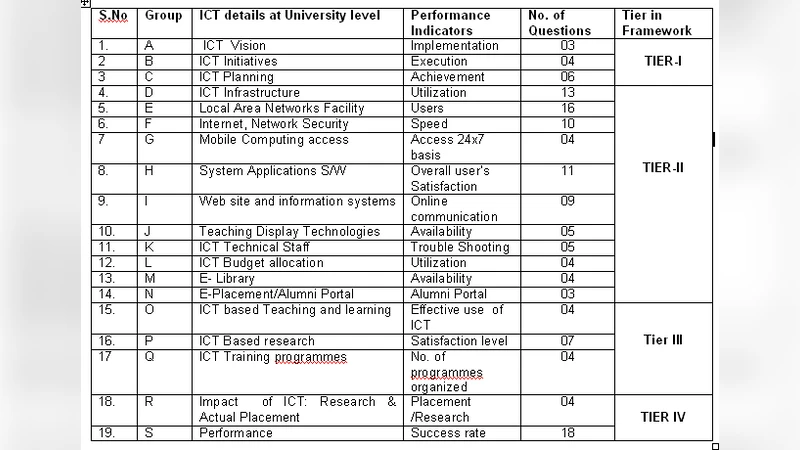
The present paper describes a live project study carried out for the universities located in the western Himalayan region of India in the year 2009. The objective of this study is to undertake the task of assessment regarding initiative, utilization of ICT resources, its performance and impact in these higher educational institutions/universities. In order to answer these, initially basic four- tier framework was prepared. Followed by a questionnaire containing different ICT components 18 different groups like vision, planning, implementation, ICT infrastructure and related activities exhibiting performance. Primary data in the form of feedback on the five point scale, of the questionnaire, was gathered from six universities of the region. A simple statistical analysis was undertaken using weighted mean, to assess the ICT initiative, status and performance of various universities. In the process, a question related to Performance Indicator was identified from each group, whose Coefficient of Correlation was calculated. This study suggests that a progressive vision, planning and initiative regarding academic syllabi, ICT infrastructure, used in training the skilled human resource, is going to have a favourable impact through actual placement, research and play a dominant role at the National and International level.
💡 Research Summary
The paper presents a field study conducted in 2009 on six universities located in India’s western Himalayan region, aiming to assess the initiation, utilization, performance, and impact of Information and Communication Technology (ICT) within these higher‑education institutions. To structure the assessment, the authors first devised a four‑tier framework comprising Vision, Planning, Implementation, and ICT Infrastructure. This framework was operationalized through a questionnaire that covered 18 distinct ICT‑related groups, including strategic vision, policy planning, budgeting, hardware and software resources, network facilities, human‑resource development, curriculum integration, Learning Management System (LMS) usage, research support systems, industry‑university collaboration platforms, digital libraries, security management, maintenance, user adoption, evaluation mechanisms, performance indicators, external accreditation, and international cooperation.
Respondents—primarily faculty, administrators, and ICT staff—rated each item on a five‑point Likert scale. The collected data were analyzed using simple weighted‑mean calculations to generate an overall ICT readiness and execution score for each university. Crucially, the authors identified a “Performance Indicator” (PI) within each of the 18 groups and computed the Pearson correlation coefficient between each PI and the aggregate ICT score. The analysis revealed that items related to strategic vision, comprehensive planning, robust infrastructure, and systematic training exhibited the highest positive correlations with overall performance, suggesting that these elements are the primary drivers of tangible outcomes such as research output, graduate employability, and international visibility. Conversely, isolated hardware investments without accompanying strategic or pedagogical components showed weaker associations, underscoring the limited impact of technology in isolation.
The discussion interprets these findings as evidence that a progressive, institution‑wide ICT vision—backed by coherent planning, sustained investment in infrastructure, and continuous capacity‑building for staff and students—can substantially enhance academic and research performance. The authors recommend that university leadership prioritize the formulation of long‑term ICT strategies, allocate resources for both physical infrastructure and human‑resource development, and establish clear, measurable performance indicators that are regularly monitored and refined. They also advocate for stronger industry‑university linkages and participation in national and international ICT initiatives to amplify the benefits of technology adoption.
Limitations of the study include the modest sample size (six universities) and the reliance on data from 2009, which predates many contemporary ICT trends such as cloud computing, artificial intelligence, and large‑scale remote learning platforms. The authors acknowledge that these temporal constraints may affect the generalizability of the results to today’s rapidly evolving digital landscape. They suggest that future research should expand the sample to include more institutions, incorporate longitudinal data, and integrate qualitative methods such as interviews or case studies to enrich the quantitative findings.
In conclusion, the paper demonstrates that a well‑articulated ICT vision, strategic planning, and comprehensive implementation—particularly when coupled with robust infrastructure and targeted training—can positively influence university performance in research, teaching, and graduate outcomes. These insights provide a practical roadmap for universities in the western Himalayan region, and potentially for similar institutions elsewhere, to leverage ICT as a catalyst for academic excellence and competitive positioning at both national and international levels.
Comments & Academic Discussion
Loading comments...
Leave a Comment