Nonassociative Riemannian Geometry by Twisting
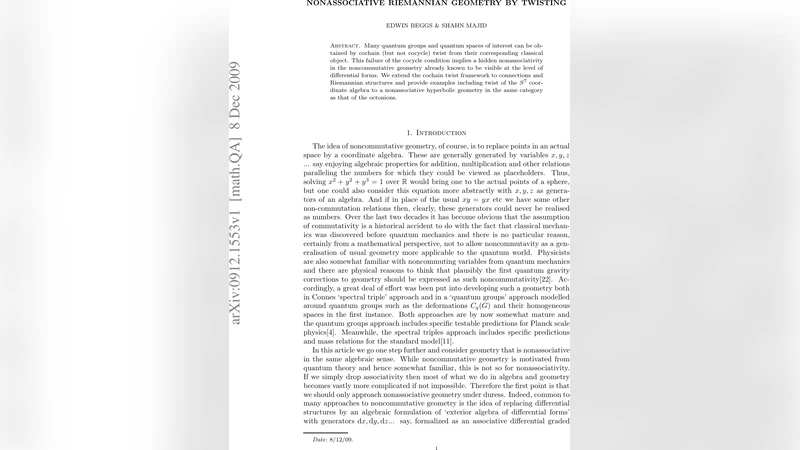
Many quantum groups and quantum spaces of interest can be obtained by cochain (but not cocycle) twist from their corresponding classical object. This failure of the cocycle condition implies a hidden nonassociativity in the noncommutative geometry already known to be visible at the level of differential forms. We extend the cochain twist framework to connections and Riemannian structures and provide examples including twist of the $S^7$ coordinate algebra to a nonassociative hyperbolic geometry in the same category as that of the octonions.
💡 Research Summary
The paper investigates how cochain twists that fail to satisfy the cocycle condition introduce a hidden non‑associativity into the geometry of quantum groups and quantum spaces, and it extends this phenomenon from the level of differential forms to the full Riemannian framework. After a concise introduction that reviews the standard Drinfel’d (cocycle) twist and its limitations, the authors recall the algebraic background of quasi‑Hopf algebras, cochain twists, and the associator $\Phi$ that measures the deviation from strict associativity. The central technical contribution is a systematic procedure for transporting classical geometric data—connections, metrics, and curvature tensors—onto a twisted non‑associative algebra $A_F$ obtained from a classical algebra $A$ by a cochain $F$. The key observation is that the tensor product in the category of $A$‑modules must be deformed by the associator $\Phi$, which in turn modifies the wedge product, the composition of linear maps, and the Leibniz rule for covariant derivatives.
A connection $\nabla$ is encoded by a 1‑form $\omega$; under the twist it becomes $\omega_F$ and satisfies a deformed Maurer–Cartan equation $\mathrm{d}\omega_F+\omega_F\wedge_F\omega_F=R_F$, where $\wedge_F$ is the $\Phi$‑twisted exterior product. Metric compatibility is reformulated as $\nabla_F g_F=0$ with $g_F$ the twisted metric, and the curvature $R_F$ retains the usual Bianchi identities when expressed with the appropriate $\Phi$‑insertions. The authors prove that the cohomology of the twisted exterior derivative coincides with the classical de Rham cohomology, guaranteeing that scalar curvature and other invariant quantities remain unchanged under the twist.
To illustrate the theory, the paper presents a detailed example: the coordinate algebra of the 7‑sphere $S^7$ is twisted by a specific cochain that reproduces the multiplication rules of the octonions. The resulting non‑associative “hyperbolic” $S^7$ lives in the same monoidal category as the octonions, carries a Lorentzian‑type metric, and admits a $G_2$‑like connection whose curvature reflects the underlying octonionic structure. This example demonstrates that the framework can accommodate highly non‑trivial non‑associative geometries while preserving essential differential‑geometric features.
In the concluding section the authors discuss broader implications. They argue that non‑associative Riemannian geometry could provide a natural language for certain approaches to quantum gravity where spacetime may acquire a non‑associative structure (for instance, in backgrounds with non‑geometric fluxes). Moreover, the formalism opens the door to defining spinor bundles, Dirac operators, and index theory in a non‑associative setting, as well as to exploring topological invariants that are sensitive to the associator. Future work is suggested on extending the construction to super‑geometries, investigating physical field theories on such spaces, and classifying possible cochain twists that yield physically relevant non‑associative manifolds. Overall, the paper delivers a rigorous and versatile toolkit for embedding non‑associativity into the full machinery of Riemannian geometry, thereby bridging a gap between abstract algebraic deformations and concrete geometric applications.
Comments & Academic Discussion
Loading comments...
Leave a Comment