Magnetofluid dynamics of magnetized cosmic plasma: firehose and gyrothermal instabilities
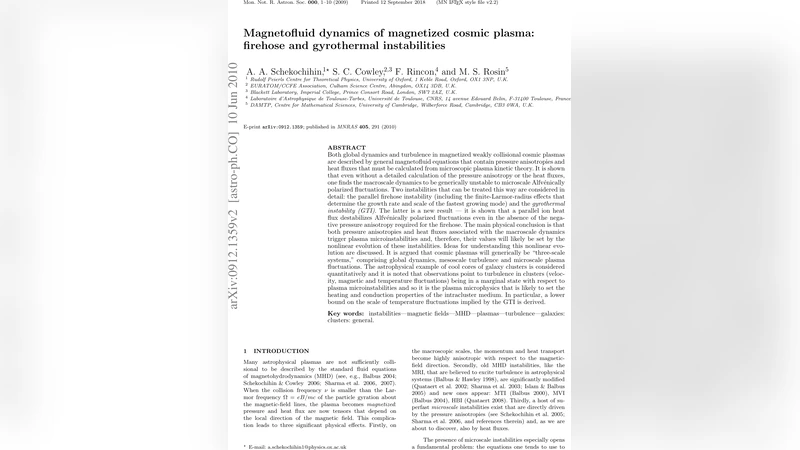
Both global dynamics and turbulence in magnetized weakly collisional cosmic plasmas are described by general magnetofluid equations that contain pressure anisotropies and heat fluxes that must be calculated from microscopic plasma kinetic theory. It is shown that even without a detailed calculation of the pressure anisotropy or the heat fluxes, one finds the macroscale dynamics to be generically unstable to microscale Alfvenically polarized fluctuations. Two instabilities are considered in detail: the parallel firehose instability (including the finite-Larmor-radius effects that determine the fastest growing mode) and the gyrothermal instability (GTI). The latter is a new result - it is shown that a parallel ion heat flux destabilizes Alfvenically polarized fluctuations even in the absence of the negative pressure anisotropy required for the firehose. The main conclusion is that both pressure anisotropies and heat fluxes trigger plasma microinstabilities and, therefore, their values will likely be set by the nonlinear evolution of these instabilities. Ideas for understanding this nonlinear evolution are discussed. It is argued that cosmic plasmas will generically be “three-scale systems,” comprising global dynamics, mesoscale turbulence and microscale plasma fluctuations. The astrophysical example of cool cores of galaxy clusters is considered and it is noted that observations point to turbulence in clusters being in a marginal state with respect to plasma microinstabilities and so it is the plasma microphysics that is likely to set the heating and conduction properties of the intracluster medium. In particular, a lower bound on the scale of temperature fluctuations implied by the GTI is derived.
💡 Research Summary
The paper develops a generalized magnetofluid framework for weakly collisional, magnetized cosmic plasmas by augmenting the standard magnetohydrodynamic (MHD) equations with two kinetic‐derived terms: a pressure anisotropy (p⊥≠p∥) and a parallel ion heat flux (q∥). The authors show that, even without specifying the exact values of these quantities, the resulting equations inevitably admit Alfvén‑polarized modes that are linearly unstable on microscopic scales. Two distinct instabilities are examined in depth.
First, the classic parallel fire‑hose instability is revisited with finite‑Larmor‑radius (FLR) corrections. The analysis confirms that a negative pressure anisotropy (p∥>p⊥) reduces the magnetic tension and drives an Alfvénic mode unstable. FLR effects select the fastest‑growing wavenumber, roughly k∥ρi≈|Δ|½, where Δ≡(p⊥−p∥)/p∥, and limit the growth rate to γ≈|Δ|Ωi. This refines earlier infinite‑Larmor‑radius treatments and demonstrates that the most unstable mode resides at scales comparable to the ion gyroradius.
Second, the authors introduce a new “gyrothermal instability” (GTI). Unlike the fire‑hose, GTI does not require a negative pressure anisotropy. Instead, a sufficiently large parallel ion heat flux destabilizes the same Alfvénic polarization. The instability criterion can be expressed as q∥/(p∥vth,i) > 2|Δ|, where vth,i is the ion thermal speed. When satisfied, the growth rate scales as γ≈(q∥/p∥vth,i)k∥vA, with FLR corrections again fixing the optimal wavenumber at k∥ρi≈(q∥/p∥vth,i)½. Physically, the heat flux reduces the effective magnetic tension in a way analogous to a negative pressure anisotropy, allowing the mode to tap the free energy stored in the temperature gradient.
Both instabilities act as self‑regulating agents. In the nonlinear stage, particle scattering off the generated fluctuations relaxes the pressure anisotropy and limits the heat flux, driving the plasma toward marginal stability. Consequently, the macroscopic values of Δ and q∥ are expected to be set by the saturation of these microinstabilities rather than by external forcing alone.
The paper then applies the theory to the intracluster medium (ICM) of galaxy clusters, focusing on cool‑core regions where X‑ray observations reveal modest temperature gradients and subsonic turbulence. By estimating the turbulent strain rate and the conductive heat flux, the authors find that the ICM plasma sits close to the fire‑hose and GTI thresholds. The GTI, in particular, imposes a lower bound on the scale of temperature fluctuations: λmin≈(q∥/p∥vth,i)⁻¹ρi. This scale is typically far below current X‑ray resolution, implying that the ICM cannot sustain temperature structures smaller than λmin because they would be rapidly erased by GTI‑driven turbulence. This provides a natural explanation for the observed smoothness of temperature maps and suggests that microphysics, not macroscopic transport coefficients, governs heating and conduction in cluster cores.
Finally, the authors discuss avenues for future work. They propose high‑resolution kinetic simulations that resolve both the ion gyroradius and the turbulent cascade to capture the nonlinear saturation of fire‑hose and GTI modes. Observationally, they suggest looking for indirect signatures such as anisotropic pressure constraints from Faraday rotation measures or subtle spectral distortions in X‑ray emission that could betray the presence of marginally stable microturbulence.
In summary, the study demonstrates that pressure anisotropies and parallel ion heat fluxes each independently trigger Alfvénic microinstabilities, leading to a three‑scale hierarchy—global dynamics, mesoscale turbulence, and microscale fluctuations—that is likely universal in weakly collisional astrophysical plasmas. The microinstabilities not only limit the amplitude of Δ and q∥ but also set fundamental bounds on transport processes, with direct implications for the thermal balance of galaxy‑cluster cores and other cosmic environments.
Comments & Academic Discussion
Loading comments...
Leave a Comment