Differential Galois theory and Integrability
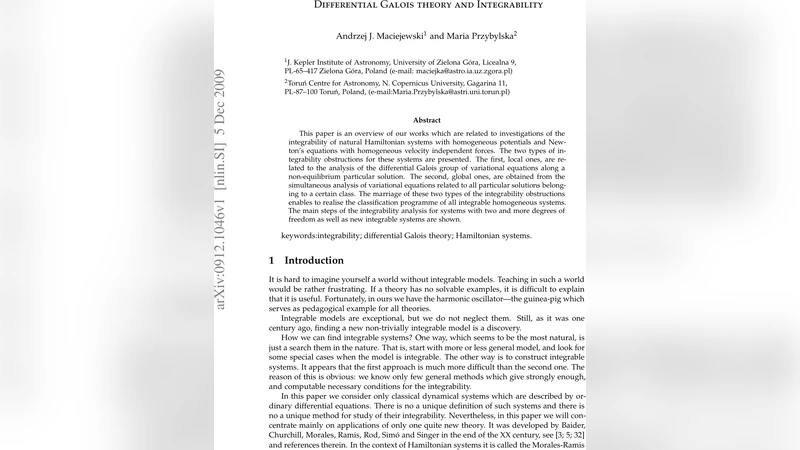
This paper is an overview of our works which are related to investigations of the integrability of natural Hamiltonian systems with homogeneous potentials and Newton’s equations with homogeneous velocity independent forces. The two types of integrability obstructions for these systems are presented. The first, local ones, are related to the analysis of the differential Galois group of variational equations along a non-equilibrium particular solution. The second, global ones, are obtained from the simultaneous analysis of variational equations related to all particular solutions belonging to a certain class. The marriage of these two types of the integrability obstructions enables to realise the classification programme of all integrable homogeneous systems. The main steps of the integrability analysis for systems with two and more degrees of freedom as well as new integrable systems are shown.
💡 Research Summary
This paper surveys a series of works devoted to the integrability analysis of natural Hamiltonian systems with homogeneous potentials and Newtonian equations with homogeneous, velocity‑independent forces, using differential Galois theory as the main tool. The authors distinguish two complementary types of integrability obstructions.
The first, called local obstructions, are obtained by selecting a non‑equilibrium particular solution (for example a straight‑line, circular, or homothetic trajectory) and writing the variational equations (VEs) along this solution. The VEs form a linear differential system whose differential Galois group (G) can be computed or estimated. By the Morales‑Ramis theorem and its extensions to higher‑order variational equations, if (G) is non‑abelian, contains a non‑trivial connected component, or is as large as (\mathrm{SL}(2,\mathbb{C})), (\mathrm{Sp}(2n,\mathbb{C})), etc., then the original nonlinear system cannot possess a sufficient number of independent first integrals meromorphic in the phase space; in other words, it is not Liouville‑integrable. The paper details how the degree (k) of the homogeneous potential and the number of degrees of freedom (n) constrain the possible structure of (G), and it shows how to apply Kovacic’s algorithm, the Kovalevskaya exponents, and other algorithmic tools to decide the Galois group in concrete examples.
The second type, global obstructions, arise when one considers an entire class of particular solutions (for instance all straight‑line solutions, all homothetic orbits, or all solutions with a given energy level). For each member of the class one obtains a Galois group; the intersection (or common subgroup) of all these groups yields a stronger restriction. If this common subgroup is already large enough to forbid additional first integrals, the system is globally non‑integrable, regardless of which particular solution one examines. The authors demonstrate that, by simultaneously analysing the VEs for all members of a class, one can often eliminate parameter regions that would survive a purely local analysis.
The core methodological contribution is the combined or mixed obstruction approach. The authors propose a systematic algorithm:
- Enumerate all admissible homogeneous potentials (or force fields) of a given degree (k) and with a prescribed number of parameters.
- For each candidate, select a representative set of particular solutions that spans the relevant symmetry class.
- Derive the first‑order and, when necessary, higher‑order variational equations along each solution.
- Compute the differential Galois groups of these equations, using symbolic‑algebra packages, Kovacic’s algorithm, and the Morales‑Ramis‑Simo criteria.
- Compare the groups obtained from different solutions; if their intersection is non‑abelian or otherwise “large”, declare a global obstruction.
- If no obstruction appears, search for additional first integrals by other means (e.g., searching for polynomial invariants, exploiting hidden symmetries).
Applying this program, the paper revisits the classical integrable homogeneous systems (such as the Calogero‑Moser and Garnier families) and reproduces their known integrability conditions. More importantly, it uncovers new integrable cases for potentials of degree three, four and five. For instance, a quartic potential with a specific relation between its two coupling constants exhibits an extra scaling symmetry that survives the Galois analysis, leading to a new Liouville‑integrable model. Similarly, a quintic potential with a particular parameter configuration admits a non‑trivial first integral that is not polynomial but rational, a fact that becomes visible only after examining higher‑order variational equations.
The authors also discuss the limitations of the approach. While the local obstruction is algorithmically tractable, the global obstruction may require a comprehensive classification of all particular solutions within a class, which can be technically demanding. They suggest that algebraic‑geometric techniques (e.g., studying the moduli space of homothetic orbits, using resolution of singularities) could streamline the global analysis. Moreover, they advocate the development of automated software that integrates differential Galois group computation with symbolic dynamics to handle higher‑dimensional systems efficiently.
In conclusion, the paper establishes a robust, unified framework that merges local differential‑Galois obstructions with global simultaneous analysis of variational equations. This framework enables a systematic classification of integrable homogeneous Hamiltonian and Newtonian systems with two or more degrees of freedom, provides concrete criteria for ruling out integrability, and yields several previously unknown integrable models. The methodology is poised to become a standard tool in the study of non‑linear dynamical systems, celestial mechanics, and mathematical physics where homogeneous forces play a central role.