Hot and cool: two emission-line stars with constrasting behaviours in the same XMM-Newton field
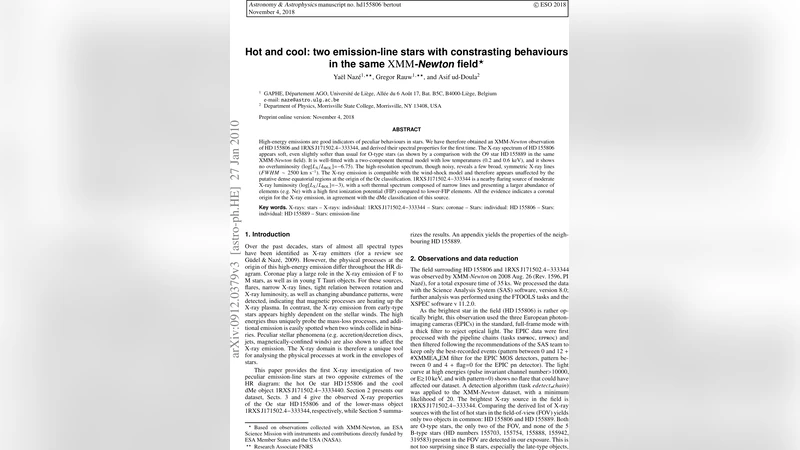
High-energy emissions are good indicators of peculiar behaviours in stars. We have therefore obtained an XMM-Newton observation of HD155806 and 1RXSJ171502.4-333344, and derived their spectral properties for the first time. The X-ray spectrum of HD155806 appears soft, even slightly softer than usual for O-type stars (as shown by a comparison with the O9 star HD155889 in the same XMM field). It is well-fitted with a two-component thermal model with low temperatures (0.2 and 0.6 keV), and it shows no overluminosity (log[LX/Lbol]=-6.75). The high-resolution spectrum, though noisy, reveals a few broad, symmetric X-ray lines (FWHM ~ 2500 km/s). The X-ray emission is compatible with the wind-shock model and therefore appears unaffected by the putative dense equatorial regions at the origin of the Oe classification. 1RXSJ171502.4-333344 is a nearby flaring source of moderate X-ray luminosity (log[LX/Lbol]=-3), with a soft thermal spectrum composed of narrow lines and presenting a larger abundance of elements (e.g. Ne) with a high first ionization potential (FIP) compared to lower-FIP elements. All the evidence indicates a coronal origin for the X-ray emission, in agreement with the dMe classification of this source.
💡 Research Summary
The authors present the first X‑ray spectral analysis of two emission‑line stars that happen to lie in the same XMM‑Newton field: the Oe star HD 155806 and the nearby dMe flare star 1RXS J171502.4‑333344. The study aims to compare the high‑energy characteristics of a massive, early‑type star with a putative dense equatorial disk (the Oe classification) against those of a low‑mass, magnetically active dwarf, thereby probing how stellar winds and magnetic coronae shape X‑ray emission.
HD 155806 exhibits a soft X‑ray spectrum that is even slightly softer than that of a typical O‑type star. A two‑temperature thermal plasma model (kT ≈ 0.2 keV and 0.6 keV) provides an excellent fit, and the X‑ray luminosity relative to the bolometric output is log (L_X/L_bol) = ‑6.75, i.e., consistent with the canonical value for O stars and showing no over‑luminosity. The high‑resolution RGS data, although noisy, reveal a few broad, symmetric emission lines with full‑width at half‑maximum of roughly 2500 km s⁻¹. Such line widths are characteristic of wind‑embedded shocks rather than confined, slow‑moving plasma. Consequently, the X‑ray emission is well explained by the standard line‑driven wind‑shock paradigm, indicating that the hypothesised dense equatorial regions that give rise to the Oe spectral peculiarities do not dominate the X‑ray production in this object.
In contrast, 1RXS J171502.4‑333344 is identified as a nearby dMe star undergoing frequent flares. Its X‑ray luminosity is relatively high, with log (L_X/L_bol) ≈ ‑3, and its spectrum is dominated by a soft thermal component (kT ≈ 0.3–1 keV). The emission lines are narrow (a few hundred km s⁻¹), pointing to a low‑velocity, coronal plasma. Moreover, the elemental abundances show an enhancement of high‑first‑ionisation‑potential (FIP) elements such as neon relative to low‑FIP elements, a pattern reminiscent of the solar corona and other active M dwarfs. These characteristics collectively argue for a magnetic‑coronal origin of the X‑ray emission, fully consistent with the dMe classification.
By juxtaposing these two objects, the paper demonstrates that, despite sharing the same observational field, their X‑ray phenomenology is governed by fundamentally different physical mechanisms: wind‑driven shocks in the massive Oe star versus magnetic reconnection and coronal heating in the low‑mass dMe star. The findings reinforce the view that Oe stars, at least in the case of HD 155806, do not require additional X‑ray contributions from dense equatorial disks, while dMe stars continue to exhibit the classic coronal signatures, including FIP‑related abundance anomalies and flare‑driven variability. The work underscores the importance of high‑resolution spectroscopy and time‑domain analysis for disentangling the diverse high‑energy processes operating across the Hertzsprung‑Russell diagram.
Comments & Academic Discussion
Loading comments...
Leave a Comment