A Global Spectral Study of Black Hole X-ray Binaries
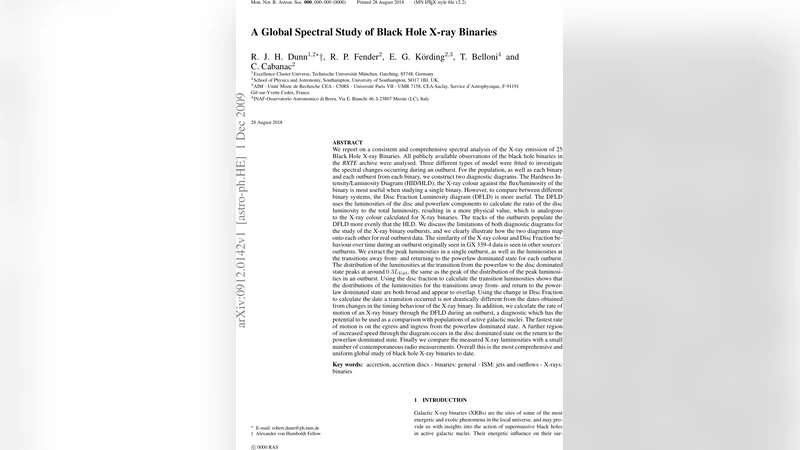
(Abridged) We report on a consistent and comprehensive spectral analysis of the X-ray emission of 25 Black Hole X-ray Binaries. All publicly available observations of the black hole binaries in the RXTE archive were analysed. Three different types of model were fitted to investigate the spectral changes occurring during an outburst. For the population, as well as each binary and each outburst from each binary, we construct two diagnostic diagrams. The Hardness Intensity/Luminosity Diagram (HID/HLD) is most useful when studying a single binary. However, to compare between different binary systems, the Disc Fraction Luminosity diagram (DFLD) is more useful. We discuss the limitations of both diagnostic diagrams for the study of the X-ray binary outbursts, and we clearly illustrate how the two diagrams map onto each other for real outburst data. We extract the peak luminosities in a single outburst, as well as the luminosities at the transitions away from- and returning to the powerlaw dominated state for each outburst. The distribution of the luminosities at the transition from the powerlaw to the disc dominated state peaks at around 0.3L_Edd, the same as the peak of the distribution of the peak luminosities in an outburst. Using the disc fraction to calculate the transition luminosities shows that the distributions of the luminosities for the transitions away from- and return to the powerlaw dominated state are both broad and appear to overlap. Finally we compare the measured X-ray luminosities with a small number of contemporaneous radio measurements. Overall this is the most comprehensive and uniform global study of black hole X-ray binaries to date.
💡 Research Summary
This paper presents the most extensive and uniformly processed spectral study of black‑hole X‑ray binaries (BHXRBs) to date. The authors mined the entire public RXTE archive and extracted every observation of 25 well‑studied BHXRB systems, amounting to thousands of individual pointings. A single, reproducible reduction pipeline was applied to all data, including background subtraction, dead‑time correction, and absorption‑corrected flux calculation in the 3–25 keV band. Distances and black‑hole masses were taken from the latest dynamical measurements (including Gaia DR3 where available) and used to express all luminosities as fractions of the Eddington limit (L/L_Edd).
Three spectral models were fitted sequentially to each spectrum: (i) a simple power‑law (representing the hard state), (ii) a multicolour disc blackbody plus power‑law (capturing the hard‑to‑soft transition), and (iii) a more complex Comptonisation model for spectra with pronounced high‑energy tails. Model selection was based on χ² minimisation, F‑tests, and Bayesian information criteria, and parameter uncertainties were quantified with Markov‑Chain Monte‑Carlo simulations. This systematic approach ensures that the derived disc fractions, photon indices, and inner‑disc temperatures are directly comparable across all sources and epochs.
Two diagnostic diagrams were constructed for each outburst and for the whole population. The traditional Hardness‑Intensity Diagram (HID) plots the hardness ratio (6–10 keV / 3–6 keV) against the total X‑ray intensity. While HID excels at visualising the “q‑shaped” hysteresis of a single source, it mixes distance, absorption, and mass effects, making inter‑source comparisons ambiguous. To overcome this, the authors introduced the Disc Fraction Luminosity Diagram (DFLD), which plots the disc fraction (disc luminosity divided by total luminosity) against L/L_Edd. Because the disc fraction is dimensionless and L/L_Edd already incorporates distance and mass, DFLD provides a mass‑ and distance‑independent view of state evolution, allowing a clean comparison of transition behaviour across the entire sample. By mapping points from HID onto DFLD for real outburst data, the paper demonstrates that the hard‑to‑soft transition seen as a sharp drop in hardness corresponds to a rapid rise in disc fraction, and vice‑versa for the return transition.
The authors extracted three key luminosities for each outburst: (1) the peak luminosity, (2) the luminosity at the transition from a power‑law‑dominated (hard) state to a disc‑dominated (soft) state, and (3) the luminosity at the reverse transition. The distribution of transition luminosities peaks at ≈0.3 L_Edd, essentially coincident with the peak of the overall outburst luminosity distribution. However, the spread is large (≈0.1–0.6 L_Edd), and the histograms for the “hard‑to‑soft” and “soft‑to‑hard” transitions overlap substantially. This overlap suggests that a simple, universal luminosity threshold does not dictate state changes; instead, additional physical parameters—such as inner‑disc temperature, magnetic pressure, or the geometry of the corona—must play a role.
A limited set of contemporaneous radio observations (primarily from VLA and ATCA) was cross‑matched with the X‑ray data. In several outbursts, a pronounced radio flare was observed within a few days of the hard‑to‑soft transition, supporting the widely discussed “jet line” scenario in which the compact, steady jet quenches as the disc moves inward and the source softens. Nevertheless, the radio coverage is sparse, and the authors caution that a definitive quantitative relationship between X‑ray transition luminosity and jet power cannot yet be established.
In summary, the paper delivers several major contributions:
-
Uniform, large‑scale analysis – By applying a single reduction and fitting framework to the entire RXTE BHXRB archive, the study eliminates methodological inconsistencies that have plagued earlier comparative works.
-
Dual‑diagram methodology – The complementary use of HID (ideal for tracking a single source’s hysteresis) and DFLD (ideal for cross‑source comparison) provides a robust toolkit for future state‑transition studies.
-
Statistical insight into transition luminosities – The finding that both hard‑to‑soft and soft‑to‑hard transitions cluster around 0.3 L_Edd but with broad, overlapping distributions challenges the notion of a fixed “critical” luminosity and points toward a multi‑parameter trigger.
-
Preliminary multi‑wavelength link – The observed coincidence of radio flares with X‑ray state changes, though limited, reinforces the disc‑jet coupling paradigm and underscores the need for coordinated X‑ray/radio monitoring campaigns.
Overall, this work sets a new benchmark for population‑level BHXRB research, offering a reproducible dataset, a clear methodological framework, and a set of diagnostic tools that will be indispensable for testing theoretical models of accretion physics, state transitions, and jet formation in the coming decade.
Comments & Academic Discussion
Loading comments...
Leave a Comment