Sub-THz radiation mechanisms in solar flares
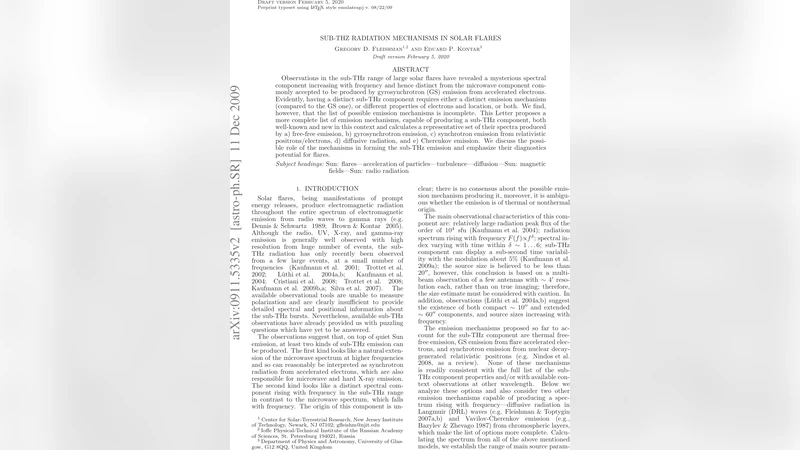
Observations in the sub-THz range of large solar flares have revealed a mysterious spectral component increasing with frequency and hence distinct from the microwave component commonly accepted to be produced by gyrosynchrotron (GS) emission from accelerated electrons. Evidently, having a distinct sub-THz component requires either a distinct emission mechanism (compared to the GS one), or different properties of electrons and location, or both. We find, however, that the list of possible emission mechanisms is incomplete. This Letter proposes a more complete list of emission mechanisms, capable of producing a sub-THz component, both well-known and new in this context and calculates a representative set of their spectra produced by a) free-free emission, b) gyrosynchrotron emission, c) synchrotron emission from relativistic positrons/electrons, d) diffusive radiation, and e) Cherenkov emission. We discuss the possible role of the mechanisms in forming the sub-THz emission and emphasize their diagnostics potential for flares.
💡 Research Summary
The paper addresses the puzzling “sub‑THz” spectral component that has been observed in large solar flares, a component that rises with frequency and therefore cannot be explained by the standard microwave gyrosynchrotron (GS) emission that dominates at lower frequencies. The authors argue that the existing list of possible emission mechanisms is incomplete and set out to compile a more exhaustive catalogue, evaluate each candidate quantitatively, and discuss the diagnostic power of each mechanism for flare physics.
First, the authors review the observational facts: in several major flares, flux densities measured at 200–400 GHz increase with frequency, in contrast to the decreasing GS spectrum that typically rolls over above a few tens of GHz. Simple adjustments of the GS parameters (electron spectral index, magnetic field strength, source size) cannot reproduce the observed rising trend without invoking unrealistically extreme conditions.
The paper then proposes five classes of mechanisms that could generate a sub‑THz component:
-
Thermal free‑free (bremsstrahlung) emission – In a hot, dense plasma the free‑free emissivity scales as ν², naturally producing a rising spectrum. However, to match the observed fluxes the required emission measure would imply plasma densities or temperatures far beyond typical flare values, making this mechanism unlikely to dominate unless a very compact, super‑hot source exists.
-
Modified gyrosynchrotron emission – By assuming an unusually hard electron distribution or an extremely strong magnetic field (several kilogauss) confined to a small region, the GS spectrum can be flattened and even show a modest rise at sub‑THz frequencies. The authors demonstrate that such parameter choices are marginally compatible with some flare observations but generally conflict with independent diagnostics (e.g., hard X‑ray spectra, magnetic field extrapolations).
-
Relativistic synchrotron from electrons/positrons – Relativistic particles spiraling in strong magnetic fields emit synchrotron radiation with a spectral index that can be flat or slightly positive (ν⁰–ν¹/3) in the sub‑THz band. Positrons may be produced in nuclear reactions (e.g., ¹⁴N(p,α)¹¹C) during the flare, providing an additional hard particle population. The authors calculate that, for magnetic fields of a few hundred gauss and particle energies >10 MeV, synchrotron can account for a substantial fraction of the observed sub‑THz flux.
-
Diffusive radiation – This mechanism involves non‑thermal electrons scattering off plasma turbulence (e.g., electron‑acoustic waves) and emitting radiation as they diffuse in momentum space. The resulting spectrum can be roughly flat (ν⁰) or slowly rising (ν¹) over the 200–500 GHz range, depending on the turbulence spectrum. The authors argue that strong turbulence is expected in the early impulsive phase of flares, making diffusive radiation a plausible contributor.
-
Cherenkov (or Vavilov‑Cherenkov) emission – If the refractive index of the plasma exceeds unity at sub‑THz frequencies (ε(ω) > 1), relativistic electrons or positrons moving faster than the phase speed of light in the medium will emit Cherenkov radiation. The authors show that, in dense, relatively cool plasma (electron density >10¹² cm⁻³, temperature ≲10⁶ K), the dielectric response can produce a pronounced Cherenkov peak in the sub‑THz band. This mechanism is highly sensitive to the plasma’s density and temperature profile, offering a direct diagnostic of those parameters.
For each mechanism, the authors select representative parameter sets (magnetic field strength, electron/positron energy distribution, plasma temperature and density, turbulence level) and compute synthetic spectra using standard radiative transfer formulas. The resulting spectra illustrate that free‑free and Cherenkov dominate at the lowest frequencies (<200 GHz), synchrotron and diffusive radiation can produce the observed rising trend between 300 and 500 GHz, while a modified GS component may contribute a modest background.
The discussion emphasizes that no single mechanism universally explains all observed sub‑THz events; instead, a combination of processes is likely at work, with the relative importance varying from flare to flare. Importantly, each mechanism carries distinct diagnostic information:
- Free‑free probes the emission measure and thus the bulk plasma heating.
- Modified GS constrains the high‑energy tail of the electron distribution and the magnetic field topology.
- Synchrotron from relativistic particles offers a window on nuclear reaction by‑products (positrons) and on the presence of >10 MeV electrons.
- Diffusive radiation reveals the level and spectrum of plasma turbulence during the impulsive phase.
- Cherenkov emission directly measures the refractive index, hence the electron density and temperature structure of the emitting region.
The authors conclude by advocating for coordinated multi‑frequency observations that include sub‑THz, microwave, hard X‑ray, and gamma‑ray measurements. Such campaigns, combined with high‑resolution imaging spectroscopy, would allow the disentanglement of the various contributions and enable the use of sub‑THz diagnostics to probe flare energetics, particle acceleration, and plasma conditions with unprecedented precision. They also suggest that upcoming facilities (e.g., the Atacama Large Millimeter/sub‑millimeter Array, dedicated solar sub‑THz telescopes) will be crucial for testing the proposed mechanisms and refining flare models.
Comments & Academic Discussion
Loading comments...
Leave a Comment