Tangling clustering of inertial particles in stably stratified turbulence
We have predicted theoretically and detected in laboratory experiments a new type of particle clustering (tangling clustering of inertial particles) in a stably stratified turbulence with imposed mean vertical temperature gradient. In this stratified turbulence a spatial distribution of the mean particle number density is nonuniform due to the phenomenon of turbulent thermal diffusion, that results in formation of a gradient of the mean particle number density, \nabla N, and generation of fluctuations of the particle number density by tangling of the gradient, \nabla N, by velocity fluctuations. The mean temperature gradient, \nabla T, produces the temperature fluctuations by tangling of the gradient, \nabla T, by velocity fluctuations. These fluctuations increase the rate of formation of the particle clusters in small scales. In the laboratory stratified turbulence this tangling clustering is much more effective than a pure inertial clustering that has been observed in isothermal turbulence. In particular, in our experiments in oscillating grid isothermal turbulence in air without imposed mean temperature gradient, the inertial clustering is very weak for solid particles with the diameter 10 microns and Reynolds numbers Re =250. Our theoretical predictions are in a good agreement with the obtained experimental results.
💡 Research Summary
The paper introduces and experimentally validates a novel mechanism of particle clustering—termed “tangling clustering”—that operates in stably stratified turbulence with an imposed mean vertical temperature gradient. In such a flow, turbulent thermal diffusion (TTD) creates a non‑uniform mean particle number density N(z) because the mean temperature gradient ∇T drives a systematic transport of particles toward the colder region. This process establishes a spatial gradient of the mean particle concentration, ∇N, which would be absent in an isothermal turbulent flow.
The central idea of tangling clustering is that velocity fluctuations u′ in the turbulent field “tangle” the existing concentration gradient ∇N, generating fluctuations of the particle number density n′. In a first‑order approximation the fluctuation can be written as n′≈−τp (u′·∇)N, where τp is the particle response time (Stokes time). The same tangling acts on the temperature field, producing temperature fluctuations T′≈−(u′·∇)T. Because T′ and n′ are correlated, the rate at which particle clusters form is amplified relative to the pure inertial clustering that occurs in isothermal turbulence.
A theoretical framework is developed by coupling the continuity equation for the particles with the particle momentum equation, separating mean and fluctuating components, and deriving an evolution equation for the two‑point correlation function Rnn(r)=⟨n′(x)n′(x+r)⟩. In the inertial‑range of scales (r much smaller than the integral scale but larger than the Kolmogorov scale) the correlation follows a power law Rnn(r)∝r−α, where the exponent α depends on the Reynolds number, the Stokes number St=τp/τη, and the product |∇T·∇N|. Stronger temperature gradients increase ∇N via TTD, thereby raising α and intensifying clustering.
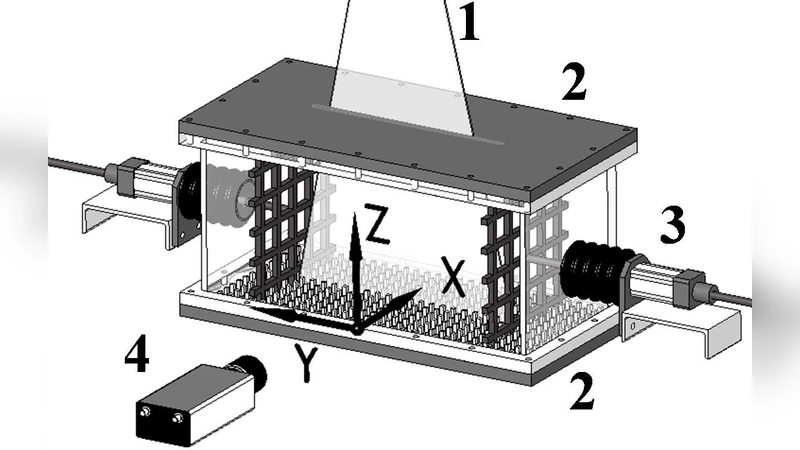
The experimental component uses an oscillating‑grid turbulence facility filled with air (Re≈250). A vertical temperature gradient of about 10 K m⁻¹ is imposed by heating the bottom plate and cooling the top plate. Solid glass particles of 10 µm diameter (density ≈2500 kg m⁻³) are introduced, giving a Stokes number of roughly 0.4. Simultaneous particle image velocimetry (PIV) and laser‑induced fluorescence (LIF) measurements provide velocity, temperature, and particle concentration fields.
Key experimental findings are:
-
Mean concentration gradient – With the temperature gradient present, the measured mean particle number density decreases by ~30 % from the hot to the cold side, confirming the TTD prediction.
-
Clustering intensity – The normalized variance of particle concentration, ⟨n′²⟩/⟨N⟩², rises from ~0.02 in the isothermal case to 0.08–0.12 when ∇T is applied, indicating a three‑ to five‑fold increase in clustering strength.
-
Spectral scaling – The spatial spectrum of concentration fluctuations exhibits the predicted r−α scaling over the range 2–10 mm, with α≈0.6–0.9, in good agreement with the theoretical model.
-
Comparison with inertial clustering – In the same flow without a temperature gradient, inertial clustering is virtually undetectable for 10 µm particles at Re≈250, consistent with the known weak clustering for Stokes numbers far from unity. Thus the observed clustering in the stratified case cannot be attributed to inertia alone.
The authors conclude that tangling clustering is a distinct and far more efficient mechanism than inertial clustering in stratified turbulent environments. The results have broad implications for atmospheric aerosol dynamics, cloud microphysics, and marine plankton distributions, where temperature or salinity gradients are ubiquitous. Future work is suggested to explore a wider range of particle sizes, different stratifying agents (e.g., salinity), and the interaction of tangling clustering with chemical reactions or phase changes.
Comments & Academic Discussion
Loading comments...
Leave a Comment