Variable precession of the neutron star in Her X-1
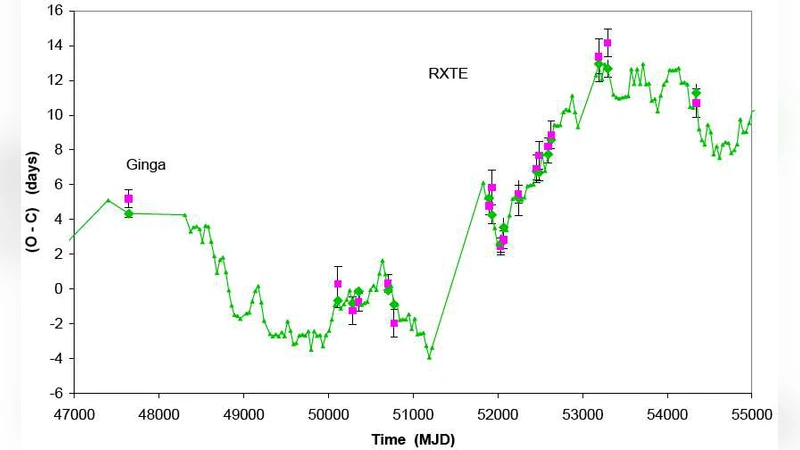
We present evidence for an identical behavior of the precession of the accretion disk and that of the neutron star (NS) in Her X-1, based on investigating the well established 35 day modulation in Her X-1 in two different ways: 1) following the turn-ons, thought to be due to the precession of the accretion disk, and 2) following the re-appearance of the shape of the pulse profiles, which we assume to be due to precession of the NS. The turn-on evolution and the evolution of the phase-zero values of the precessing NS (as determined from the pulse profiles) track each other very closely. Since the turn-on evolution is strongly correlated with the pulse period evolution, this means that there is also a strong correlation between the spin and the precession of the NS. There is a very strong physical coupling between the NS and the accretion disk, we suggest through physical feedback in the binary system. The apparent long-term stability of the 35 d clock may be due to the interior of the NS, the coupling of which to the observable surface effects is of general importance for the physics of super-dense, highly magnetized material.
💡 Research Summary
Her X‑1 is a well‑studied accreting X‑ray binary that exhibits a remarkably stable 35‑day modulation of its X‑ray flux. Historically this modulation has been interpreted as the result of a precessing, tilted accretion disk that periodically obscures the line of sight to the neutron star’s magnetic poles. Independent of this, earlier work noted systematic changes in the shape of the X‑ray pulse profiles over the same 35‑day cycle, suggesting that the neutron star itself might be undergoing precession. In this paper Staubert et al. combine these two diagnostics to test whether the disk precession and the neutron‑star precession are physically linked.
The authors use pulse‑profile data in the 9–13 keV band obtained with RXTE (1997–2005), supplemented by Ginga (1989) and INTEGRAL (2007) observations. For each 35‑day cycle they construct a high‑resolution template of the mean pulse shape sampled every 0.01 in phase. Any observed profile is then compared to the template by χ² minimisation, yielding an estimate of the 35‑day phase with an accuracy of about ±0.02. The phase at which the template matches the observed profile is identified as the “phase‑zero” of the neutron‑star precession.
These phase‑zero times are plotted on an O‑C (observed minus calculated) diagram, where the calculated times assume a constant 34.85‑day period (the nominal 35‑day clock). The same O‑C diagram is constructed for the turn‑on times, i.e., the moments when the X‑ray flux rises sharply as the precessing disk uncovers the neutron star. The striking result is that the two O‑C series track each other almost perfectly over the entire data span. The agreement holds not only on long (year‑scale) intervals but also on short (tens‑of‑days) intervals, indicating that any change in the precession period of the disk is mirrored by an identical change in the neutron‑star precession.
From these observations the authors draw three main conclusions. First, the neutron‑star precession period is not strictly constant; it can vary on timescales of a few tens of days. Second, the variations of the neutron‑star precession are synchronized with those of the accretion‑disk precession, implying a very strong physical coupling between the two. Third, because the spin period of the neutron star is already known to be correlated with the turn‑on times, the spin period is also indirectly linked to the neutron‑star precession. This three‑way correlation cannot be explained by a simple torque‑free (free) precession model. Instead, the authors argue that the torque exerted by the magnetosphere on the inner edge of the disk (and vice‑versa) provides a feedback loop that forces the neutron star to precess in step with the disk.
The paper also speculates on the internal physics that could allow such rapid changes in the precession period. A change in the orientation of the principal axes of inertia—perhaps caused by adjustments in the super‑dense, super‑conducting interior of the neutron star—could modify the effective moment of inertia and thus the precession rate. The observed coupling therefore offers a rare observational probe of the behaviour of ultra‑dense, highly magnetised matter under the influence of external torques.
In summary, Staubert et al. present compelling evidence that the 35‑day clock in Her X‑1 is a joint phenomenon of the accretion disk and the neutron star. Their analysis demonstrates that the neutron‑star precession is variable, tightly synchronized with the disk precession, and linked to the spin evolution of the star. This work highlights the importance of magnetosphere‑disk interaction in shaping the timing behaviour of accreting pulsars and provides a valuable laboratory for studying the dynamics of super‑dense, magnetised nuclear matter.
Comments & Academic Discussion
Loading comments...
Leave a Comment