Perturbation theory for a stochastic process with Ornstein-Uhlenbeck noise
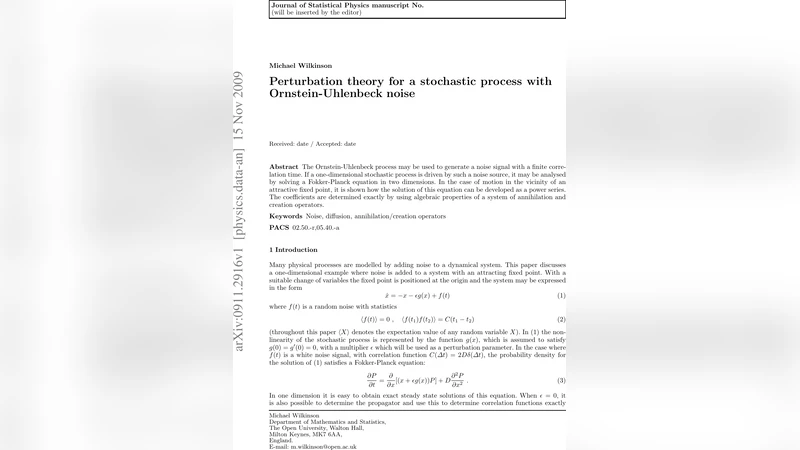
The Ornstein-Uhlenbeck process may be used to generate a noise signal with a finite correlation time. If a one-dimensional stochastic process is driven by such a noise source, it may be analysed by solving a Fokker-Planck equation in two dimensions. In the case of motion in the vicinity of an attractive fixed point, it is shown how the solution of this equation can be developed as a power series. The coefficients are determined exactly by using algebraic properties of a system of annihilation and creation operators.
💡 Research Summary
The paper investigates a stochastic differential equation driven by Ornstein‑Uhlenbeck (OU) noise, which possesses a finite correlation time, and develops a systematic perturbation theory for the associated two‑dimensional Fokker‑Planck equation. Starting from the Langevin system
dx/dt = –γ x + f(x) + y,
dy/dt = –λ y + √(2D) ξ(t),
where ξ(t) is standard white Gaussian noise, the authors show that the joint probability density P(x,y,t) obeys a Fokker‑Planck operator that can be split into a solvable linear part L₀ and a nonlinear perturbation L₁ proportional to a small parameter ε. By expanding the drift term f(x) = –γ x + ε g(x) and focusing on the neighbourhood of the stable fixed point (x=0, y=0), the linear operator L₀ is identified with the Hamiltonian of a harmonic oscillator. This observation allows the introduction of annihilation and creation operators a and a† satisfying
Comments & Academic Discussion
Loading comments...
Leave a Comment