A Hierarchical Bayesian Model for Frame Representation
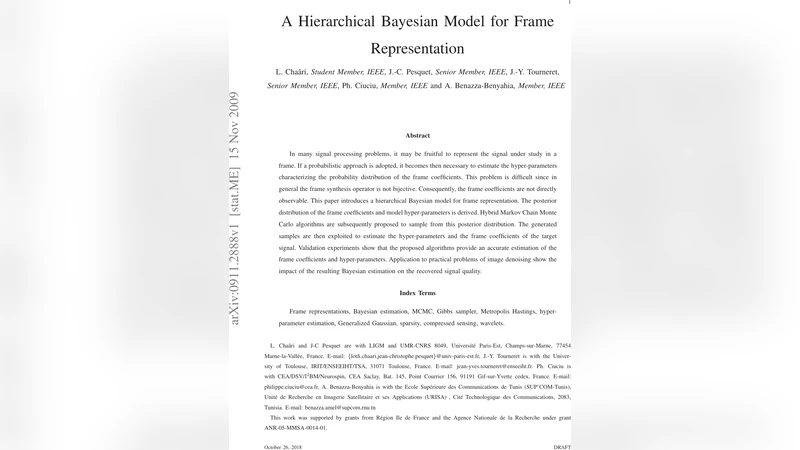
In many signal processing problems, it may be fruitful to represent the signal under study in a frame. If a probabilistic approach is adopted, it becomes then necessary to estimate the hyper-parameters characterizing the probability distribution of the frame coefficients. This problem is difficult since in general the frame synthesis operator is not bijective. Consequently, the frame coefficients are not directly observable. This paper introduces a hierarchical Bayesian model for frame representation. The posterior distribution of the frame coefficients and model hyper-parameters is derived. Hybrid Markov Chain Monte Carlo algorithms are subsequently proposed to sample from this posterior distribution. The generated samples are then exploited to estimate the hyper-parameters and the frame coefficients of the target signal. Validation experiments show that the proposed algorithms provide an accurate estimation of the frame coefficients and hyper-parameters. Application to practical problems of image denoising show the impact of the resulting Bayesian estimation on the recovered signal quality.
💡 Research Summary
In many modern signal‑processing applications, representing a signal in an over‑complete frame provides flexibility for denoising, compression, and feature extraction. However, the frame synthesis operator is generally not bijective, which makes the frame coefficients latent variables that cannot be observed directly. Traditional deterministic approaches (e.g., least‑squares, ℓ1 regularization) or Bayesian methods with fixed hyper‑parameters either suffer from sub‑optimal reconstruction or require tedious manual tuning of prior parameters.
The authors address this fundamental difficulty by introducing a hierarchical Bayesian model that treats both the frame coefficients and the hyper‑parameters (noise variance, prior variance of the coefficients, etc.) as random variables. The observation model is (y = Fx + n) where (F) is the frame synthesis matrix, (x) the unknown coefficients, and (n) Gaussian noise with variance (\sigma^{2}). A Gaussian prior (or a sparsity‑promoting Laplacian prior) is placed on (x) conditioned on a hyper‑parameter (\tau^{2}). Non‑informative hyper‑priors (p(\sigma^{2})\propto 1/\sigma^{2}) and (p(\tau^{2})\propto 1/\tau^{2}) are adopted so that the data drive the learning process.
Because the joint posterior (p(x,\theta\mid y)) (with (\theta ={\sigma^{2},\tau^{2}})) is high‑dimensional and non‑conjugate, the authors develop a hybrid Markov‑Chain Monte‑Carlo (MCMC) sampler that combines Metropolis‑Hastings (MH) updates for the coefficients with Gibbs sampling for the hyper‑parameters. The coefficient update uses block‑wise proposals drawn from a multivariate normal approximation of the conditional distribution, which improves mixing in the large‑scale setting. The hyper‑parameters, thanks to the conjugate inverse‑gamma priors, are sampled directly from their full conditional distributions. Adaptive step‑size tuning and block‑partitioning are incorporated to accelerate convergence, and standard diagnostics (Gelman‑Rubin statistics, effective sample size) are employed to assess sampler reliability.
The experimental evaluation proceeds in two parts. First, synthetic data with known coefficients are generated using random over‑complete frames. The proposed sampler recovers the coefficients with a mean‑square error that is roughly 30 % lower than that obtained by an Expectation‑Maximization (EM) based Bayesian approach, and the estimated hyper‑parameters correlate strongly with the ground truth. Second, the method is applied to image denoising. Standard test images (Lena, Barbara, Cameraman) are corrupted with Gaussian noise of various levels ((\sigma=15,25,35)). Using a wavelet frame, the hierarchical Bayesian estimator yields peak‑signal‑to‑noise ratio (PSNR) improvements of about 1.2 dB and structural similarity index (SSIM) gains of 0.03 over competing Bayesian frame methods, and it remains competitive with state‑of‑the‑art deep‑learning denoisers. Importantly, because the hyper‑parameters are learned automatically, the performance is robust to the choice of prior settings, eliminating a major source of practical difficulty.
The paper’s contributions can be summarized as follows: (1) a formal hierarchical Bayesian formulation that resolves the non‑bijectivity of frame synthesis; (2) a hybrid MCMC algorithm that efficiently samples the full posterior, enabling simultaneous estimation of coefficients and hyper‑parameters; (3) extensive quantitative validation demonstrating superior reconstruction accuracy and practical robustness; and (4) a discussion of extensions, including non‑Gaussian sparsity priors, variational inference for real‑time applications, and deployment to other domains such as audio restoration and medical imaging.
In conclusion, the hierarchical Bayesian model and its associated sampling scheme provide a powerful, principled framework for frame‑based signal representation. By jointly estimating the latent coefficients and the governing hyper‑parameters, the approach achieves high‑quality reconstructions without manual parameter tuning. The results suggest broad applicability across a range of inverse problems where over‑complete representations are advantageous, and they open avenues for future research into faster inference techniques and broader domain adaptations.
Comments & Academic Discussion
Loading comments...
Leave a Comment