Dynamical aspects of mean field plane rotators and the Kuramoto model
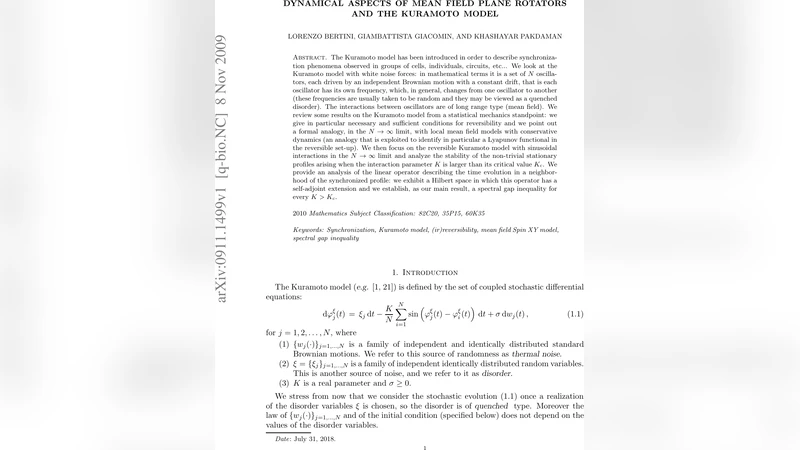
The Kuramoto model has been introduced in order to describe synchronization phenomena observed in groups of cells, individuals, circuits, etc… We look at the Kuramoto model with white noise forces: in mathematical terms it is a set of N oscillators, each driven by an independent Brownian motion with a constant drift, that is each oscillator has its own frequency, which, in general, changes from one oscillator to another (these frequencies are usually taken to be random and they may be viewed as a quenched disorder). The interactions between oscillators are of long range type (mean field). We review some results on the Kuramoto model from a statistical mechanics standpoint: we give in particular necessary and sufficient conditions for reversibility and we point out a formal analogy, in the N to infinity limit, with local mean field models with conservative dynamics (an analogy that is exploited to identify in particular a Lyapunov functional in the reversible set-up). We then focus on the reversible Kuramoto model with sinusoidal interactions in the N to infinity limit and analyze the stability of the non-trivial stationary profiles arising when the interaction parameter K is larger than its critical value K_c. We provide an analysis of the linear operator describing the time evolution in a neighborhood of the synchronized profile: we exhibit a Hilbert space in which this operator has a self-adjoint extension and we establish, as our main result, a spectral gap inequality for every K>K_c.
💡 Research Summary
The paper investigates the Kuramoto model with additive white‑noise forcing from a rigorous statistical‑mechanics perspective. Each of the N oscillators evolves according to the stochastic differential equation
dθ_i = ω_i dt + (K/N) ∑_{j=1}^N sin(θ_j−θ_i) dt + σ dB_i(t),
where ω_i are quenched random frequencies drawn from a prescribed distribution g(·), σ>0 is the noise intensity, and K>0 is the mean‑field coupling strength. The authors first address the fundamental question of reversibility (detailed balance) for the associated N‑dimensional diffusion process. By constructing the stationary density and checking the Kolmogorov forward‑backward symmetry, they prove that reversibility holds if and only if the frequency distribution is symmetric (g(ω)=g(−ω)), the mean of ω_i is zero, and the noise intensity is uniform across oscillators. Under these conditions the invariant measure is a Gibbs measure with Hamiltonian
H(θ)=−(K/N) ∑{i<j} cos(θ_i−θ_j) − (1/σ^2) ∑{i} ω_i θ_i,
and the dynamics satisfy detailed balance with respect to this measure.
Passing to the thermodynamic limit N→∞, the empirical distribution of phases and frequencies converges to a probability density ρ(t,θ,ω) that solves a nonlinear Fokker‑Planck (or McKean‑Vlasov) equation
∂_t ρ = −∂_θ
Comments & Academic Discussion
Loading comments...
Leave a Comment