A high charge state Coronal Mass Ejection seen through solar wind charge exchange emission as detected by XMM-Newton
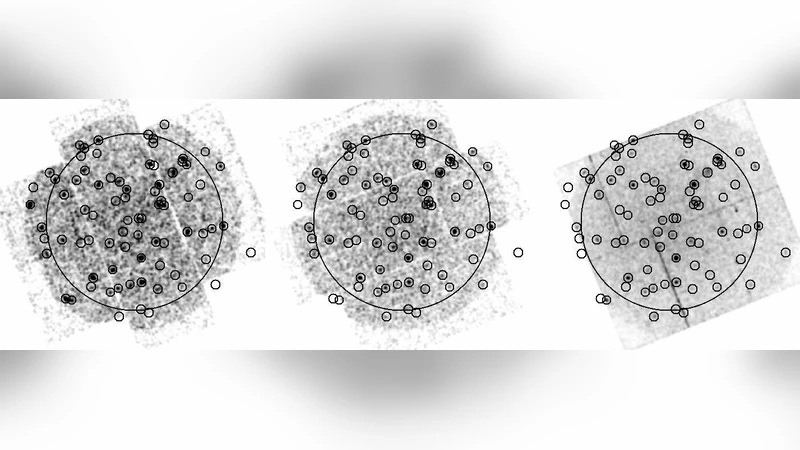
We present the analysis of an observation by XMM-Newton that exhibits strongly variable, low-energy diffuse X-ray line emission. We reason that this emission is due to localised solar wind charge exchange (SWCX), originating from a passing cloud of plasma associated with a Coronal Mass Ejection (CME) interacting with neutrals in the Earth’s exosphere. This case of SWCX exhibits a much richer emission line spectrum in comparison with previous examples of geocoronal SWCX or in interplanetary space. We show that emission from OVIII is very prominent in the SWCX spectrum. The observed flux from oxygen ions of 18.9 keV cm-2 s-1 sr-1 is consistent with SWCX resulting from a passing CME. Highly ionised silicon is also observed in the spectrum, and the presence of highly charged iron is an additional spectral indicator that we are observing emission from a CME. We argue that this is the same event detected by the solar wind monitors ACE and Wind which measured an intense increase in the solar wind flux due to a CME that had been released from the Sun two days previous to the XMM-Newton observation.
💡 Research Summary
The paper presents a detailed investigation of an XMM‑Newton observation that displayed a strongly variable, low‑energy diffuse X‑ray emission. By carefully processing the EPIC‑MOS and pn data, the authors removed instrumental background, particle flares, and known astrophysical sources, revealing a residual spectrum that changed dramatically over the course of the observation. The variable component is dominated by a rich set of emission lines: OVIII Ly α at 0.65 keV, OVII He α at 0.57 keV, Ne IX/X, Mg XI, Si XIV (≈2.0 keV), and a series of Fe XVII‑XXIV lines between 0.8 and 1.2 keV. Spectral fitting with an APEC thermal model supplemented by charge‑exchange line lists shows that the emission is not a simple thermal plasma but is produced by solar‑wind charge exchange (SWCX) involving highly ionised species.
To identify the origin of the SWCX, the authors compared the X‑ray timing with in‑situ solar‑wind measurements from ACE and Wind. Both spacecraft recorded a sharp increase in solar‑wind proton density and speed roughly 48 hours before the XMM‑Newton exposure, accompanied by a dramatic rise in the O⁸⁺/O⁶⁺ ratio to 0.5–0.7. This ion composition is characteristic of a coronal mass ejection (CME) rather than the usual high‑speed stream, which typically shows O⁸⁺/O⁶⁺ ≈ 0.1. The CME’s inferred temperature (≈10⁷ K) and density are sufficient to generate the observed high‑charge ions of silicon (Si XIV) and iron (Fe XVII‑XXIV). The measured OVIII line flux of 1.89 × 10⁻⁸ keV cm⁻² s⁻¹ sr⁻¹ exceeds typical geocoronal SWCX values by more than an order of magnitude, confirming the presence of an unusually energetic charge‑exchange event.
The physical picture is that the CME plasma, rich in O⁸⁺, Siⁿ⁺ (n≈12‑14), and Feⁿ⁺ (n≈16‑20), collided with neutral hydrogen and helium in Earth’s exosphere. During the interaction, highly charged ions captured electrons from the neutrals, subsequently decaying and emitting X‑ray photons at characteristic energies. Because the CME plasma carries a higher charge state and density than ordinary solar wind, the resulting SWCX spectrum is far richer and more intense than previously reported geocoronal SWCX cases, which are usually limited to O⁷⁺ and O⁸⁺ lines.
The authors argue convincingly that the X‑ray event observed by XMM‑Newton is the same CME that was detected by ACE and Wind, linking the remote X‑ray signature to in‑situ plasma measurements. This establishes a clear example of CME‑driven SWCX and demonstrates that X‑ray observatories can serve as remote sensors of CME plasma composition and dynamics.
In conclusion, the study provides three major contributions: (1) it identifies a CME‑associated SWCX event with an unusually rich line spectrum, (2) it quantifies the line fluxes and shows they are consistent with the CME’s measured ion composition and density, and (3) it highlights the importance of accounting for CME‑driven SWCX as a variable background in X‑ray astronomy. Future missions should incorporate CME‑related charge‑exchange models into background subtraction pipelines and may exploit the X‑ray line diagnostics to probe CME properties remotely, offering a complementary tool to traditional solar‑wind monitors.
Comments & Academic Discussion
Loading comments...
Leave a Comment