Evolutionary Dynamics of Populations with Conflicting Interactions: Classification and Analytical Treatment Considering Asymmetry and Power
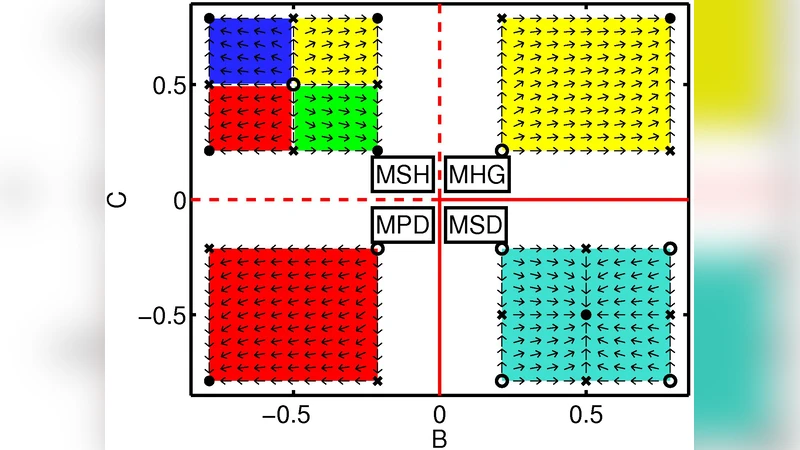
Evolutionary game theory has been successfully used to investigate the dynamics of systems, in which many entities have competitive interactions. From a physics point of view, it is interesting to study conditions under which a coordination or cooperation of interacting entities will occur, be it spins, particles, bacteria, animals, or humans. Here, we analyze the case, where the entities are heterogeneous, particularly the case of two populations with conflicting interactions and two possible states. For such systems, explicit mathematical formulas will be determined for the stationary solutions and the associated eigenvalues, which determine their stability. In this way, four different types of system dynamics can be classified, and the various kinds of phase transitions between them will be discussed. While these results are interesting from a physics point of view, they are also relevant for social, economic, and biological systems, as they allow one to understand conditions for (1) the breakdown of cooperation, (2) the coexistence of different behaviors (“subcultures”), (2) the evolution of commonly shared behaviors (“norms”), and (4) the occurrence of polarization or conflict. We point out that norms have a similar function in social systems that forces have in physics.
💡 Research Summary
The paper extends classical evolutionary game theory by focusing on a minimal yet non‑trivial setting: two heterogeneous populations that interact through conflicting pay‑offs and each individual can adopt one of two pure strategies (conventionally labeled “Cooperate” C and “Defect” D). The authors construct a 2 × 2 payoff matrix for each population, allowing the entries to differ not only between the two strategies but also between the two populations. In this way the model captures asymmetry (different incentives within each group) and inter‑group antagonism (conflict terms that reward opposite actions in the two populations).
Using the standard replicator dynamics, the state of the system is described by the pair ((x_A, x_B)), where (x_A) (resp. (x_B)) denotes the fraction of cooperators in population A (resp. B). The dynamical equations are
\
Comments & Academic Discussion
Loading comments...
Leave a Comment