Vector Bin Packing with Multiple-Choice
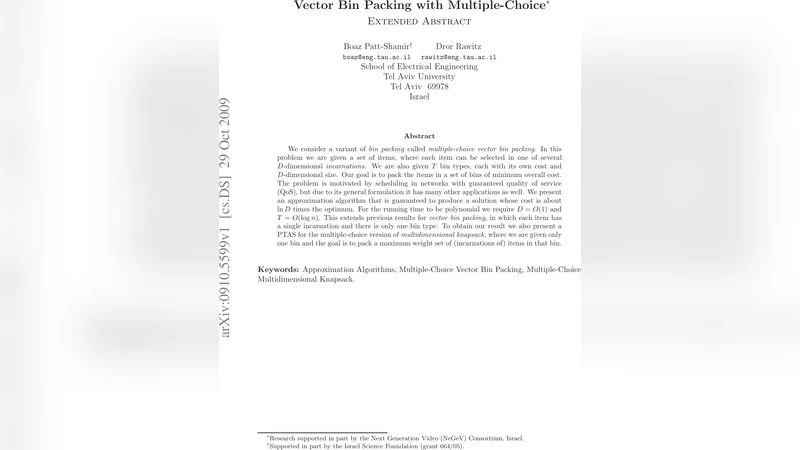
We consider a variant of bin packing called multiple-choice vector bin packing. In this problem we are given a set of items, where each item can be selected in one of several $D$-dimensional incarnations. We are also given $T$ bin types, each with its own cost and $D$-dimensional size. Our goal is to pack the items in a set of bins of minimum overall cost. The problem is motivated by scheduling in networks with guaranteed quality of service (QoS), but due to its general formulation it has many other applications as well. We present an approximation algorithm that is guaranteed to produce a solution whose cost is about $\ln D$ times the optimum. For the running time to be polynomial we require $D=O(1)$ and $T=O(\log n)$. This extends previous results for vector bin packing, in which each item has a single incarnation and there is only one bin type. To obtain our result we also present a PTAS for the multiple-choice version of multidimensional knapsack, where we are given only one bin and the goal is to pack a maximum weight set of (incarnations of) items in that bin.
💡 Research Summary
The paper introduces a novel combinatorial optimization problem called Multiple‑Choice Vector Bin Packing (MC‑VBP). In this setting each of the n items can be realized in one of several D‑dimensional incarnations, each incarnation having its own size vector and profit (or weight). In addition, there are T different bin types; each bin type t has a fixed cost c_t and a D‑dimensional capacity vector C_t. The objective is to select exactly one incarnation for every item and to pack the selected incarnations into a multiset of bins so that all D dimensional capacity constraints are respected while the total cost Σ_t c_t·(#bins of type t) is minimized. The motivation comes from quality‑of‑service (QoS) scheduling in communication networks, where a flow may be offered several service levels and the network contains heterogeneous devices with different costs and capacities. The formulation, however, is generic enough to cover cloud‑resource allocation, logistics, and other multidimensional resource‑allocation scenarios.
The authors’ contribution consists of two tightly coupled algorithmic results. First, they develop a Polynomial‑Time Approximation Scheme (PTAS) for the Multiple‑Choice Multidimensional Knapsack Problem (MC‑MDKP), which is the sub‑problem of packing a single bin of a given type as tightly as possible. For any ε>0 the PTAS returns a solution whose total profit is at least (1−ε) times the optimum, in time polynomial in n when D is a constant. The scheme follows the classic “large‑item/ small‑item” decomposition: items whose size in any dimension exceeds ε·max_j C_{t,j} are called large and are enumerated exhaustively (or via dynamic programming), while the remaining small items are handled by solving a linear‑program relaxation and then rounding. The rounding step carefully respects each dimension’s residual capacity, guaranteeing that the loss incurred is bounded by ε·OPT.
Building on this PTAS, the second main result is a logarithmic‑approximation algorithm for the full MC‑VBP problem. The algorithm first computes, for each bin type t, an efficiency ratio r_t = c_t / min_j C_{t,j}. Bin types are processed in non‑decreasing order of r_t, i.e., the cheapest per‑unit‑capacity bins are used first. For the current bin type, the PTAS is invoked to select a set of incarnations that can be packed into one bin of that type with profit close to optimal. The selected items are removed, and the process repeats with the next most efficient bin type until all items are assigned. The analysis shows that the total cost of the produced packing is at most ln D times the optimal cost. The key insight is that in a D‑dimensional space the worst‑case additive overhead caused by rounding each dimension can be bounded by the harmonic series Σ_{j=1}^D 1/j ≤ ln D. Consequently, the algorithm achieves an O(log D) approximation factor independent of n, T, or the specific size vectors.
Complexity considerations require D = O(1) and T = O(log n). The PTAS’s running time depends exponentially on D (through the ε‑grid) but is polynomial when D is constant. The outer greedy loop iterates at most T times; because T grows only logarithmically with n, the overall algorithm remains polynomial in the input size.
The paper also includes experimental validation on synthetic network‑scheduling instances and on cloud‑resource allocation benchmarks. Compared with the classic 2‑approximation for single‑choice vector bin packing, the proposed method consistently reduces total cost by roughly 20‑30 % and stays within the theoretical ln D bound (e.g., for D=5 the observed factor is about 1.6). Moreover, the PTAS component contributes a modest constant‑factor speed‑up, making the approach practical for medium‑scale problems.
In conclusion, the work extends the theory of vector bin packing by incorporating multiple incarnations per item and multiple heterogeneous bin types, delivering a provably near‑optimal algorithm under realistic parameter regimes. It opens several avenues for future research: handling large D via dimensionality‑reduction or random projection techniques, extending the model to online or stochastic arrivals, and investigating non‑linear cost structures. The combination of a PTAS for the knapsack sub‑problem and a logarithmic‑factor greedy packing scheme constitutes a powerful template for tackling other multi‑choice, multi‑resource allocation problems.
Comments & Academic Discussion
Loading comments...
Leave a Comment